


First author article in Journal of Tectonophysics
First author article by Yangbaihe Hong et al.
Timing and kinematics of nappe stacking in the Olympos–Ossa Region, Greece
Yangbaihe Hong, Johannes Glodny, Rolf L. Romer, Alasdair Skelton, Alexandre Peillod, and Uwe Ring, 2026. Timing and kinematics of nappe stacking in the Olympos–Ossa Region, Greece. Tectonophysics: 941, 231426, ISSN 0040-1951. https://doi.org/10.1016/j.tecto.2026.231426.
Abstract
The Olympos–Ossa region of mainland Greece preserves a high-pressure nappe sequence that exposes metamorphic equivalents of the Cycladic Blueschist Unit (CBU) in the Cyclades. This unique structural position allows for a direct evaluation of the spatial and temporal continuity of subduction-related processes from the central Aegean across the Greek mainland. In this study, we integrated petrological and structural investigations with eighteen new multi-mineral Rb-Sr ages from the Pelagonian Unit, the Ambelakia Unit (CBU equivalent), and the lowermost Olympos–Ossa Unit (Basal Unit equivalent) to reconstruct the tectono-metamorphic evolution of the region. We identified four distinct stages of deformation (D1–D4) associated with progressive nappe stacking. The earliest phase, D1 (pre-Tertiary), involves prolonged recrystallization of the Pelagonian Unit under greenschist- to amphibolite-facies conditions, following the Early Cretaceous obduction and top-to-the-SW thrusting of the overlying Vardar-derived ophiolitic unit. D2 (51–40 Ma) records the top-to-the-SW thrusting of the Ambelakia Unit and the subduction erosion of the overlying Pelagonian Unit. Syn-kinematic mineral assemblages indicate transitional metamorphic conditions where blueschist- and greenschist-facies lithologies co-existed. During D3 (28–26 Ma), subduction-related high-pressure metamorphism affected the lowermost Olympos–Ossa Unit. We suggest initial extrusion and vertical ductile thinning of the Ambelakia Unit during its emplacement onto the Olympos-Ossa Unit. D4 (23 Ma to present) is characterized by NE-dipping low- and high-angle extensional faults that facilitated the exhumation of the nappe sequence, synchronous with large-scale back-arc extension in the Aegean. These results establish the structural and metamorphic correlations between the major tectonic units of mainland Greece and the Cyclades. Early Cretaceous and Eocene deformational events under blueschist-facies conditions preserved in the Pelagonian Unit from Olympos–Ossa region directly link it to the Makrotantalon Unit on Andros Island. Additionally, our age data affirm that the tectonic evolution of the Ambelakia Unit parallels that of the CBU passive margin sequence of the central Aegean, while the Olympos–Ossa Unit correlates with the Basal Unit in the Cyclades.
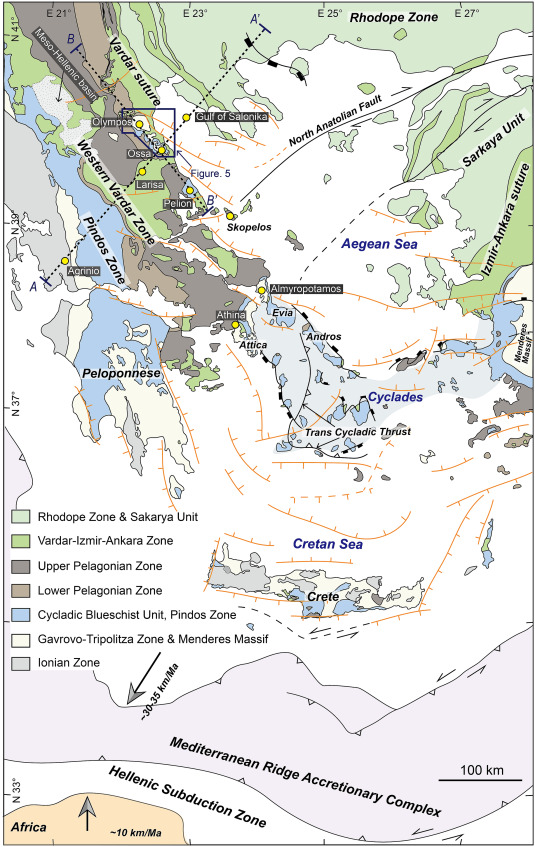
Fig. 1. Tectonic map of the Aegean Sea region showing major tectonic units (Ferrière et al., 2004; Schmid et al., 2020). Cross-sections AA′ and BB′ are shown in Fig. 2. The southwestward moving of Anatolian plate above the Hellenic subduction zone and the northward motion of the underthrusting African plate result in current subduction rates of 40–45 km/Ma (Reilinger et al., 2006, Reilinger et al., 2010).
Last updated: 2026-10-19
Source: Department of Geological Sciences