


Previously unknown source of methane discovered beneath Greenland’s ice sheet
Researchers from Stockholm University are part of an international research team that has discovered a previously unknown source of methane beneath the northern Greenland Ice Sheet.
The study, published in Nature Communications, shows through analyses of meltwater, isotopes and geological data that the methane is of geological origin and was formed deep within the bedrock hundreds of millions of years ago. The findings show that geological methane can reach the surface through glacial meltwater and point to a previously overlooked source of natural methane emissions.
Martin Jakobsson, Camille H. Akhoudas, Wei-Li Hong, Matt O’Regan and Christian Stranne (senior author) from the Department of Geological Sciences at Stockholm University are among the researchers involved in the study.
Read more about the study in Linnéuniversitetet’s article (in Swedish).
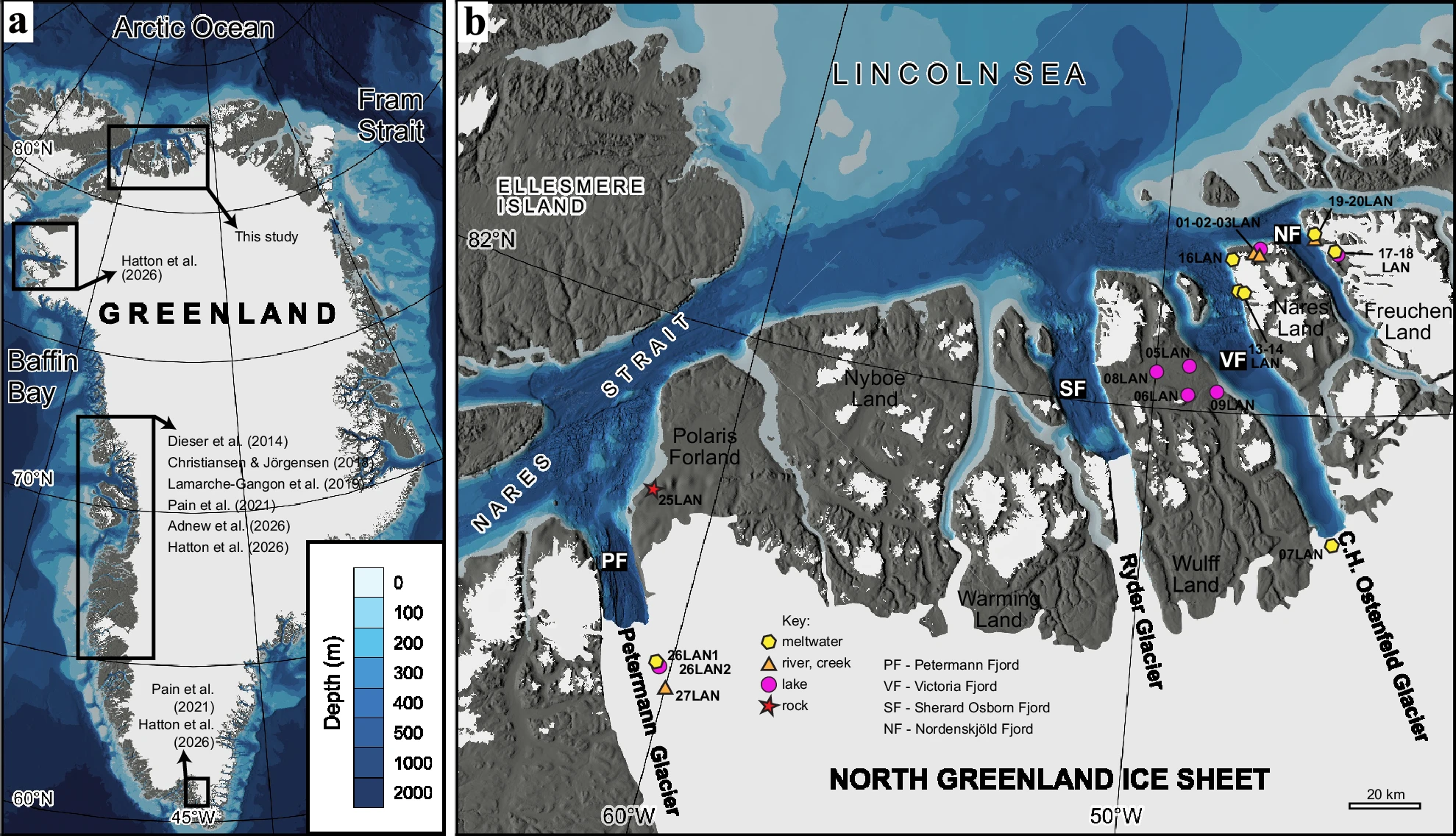
a Areas in south, southwestern, and northwestern Greenland with previous methane data used in this paper and the present study area in the north. b Detail of the study area showing location of sampling stations for meltwater (yellow hexagons), rivers and creeks (orange triangles), lakes (purple circles), and rock (red star). Note that sampling locations 26LAN2 and 27LAN, adjacent to Petermann Glacier, correspond to a lake and a creek, respectively. These features cannot be visually distinguished from the ice sheet at the map scale. Coordinates for all sampling sites are in Supplementary Table 1. Bathymetric data are from the International Bathymetric Chart of the Arctic Ocean (IBCAO) Version 5.0, which incorporates BedMachine Version 5 data for the inner-fjord bathymetry and subglacial topography. The bathymetry of Victoria Fjord and Nordenskjöld Fjord has been updated using data collected during the GEOEO 2024 expedition.
Last updated: 2026-08-30
Source: Department of Geological Sciences