


First author article in Journal of Micropalaeontology
Revealing Arctic invaders: IGV's Helen Coxall and team lay the foundations for identifying past warm-water planktonic foraminifera and reconstructing ancient Arctic environments.
First author article by Helen Coxall, Thomas M. Cronin, Kate Darling, Katrine Husum, Tamara Handl, Brian T. Huber, Megh M. Kanvinde, Mohammad Razmjooei, Flor Vermassen, Antje H. L. Voelker, Tirza M. Weitkamp, and Matt O'Regan. Quaternary Arctic planktonic foraminifera: morphological differentiation and taxonomic reassessment of subpolar spinose taxa, J. Micropalaeontol., 45, 581–622, 10.5194/jm-45-581-2026.
Abstract
Planktonic foraminifera in the modern Arctic Ocean are dominated by the non-spinose polar species Neogloboquadrina pachyderma. Acmes of two spinose, presumed subpolar taxa in Quaternary central Arctic sediment cores are therefore anomalous, implying significantly different past conditions. Currently the names Turborotalita quinqueloba (Natland) and Turborotalita egelida (Cifelli and Smith) are applied to the subpolar morphotypes, which have been associated with marine isotope stages (MISs) 5 and 11, respectively, although the latest age models challenge this. Besides age uncertainties, a major obstacle to fully interpreting these plankton events is unclear taxonomy, which complicates species identification, core correlations, and paleoenvironmental reconstructions. We address this by analyzing Arctic and sub-Arctic planktonic foraminifera using light and SEM imaging and conducting morphometric analysis.
Our results reveal consistent morphological and stratigraphic differences between the two Arctic spinose morphotypes, providing a basis for their taxonomic differentiation. We confirm that the younger morphotype corresponds to T. quinqueloba, characterized by tight coiling; an elongate final chamber overhanging the umbilicus; and, on average, a smaller proloculus. However, the central Arctic forms exhibit overall smaller tests than Nordic Sea counterparts and display smooth, non-encrusted wall textures. The older spinose morphotype is distinguished by larger size, a globular final chamber, an open umbilicus, evolute coiling, and a wider range and larger mean proloculus size. Compared to T. quinqueloba, it also has a lower chamber count and a distinctive wall texture that is never encrusted and characterized by sparse, robust spine bases and occasional linear ridges formed by aligned pustules. Our taxonomic investigation shows that the species name egelida is not appropriate for the older morphotype. We therefore reinstate the original species name exumbilicata, established by Herman in 1974. We highlight several morphospecies that may be confused with exumbilicata and that have contributed, or may contribute, to misassignments: Globigerina atlantisae Cifelli and Smith is consistent with the non-spinose Tenuitellita iota, whereas smooth-walled morphotypes of N. pachyderma that have been conflated with exumbilicata (egelida) can be seen under SEM to have a non-spinose wall. While it remains possible that the exumbilicata morphotype is an ecophenotype of T. quinqueloba, the absence of primary turborotalitid features and possession of some other features seen in the Globigerina falconensis lineage are instead suggestive of genus Globigerina. We here adopt a conservative taxonomic approach, referring to the older morphotype as “Globigerina” exumbilicata, pending future investigation. Our conclusions are outlined in a focused taxonomic framework covering relevant Arctic and subpolar planktonic foraminifera. The latest available biostratigraphic age constraints imply that “G.” exumbilicata is older than 0.44 Ma and younger than 1.8 Ma. It is possible that the “G.” exumbilicata acme represents a polar occupation by planktonic foraminifera in the central Arctic Ocean before ecological dominance by N. pachyderma. These new insights provide a foundation for advancing our understanding of Arctic planktonic foraminiferal evolution, the development of polar ecosystems, and Quaternary climate dynamics.
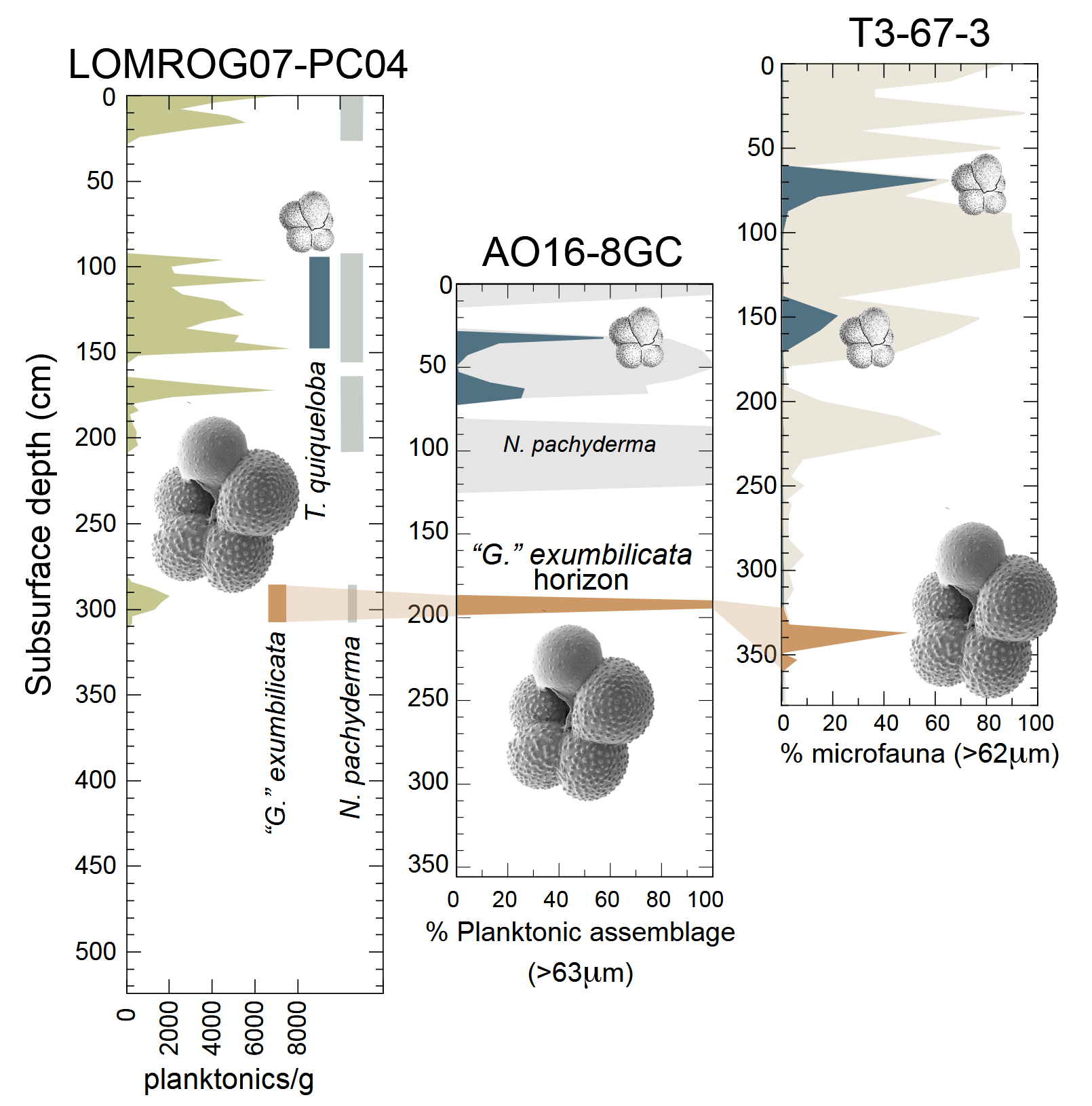
Figure 1Schematic stratigraphic distribution of foraminifera in selected CAO cores illustrating the broad occurrence of subpolar planktonic morphotypes (i.e. Morphotypes 1 and 2) based on published studies. The figure provides a simplified overview of their general stratigraphic relationships, which continue to be refined as new records become available. Count data are in different forms reflecting different data types in the respective studies. LOMROG07-PC04: total planktonic forams/g (olive shading) and subpolar species stratigraphic occurrences (Hanslik, 2011). AO16-8GC: quantitative data (% of the total foraminifera assemblage) for the three relevant morphospecies: N. pachyderma (pale grey shading), Morphotype-1 (T. quinqueloba, dark blue shading), and Morphotype-2 (“?” egelida/exumbilicata, gold shading) (Vermassen et al., 2021). T3-67-3: “% microfauna of the > 62 µm sand fraction” (pale beige shading), % “Globigerina quinqueloba” (dark blue shading), and % G. exumbilicata (gold shading) of Herman (1974). “Aggluts. only?” refers to the observation that below the Morphotype-2 horizon, calcareous foraminifera are largely absent and only agglutinated benthics occur (Cronin et al., 2008). See Fig. 2 and Table 1 for site localities. HO: highest occurrence of the P. lacunosa nannofossil event (ca. 0.44 Ma). Red markers: SEM sample horizons, this study. Throughout the paper we refer to Morphotype-1′, concluded to be T. quinqueloba, occurring stratigraphically above Morphotype-2′, concluded to be “Globigerina” exumbilicata Herman, previously known as T. egelida.
Last updated: 2026-08-11
Source: Department of Geological Sciences