


Two First-Author Publications by Guest Researcher
Bo Liu, Guest Researcher at IGV, is behind two First-Author Papers.
International Geology Review
Liu, B., et al. Post-accretionary crustal growth and recycling in the Central Asian Orogenic Belt: new insights from Early Permian Bole rhyolites and regional zircon Hf mapping. International Geology Review (2026). https://doi.org/10.1080/00206814.2026.2651236
Distinguishing between syn-accretionary and post-accretionary settings for Early Permian rhyolites in Western Tianshan Orogen (WTO) is crucial for understanding crustal growth and/or reworking processes within the Central Asian Orogenic Belt. We investigated the Early Permian Bole rhyolites (296 to 299 Ma) from the Alataw Mountains to clarify tectonic evolution and define boundary between the WTO and the West Junggar Terrane (WJT). These rhyolites exhibit high-K calc-alkaline aluminous A2-type affinities, corresponding to an extensional post-accretionary setting. Positive zircon εHf(t) values (+3.2 to +15.2) and low Mg# values (21–38) suggest a primary origin from the partial melting of dominant juvenile lower crust with localized reworking of ancient components. The coeval occurrence of Early Permian A2-type granites and rhyolites with I-, and S-type series suggests that the final closure of the ocean basin occurred before the Early Permian. Mantle-derived magma underplating during this phase led to a shift in continental growth from lateral to vertical. Regional-scale zircon Hf isotopic mapping illustrates a significant isotopic gradient between the Bole area and WJT, identifying the Bortala Fault as the first-order tectonic boundary. This case study highlights that regional-scale zircon Hf mapping is a powerful tool for illuminating deep crustal architecture in an accretionary orogen.
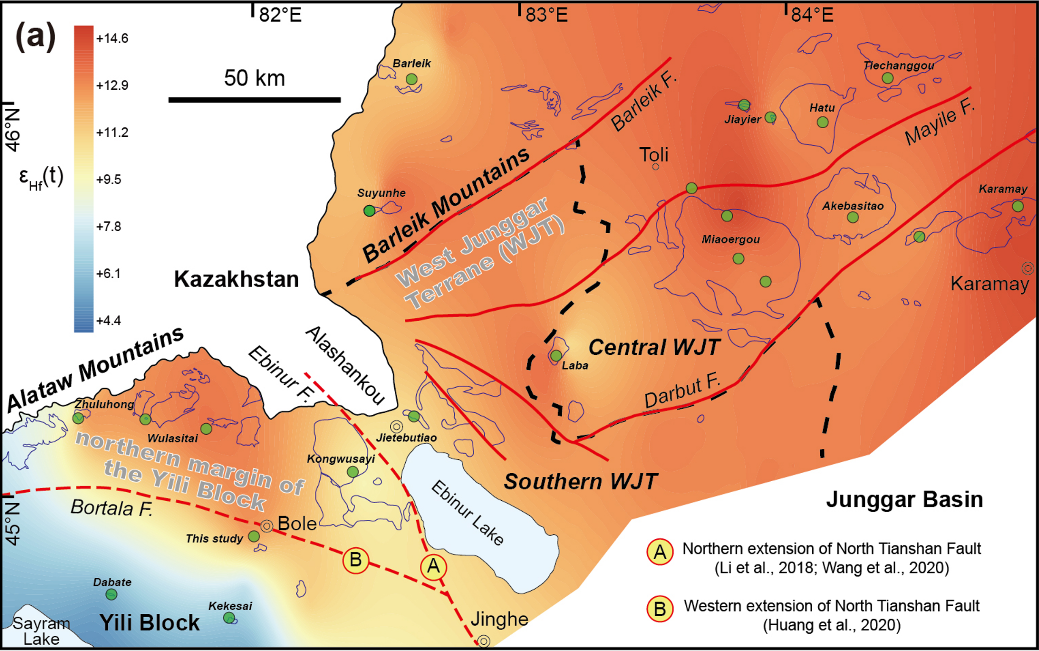
Zircon contour map of εHf(t) values of Late Carboniferous to Early Permian igneous rocks from the northern margin of the Yili Block and the West Junggar Terrane.
Journal of Earth Science
Liu, B., Han, B. Late Ediacaran Subduction Initiation in the Southern Altaids. Journal of Earth Science 36, 2803–2806 (2025). https://doi.org/10.1007/s12583-025-2040-1
Published as the cover story in the December 2025 issue of the SCI Q1-ranked Journal of Earth Science, researchers Bo Liu and Baofu Han demonstrate that intra-oceanic subduction in the southern West Junggar terrane of the southern Altaids initiated no later than the Late Ediacaran (~572 Ma), significantly later than the Late Mesoproterozoic initiation (~1,022 Ma) observed in the northern Altaids. By synthesizing evidence from the region's oldest supra-subduction zone (SSZ)-type ophiolitic mélanges, intra-oceanic arc volcanic rocks, and high-pressure metamorphic complexes like blueschists and garnet amphibolites, the authors confirm a southward progression model for the Paleo-Asian Ocean's evolution. This Ediacaran initiation aligns with global tectonic reorganization during the breakup of Laurasia and the assembly of Gondwana, suggesting the operation of a modern Mariana-type plate tectonic regime in the southern Altaids during this period.
This contribution was supported by the Geological Society Research Grants-Mike Coward Fund awarded to the first author.
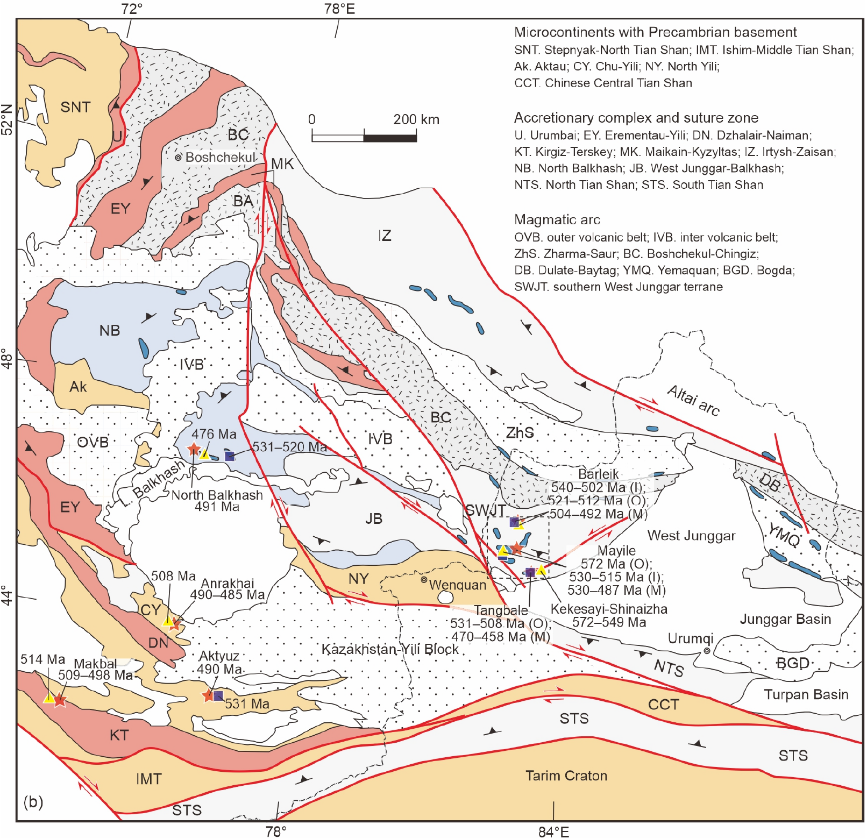
Tectonic map showing the tectonic units of the southern Altaids and the oldest ages of ophiolitic mélanges, igneous and subduction-related metamorphic complexes.
Last updated: 2026-05-04
Source: Department of Geological Sciences