


Arctic Seabed Mapping Paves Way for Fibre-Optic Cable
This summer, Stockholm University researchers continue to take part in the Polar Connect project, mapping the Arctic seabed from the icebreaker Oden. The work aims to improve and secure fibre-optic communications between Europe and Asia.
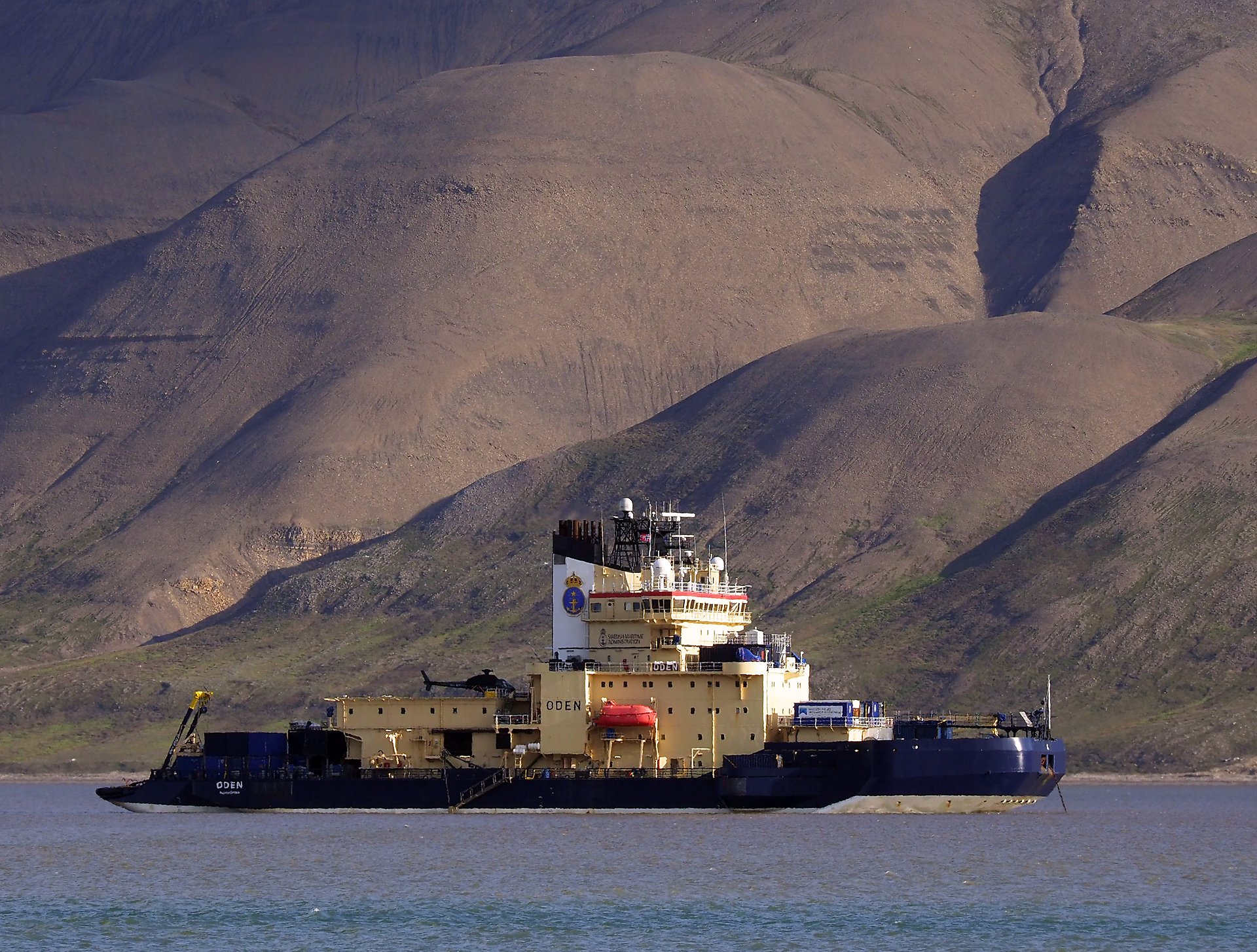
Seabed mapping of the Arctic Ocean is being carried out from the icebreaker Oden, here off Longyearbyen, Svalbard, in summer 2025. Photo: Martin Jakobsson
Martin Jakobsson is Professor of Marine Geology and Geophysics and one of three Deputy Vice Presidents of Stockholm University with responsibility for the Science Academic Area. He has extensive experience in polar research and has led nine major international marine research expeditions, most recently the GEOEO expedition in summer 2024 to waters off north-west Greenland. Jakobsson is also one of the leading figures in the global Nippon Foundation–GEBCO Seabed 2030 initiative, which aims to map the entire world ocean by 2030.
One of Jakobsson’s areas of focus is geophysical seabed mapping using acoustic methods. This expertise is now being applied in the large international Polar Connect project, a Northern European initiative to establish a fibre connection between Europe and Asia via the Arctic, the shortest route between the two continents. The cable is intended to provide ultra-high transmission capacity while avoiding geopolitically sensitive areas such as the Red Sea, through which around 90 per cent of today’s fibre-optic connections between Europe and Asia run. In Sweden, the work is coordinated by the Swedish Research Council and the Swedish Polar Research Secretariat, with partial funding from the EU.
Swedish-Canadian Icebreaker Expedition
In summer 2025, the Swedish icebreaker Oden spent just over a month at sea alongside the Canadian icebreaker CCGS Louis S. St-Laurent on an expedition to map the seabed of the Arctic Ocean. In addition to Swedish and Canadian researchers, geologists from Denmark and Greenland also participated. A parallel international summer school for researchers, led by Professor Michael Tjernström at Stockholm University, was held onboard Oden. Alongside geological surveys and the summer school, seabed mapping for the fibre-optic cables under Polar Connect took place. Jakobsson led the work of calibrating and upgrading the echo sounder systems onboard Oden prior to the expedition. Professor Matt O’Regan, also from Stockholm University, was onboard to take sediment samples from the seabed.
Stockholm University Involved from the Start
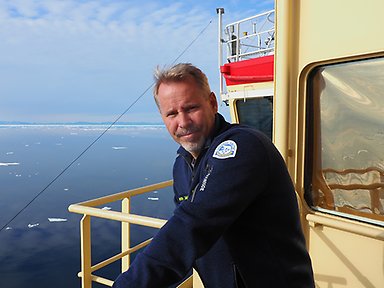
Photo: Björn Eriksson
This summer, as well as in summer 2027, the work to map the Arctic seabed in preparation for Polar Connect continues. On both occasions, Oden will operate alongside the Canadian icebreaker, with researchers from Stockholm University playing key roles onboard.
“Stockholm University has been involved from an early stage because we have built up expertise in seabed mapping. For example, we run the regional centre within Nippon Foundation–GEBCO Seabed 2030, which is responsible for compiling depth data across the Arctic Ocean. Our international involvement began with the International Bathymetric Chart of the Arctic Ocean (IBCAO), launched in St. Petersburg in 1997. Eventually, the work of compiling all seabed data moved to Stockholm University, where it has remained,” says Martin Jakobsson.
Stockholm University also led the funding and installation of Oden’s first advanced echo sounder, enabling researchers over the years to collect valuable data for the Polar Connect project. Oden received its first multibeam echo sounder in 2007, funded by the Knut and Alice Wallenberg Foundation and the Swedish Research Council, with installation costs in the hull covered by the Swedish Maritime Administration. Over the years, the Polar Research Secretariat has increased its responsibility for research infrastructure and contributed significantly to keeping the systems up to date.
“All this mapping work has allowed us to analyse where the cable can be laid on the seabed and identify potential risks along the route. We have also contributed by collecting new data for the cable, identifying where measurements are needed, and analysing collected data. This summer, we will additionally have a team onboard operating the echo sounders as we gather further data,” says Martin Jakobsson.
Stockholm Researchers on This Summer’s Expedition
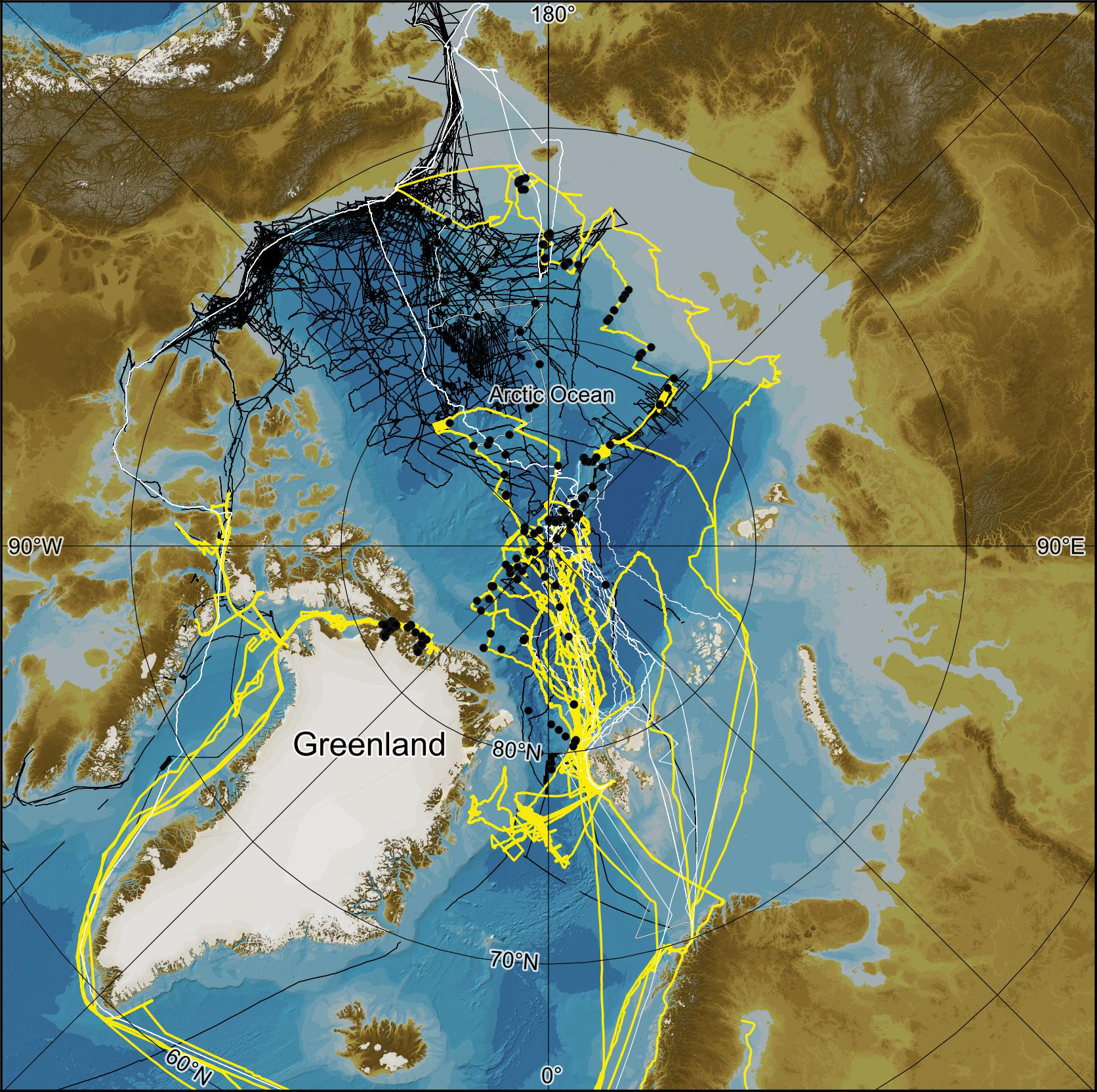
The yellow and white lines indicate seabed measurements taken from the icebreaker Oden up to 2025, which are used to analyse potential routes for the Polar Connect cable.
This summer’s expedition aboard Oden is divided into two parts. The first, a short period of just over 10 days, focuses on mapping the initial section of the cable from offshore Svalbard into the deep waters on the European side of the North Pole. Measurements will be conducted in areas with complex seabed topography, such as the Gakkel Ridge, where the seafloor splits and new crust forms through volcanic activity. These areas are particularly important for Polar Connect. The second part is a longer expedition of just over 40 days, conducted in collaboration with Canada and the icebreaker Louis S. St-Laurent. The Polar Research Secretariat will also organise a polar summer school during this period, as in previous years.
The expedition departs from Longyearbyen, Svalbard, at the end of July. After a couple of weeks, Oden returns to Longyearbyen for a crew change, before sailing out again for the second leg. During the expedition, Stockholm University researchers lead the mapping work. Martin Jakobsson will lead a research team of six from Stockholm University during the first part, while Professor Matt O’Regan will oversee sediment sampling in the second part.
Senior Lecturer Richard Gyllencreutz will also be onboard Oden leading the mapping, alongside PhD and Master’s students from Stockholm University participating in the international polar summer school. Researchers from multiple universities in different countries will also be onboard.
Why Polar Connect Matters
“It is important both for reducing vulnerability by diversifying where internet communications run via fibre cables, and for improving communication times between East Asia and Europe. The cable also offers significant opportunities for research,” says Martin Jakobsson.
The Need for a New Swedish Icebreaker
Discussions about a new Swedish icebreaker to replace Oden have intensified, especially following President Trump’s comments on Greenland. Minister for Higher Education and Research Lotta Edholm has highlighted the need for a modern Arctic-adapted vessel. Martin Jakobsson warns:
“Without a new icebreaker, many researchers who have built their work around Oden may have to pursue other research paths.”
Read more about Polar Connect
Read more about Martin Jakobsson's research
Read about Martin Jakobsson's Wallenberg project Using AI to predict the retreat of glaciers
Read more about GEOEO – North of Greenland 2024 Expedition
More about: Forskarskolan på Oden ska ge ny generation forskare
Last updated: 2026-05-04
Source: Department of Geological Sciences