


Corresponding author article in Ore Geology Reviews by Bo Liu, Guest Researcher at IGV
Apatite U-Pb ages, trace elements, and in situ Sr-Nd isotopes and pyrite S isotopes of the Saima alkaline complex: Implications for the petrogenesis and tectonic setting of Nb-Ta-REE mineralization in Northeast China
Ju, N., Liu, B., Gong, Y.N., Qiu, Q.F., Wu, Y., Liu, X., Shi, L., Nan, Z., Ma, D.Z., Wang, H.H., Jiang, M.Y., Feng, Y.H., 2025, Apatite U-Pb ages, trace elements, and in situ Sr-Nd isotopes and pyrite S isotopes of the Saima alkaline complex: Implications for the petrogenesis and tectonic setting of Nb-Ta-REE mineralization in Northeast China, Ore Geology Reviews, 183, 106704. https://doi.org/10.1016/j.oregeorev.2025.106704
Abstract
Alkaline complexes host economically strategic deposits of rare metals such as niobium (Nb) and tantalum (Ta) and rare earth elements (REEs). However, their enrichment and metallogenic processes remain poorly understood. The discovery of the Saima alkaline complex-hosted Nb-Ta-REE deposit (also referred to as the Saima deposit) in the eastern Liaoning Province in Northeast China provides an ideal opportunity to address these challenges. Petrographic analysis indicates that the Saima deposit occurs in aegirine nepheline syenite, with primary ore minerals including loparite, columbite-tantalite, fergusonite, fersmite, betafite, and bastnaesite. These characteristics are consistent with typical alkaline rock-hosted rare metal and REE deposits. Using petrography, mineralogy, apatite U-Pb, trace element, and in situ Sr-Nd isotopic analyses, and pyrite S isotopic analysis of aegirine nepheline syenite associated with Nb-Ta-REE mineralization, this study explored the metallogenic ages and mechanisms, source, and tectonic setting of the Saima deposit. The apatites associated with Nb-Ta-REE mineralization exhibit uniform, concentric, and oscillatory zoning in cathodoluminescence (CL) images, as well as high (La/Yb)N ratios (124.62–11440.84) and nonsignificant Eu anomalies (δEu values: 0.68–0.85). These characteristics indicate a magmatic origin, suggesting that the Nb-Ta-REE mineralization occurred primarily during the early-stage crystallization of alkaline magmas. The laser ablation–inductively coupled plasma–mass spectrometry (LA-ICP-MS) apatite U-Pb dating results indicate that the aegirine nepheline syenite has lower intercept ages of 232 ± 7 Ma and 224 ± 17 Ma. In combination with previous geochronological studies, this study proposed that the Nb-Ta-REE mineralization in the Saima deposit might have occurred during the early Late Triassic. The in situ apatite Sr-Nd isotopic analysis reveals that the apatites feature high 87Sr/86Sr ratios (0.70835 to 0.70879) and negative εNd(t) values (–17.21 to –10.71), while the pyrites associated with Nb-Ta-bearing minerals exhibit positive δS values (+1.3 ‰ to + 3.5 ‰). These findings suggest that the mineralized alkaline rocks originated from the partial melting of a metasomatized Nb-, Ta-, and REE-rich lithospheric mantle. Based on the regional geological setting, this study proposed that the ore-bearing aegirine nepheline syenite in the Saima deposit was formed in an extensional tectonic setting after the closure of the oceanic basin. The recycled continental crust of the ancient Yangtze Craton played a key role in the formation of the Triassic Nb-Ta-REE-bearing alkaline rocks, exemplified by the Saima alkaline complex, in the eastern Liaoning Province. The entire Triassic alkaline complex in the eastern North China Craton (NCC) possesses great potential for Nb-Ta-REE mineralization, necessitating further prospecting and exploration.
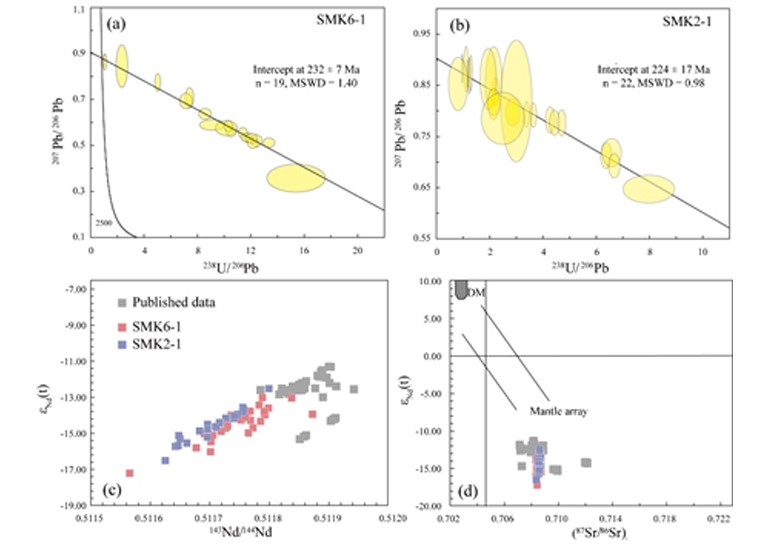
Fig. (a, b) Tera-Wasserburg concordia diagrams of apatites from the aegirine nepheline syenite in the Saima deposit, Northeast China. (c) 143Nd/144Nd vs. εNd(t), and (d) (87Sr/86Sr)i vs. εNd(t) of aegirine nepheline syenite in the Saima deposit, Northeast China.
Last updated: 2026-11-03
Source: Department of Geological Sciences