


First author article in Quaternary Science Reviews journal
by Petter L. Hällberg et al.
Disentangling seasonal and annual precipitation signals in the tropics over the Holocene: Insights from δD, alkanes and GDGTs
Petter L. Hällberg, Rienk Smittenberg, Malin E. Kylander, Joan Villanueva, Nina Davtian, Anggi Hapsari, Jenny K. Sjöström, Josefine Axelsson, Guillermo Jarne-Bueno, Kweku Yamoah, Hamdi Rifai, and Frederik Schenk.
https://doi.org/10.1016/j.quascirev.2024.108948
Abstract
Rainfall seasonality in the tropics has a substantial impact on both ecosystems and human livelihoods. Yet, reconstructions of past rainfall variability have so far generally been unable to differentiate between annual and seasonal precipitation changes. Past variations in seasonality are therefore largely unknown. Here, we disentangle hydrogen isotopic (δD) signals from terrestrial leaf waxes and algae in an 8000-year peat core from Sumatra, which reflect annual versus wet season rainfall signals, respectively. We validate these results using lipid biomarkers by reconstructing vegetation dynamics via n-alkane distributions and peatland hydrological conditions using glycerol dialkyl glycerol tetraethers (GDGTs), as well as biomass burning using levoglucosan concentrations in the core. Finally, we compare our proxy results to a transient climate model simulation (MPI-ESM1.2) to identify the mechanism for seasonality changes. We find that algal δD indicates stronger Indonesian-Australian Summer Monsoon (IASM) precipitation in the Mid-Holocene, between 8 and 4.2 cal ka BP. A period of alternating flooding, droughts and wildfires is reconstructed between 6 and 4.2 cal ka BP, implicating very strong monsoonal precipitation and drying out and burning during a longer and intensified dry season. We attribute this strong rainfall seasonality in the Mid-Holocene mainly to orbitally forced insolation seasonality and a strengthened IASM, consistent with the modeling results. In terms of annual rainfall, terrestrial plant δD, vegetation composition and GDGTs all indicate wetter conditions peaking between 3 and 4.5 cal ka BP, preceded by drier conditions, followed by drastic and rapid drying in the late Holocene from around 2.8 cal ka BP. Our multiproxy annual precipitation reconstruction thereby indicates the wettest overall conditions approximately 1500–2000 years later than a nearby speleothem δ18O record, which instead follows the seasonally biased algal δD in our record. We, therefore, hypothesize that speleothem reconstructions over the Holocene in parts of the tropics with low but significant seasonality may carry a stronger seasonal component than previously suggested. The data presented here contribute with new insights on how isotopic rainfall proxies in the tropics can be interpreted. Our findings resolve the seasonal versus annual components of Holocene rainfall variability in the Indo-Pacific Warm Pool region, highlighting the importance of considering seasonality in rainfall reconstructions.
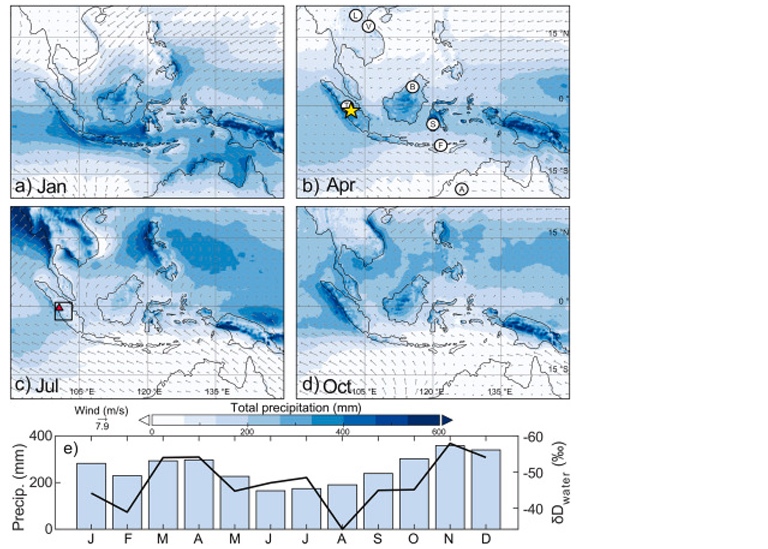
Fig. 1. Present day precipitation and wind patterns in January (a), April (b), July (c) and October (d) and monthly variability in water isotopic composition (e). The star in (b) marks the Padang peatland, and the labeled circles denote speleothem records from L: Laos, B: Borneo, T: Tangga Cave, F: Flores and A: Australia (Denniston et al., 2013; Griffiths et al., 2013, 2020; Partin et al., 2007). Precipitation and wind data are derived from ERA5 reanalysis data between 1979 and 2020 CE. The data in (d) for precipitation amount is ERA5 data from central Sumatra land areas (box between 1°N and 3°S and 100-104°E in (c)). The isotopic data is based on JAMSTEC measurements at the GAW/Kototabang station (red triangle in (c)) in Sumatra between 2001 and 2008 (Kurita et al., 2009). The line plot represents δDrainwater, and the bars represent rainfall amounts in (e).(For interpretation of the references to colour in this figure legend, the reader is referred to the web version of this article.)
Last updated: 2024-10-11
Source: Department of Geological Sciences