


Ernst Johnson's Academic dissertation
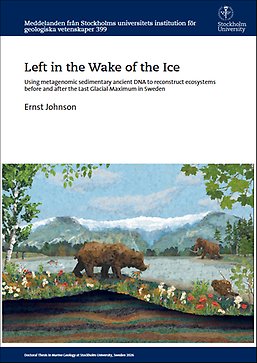
Left in the Wake of the Ice: Using metagenomic sedimentary ancient DNA to reconstruct ecosystems before and after the Last Glacial Maximum in Sweden
Academic dissertation for the Degree of Doctor of Philosophy in Marine Geology at Stockholm University to be publicly defended on May 22 2026 in William-Olsson lecture hall, Geoscience building, Stockholm University.
Supervisor
- Anna Linderholm, Docent
Center for Paleogenetics (CPG)/Department of Geological Sciences, Stockholm university. - Martin Jakobsson, Professor
Department of Geological Sciences, Stockholm university.
Opponent
- Laura Epp, Professor
Limnological Institute, Department of Biology, University of Konstanz, Germany.
Abstract
As the Fennoscandian ice-sheet retreated, plants and animals began to recolonise the Scandinavian peninsula. Current knowledge about the recolonisation patterns in Sweden during the Holocene is based mostly on fossil plant remains and preserved osteological remains, of which the latter record is sparse. Even less is known about the ecosystem composition before the Last Glacial Maximum (LGM), since the last ice-sheet eroded and reworked most deposits. Previous limitations due to gaps in the fossil record can now be addressed, as sedimentary ancient DNA (sedaDNA) is established as a powerful tool for reconstructing past ecosystems.
This thesis investigates how ancient environmental genomics based on shotgun sequencing of lake sediments can be used to reveal which species were present at certain points in time during the Holocene in central and northern Sweden. It also includes a glimpse into the Pleistocene pre-LGM ecosystem, as a comparison to the Holocene environment.
In Paper I, we present an ancient environmental genome from a male brown bear extracted from lake sediment from northern Sweden dated to 9.6 cal. ka BP. With a mitochondrial coverage of 231x and a nuclear genome coverage of 0.05x, we could investigate the genome using population genomic methods. The paper highlights the potential of sedaDNA and non-destructive methods for generating high-quality genomic data.
For metagenomic processing of sedaDNA data, an open-access ready-to-use bioinformatic pipeline was compiled from existing tools. The pipeline, called metaJAM, is presented in Paper II. It includes a pre-processing step of adapter trimming and removal of low complexity regions and microbial filtering, followed by competitive mapping against reference databases. Lastly, a module of filtering and authentication finalises the output.
From a sediment sequence from lake Orsasjön in central Sweden (Paper III), we reconstructed the local plant composition between ca. 8.1–0.1 cal. ka BP using sedaDNA. The results show a constant presence of woody taxa throughout the sediment sequence, with little turnover in the sedaDNA record. We demonstrate the expansion of spruce (Picea) in the region, with modelled ages overlapping with previous studies. The arrival of maple (Acer) to central Sweden, previously unreported, is also shown. Additionally, we present authenticated sedaDNA from vertebrates, including humans, fish, beaver and water vole.
There are some pre-LGM sediment deposits in Sweden left intact. In Paper IV, we investigated samples from Vålbacken outside Östersund, northern Sweden. The sediments are dated to 55–35 ka BP, i.e. within marine isotope stage 3 (MIS 3). We present indications of a mammoth steppe-like plant composition, and the presence of woolly mammoth (Mammuthus primigenius) in the sedaDNA. Our findings add to the sparse knowledge of pre-LGM ecosystems in Sweden.
A literature review is also included (Paper V). It outlines and summarises the setting for the project, and introduces many relevant concepts for readers not familiar with the field.
In conclusion, this thesis expands the knowledge of how the landscape in Scandinavia was developed before and after the LGM, based on shotgun sequenced sedaDNA. It provides an example of how lake sediments can yield genomic data from a single individual of comparable quality to osteological aDNA, reveals the arrival of maple to central Sweden, and confirms the presence of a mammoth steppe ecosystem in Sweden during MIS 3.
Last updated: 2026-05-06
Source: Department of Geological Sciences