


Robert Dunst's Academic dissertation
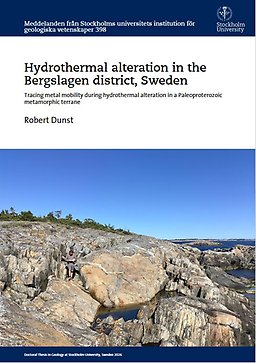
Hydrothermal alteration in the Bergslagen district, Sweden: Tracing metal mobility during hydrothermal alteration in a Paleoproterozoic metamorphic terrane
Academic dissertation for the Degree of Doctor of Philosophy in Geology at Stockholm University to be publicly defended on May 4 2026 in William-Olsson lecture hall, Geoscience building, Stockholm University.
Zoom: https://stockholmuniversity.zoom.us/j/69845345738
On the day of the defence (4 May), we will also organise a seminar with my committee members from 10.00 to 12.00 in William-Olssonsalen.
You are welcome to attend, either in person or online.
Follow this link for more information about the seminar: https://forms.gle/C9sBetki2kJYi4KU9
Supervisor
- Iain Pitcairn, Associate Professor
Department of Geological Sciences, Stockholm university. - Nils Jansson, Associate Professor
Division of Geosciences and Environmental Engineering Department of Civil, Environmental and Natural Resources Engineering, Luleå University of Technology.
Opponent
- Nick Oliver, Doctor
Economic Geology Research Unit, James Cook University, Australia..
Abstract
Regional hydrothermal alteration can redistribute metals in volcanic and volcano-sedimentary terranes, influencing the formation of ore deposits. This thesis investigates large scale sodium, magnesium and potassium dominated alteration in the Bergslagen ore province, Sweden, using field observations, drill core analyses, mineralogy and whole rock geochemistry. Three case studies, Hällefors, Riddarhyttan and Utö, capture a range of alteration styles, metal endowments and geological contexts. Results show that hydrothermal fluids strongly modified host rocks and mobilised iron (Fe) and light rare earth elements (REE), while base metal depletion was variable and controlled by the original composition of the volcanic rocks. Potassium dominated alteration is spatially associated with mineralisation but shows no systematic metal loss, whereas sodium and magnesium dominated alteration shows metal loss on a regional scale and likely supplied metals to ore forming fluids. These findings demonstrate that regional hydrothermal systems were widespread and geochemically effective. Their metallogenic impact depends on rock composition, fluid chemistry and basin architecture. This work refines models of metal mobilisation in ancient volcanic terranes and provides a framework for assessing the role of regional hydrothermal alteration in ore formation.
Last updated: 2026-04-13
Source: Department of Geological Sciences