


Honorary Doctor Stéphane Horel on PFAS, pollution and industry influence
An interactive map of the thousands of PFAS-contaminated sites in Europe, and an estimated two trillion euros needed to remediate just 2% of this pollution. That is just a fraction of what Stéphane Horel, journalist from Le Monde, uncovered through “The Forever Pollution Project” and her follow-up “The Forever Lobbying Project”. At the honorary doctorate seminar at Stockholm University, she explained how an investigation built on collaboration between journalists and researchers across Europe, brought one of Europe’s largest pollution crises into public view.
Stéphane Horel is a journalist at Le Monde, specialised in corporate harm, toxic industries and scientific disinformation. She has written several books and directed a number of documentaries, and has received major international awards, including the European Press Prize for Investigation (2018) and the European Science Journalist of the Year award (2024).
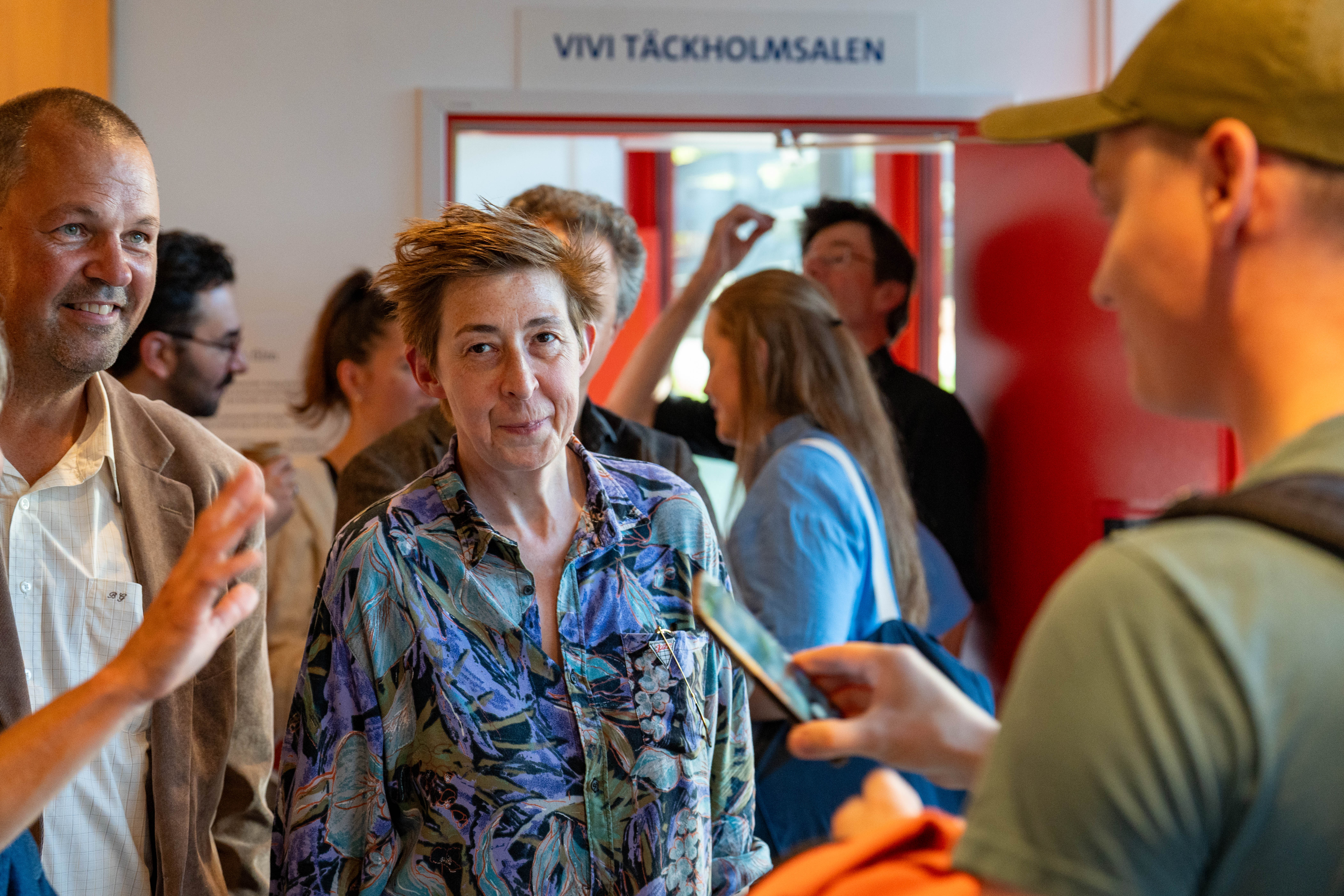
Björn Gullefors, Lawyer at Uppsala Vatten och Avfall AB, and Honorary doctor Stéphane Horel. Photo: Anette Gärdeklint Sylla/Stockholm University
Findings of The Forever Pollution Project and Forever Lobbying Project
Her latest projects, The Forever Pollution Project and The Forever Lobbying Project have been praised for pioneering the field of “expert-reviewed journalism”. This practice promotes multidisciplinary collaboration between journalists and experts, to deliver expert-reviewed coverage of complex and interconnected topics. JournalismFund Europe has launched a funding scheme of 1.67 million euros this year for expert review journalism projects, showing the methodology has spread.
The “Forever Pollution Project”, began on the bank of the River Thames. Horel was talking to Dutch colleague Tim Luimes, shortly after the discovery of widespread PFAS pollution incident in Zwijndrecht near Antwerp, when he asked a question that stuck.
You know how many of those facilities there are across Europe? We should map them.
Horel went on to coordinate the work of 29 journalists across Europe on the first project, and 46 on the second. One key challenge, she said, was bringing people together into a space of collective intelligence when they are used to competing against each other.
The result was an unprecedented mapping of hundreds of thousands of PFAS contamination hotspots across Europe, which the scientific community described as “the worst pollution crisis humanity has ever faced”.
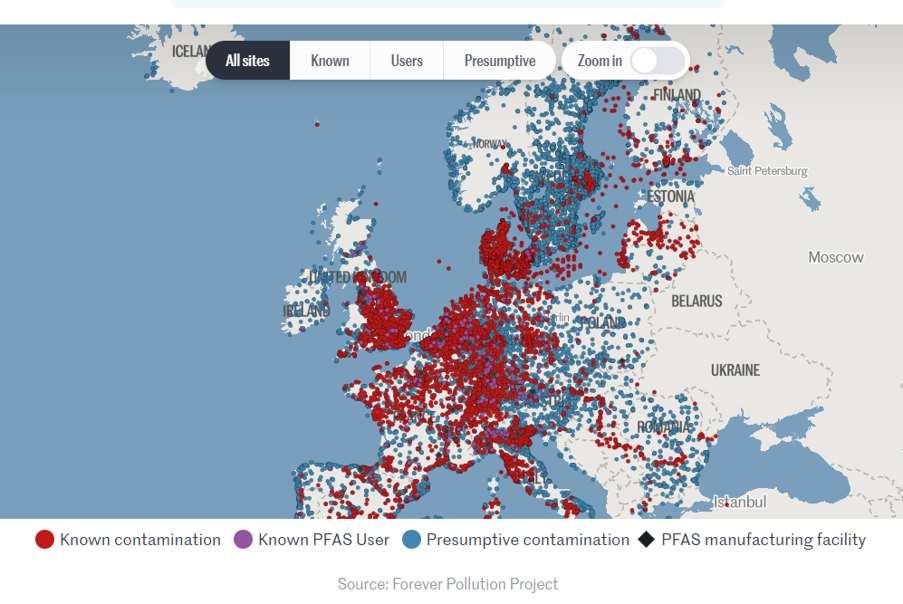
The Map of Forever Pollution in Europe shows sites where PFAS contamination has been detected across Europe. Source: Le Monde / Forever Pollution Project (2023).
The team’s next step was “The Forever Lobbying Project”, with a much broader scope: to examine how the pollution they had mapped was affecting society.
After the contamination of the environment, we should look at the contamination of politics (…),
Horel said.
To show decision-makers what the pollution means in practice, the team calculated the cost of providing clean water free from PFAS. Remediating just 2% of the PFAS emitted in Europe would cost two trillion euros over twenty years.
We can't afford this. Our societies cannot afford this,
she said.
The team also wanted to understand what arguments were being used to justify such extensive pollution. This required reviewing 14000 PFAS-related documents, obtained from public repositories and through freedom of information requests. From these, they built a taxonomy of industry arguments, and a stress test of the main scientific, economic and technical arguments used to downplay the dangers of PFAS.
The parallels with earlier merchants of doubt quickly became clear.
This was straight from the corporate disinformation playbook that we've seen for decades with the tobacco industry, but not only. Horel said.
Expert-reviewed journalism in practice
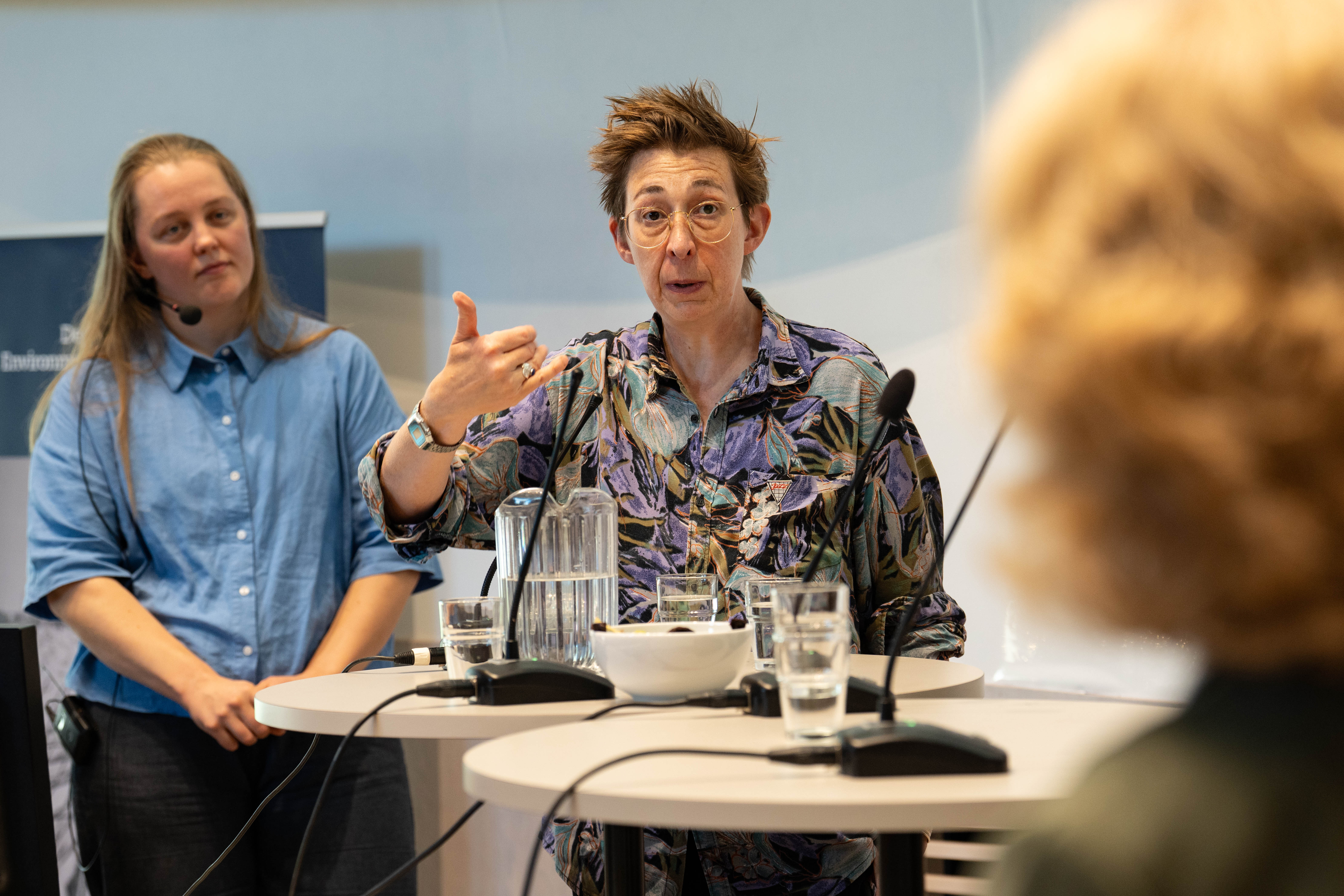
Amanda Rensmo and Stéphane Horel. Photo: Anette Gärdeklint Sylla/Stockholm University
According to Horel, this level of collaboration was unprecedented for journalists and a product of the expert-reviewed journalism framework. Experts were integrated into the team with a clearly defined role, which preserved editorial independence while raising the quality of the methodology and the credibility of the investigation.
The interest in the investigation was so high that it led to two scientific papers: one on the methodology of mapping PFAS contamination, and one on the calculation of remediation costs.
I had calls with government authorities in several countries that were asking me how to use [our method] to map presumptive contamination,
Horel said.
She encourages fellow journalists to follow suit, but to do their homework before approaching scientists.
You don't call Professors Ian Cousins or Martin Scheringer and ask them, 'What is TFA?' she said. Instead, the approach should be: 'this is what I know, how do we go forward?'
Horel concludes with results from a survey from five of the researchers on the team, asking what motivated them to take part. The most common answer was to contribute to meaningful change. Writing academic papers ranked almost last.
A legal battle in Uppsala
PFAS is not only a subject for journalists and researchers, but also increasingly in courts. Björn Gullefors, a lawyer at Uppsala Vatten och Avfall AB, presented their battle against PFAS. The company manages Uppsala’s drinking water and has faced rising operating costs due to PFAS contamination. The pollution was traced to the Swedish Air Force’s Ärna (F16) military airbase, where PFAS-based firefighting foam had been used on site. The discharged firefighting foam entered the groundwater, contaminating the source on which the company relies and making it unfit for consumption.
Gullefors explained that Professor Lutz Ahren and fellow researchers from the Swedish University of Agricultural Sciences in Uppsala helped the company trace the contamination back to the airbase.
A tight collaboration with science (…) is really helpful for us. Gullefors said.
After unsuccessful negotiations over compensation, the City of Uppsala sued the state for damages incurred. The Land and Environment Court dismissed the claim in 2019, but the Court of Appeal reversed the decision, finding that modelling and field measurements made it “highly probable” that the PFAS contamination originated from the Armed Forces. The court, therefore held the state liable under the “polluter pays principle”. However, the judgement formally covers only the period to 2021. Uppsala Vatten och Avfall has therefore invoiced for the costs incurred between 2021 and 2025. The Swedish Armed Forces have refused to pay, and a second lawsuit has been ongoing since May 8th 2026 (Land and Environment Court at Nacka District Court, case no. M 4034-26). Other Swedish cities face similar situations. For example, Halmstad is negotiating compensation for 140 million, but no other municipality has yet initiated a court case.
Regulating PFAS and PFAS-Free Innovation
Amanda Rensmo, a PhD student at Stockholm University’s Department of Environmental Science, presented her research regarding PFAS uses and their alternatives. She also discussed the universal PFAS restriction proposal and her role as an observer at the scientific committee meetings of the European Chemicals Agency (ECHA).
The EU’s universal PFAS restriction proposal, published on 7 February 2023, aims to ban all PFAS uses in the EU except those granted time-limited derogations. However, in July 2026 the EU Commission signaled in its Chemical Industry Action Plan that it would instead pursue restrictions on consumer uses of PFAS while exempting industrial uses.
Industrial uses are stated to be synonymous with no available alternatives, whereas for consumer uses alternatives would be available (...) But is it so simple?
Rensmo asked.
Her research covers critical technologies within the green energy transition, such as batteries and wind turbines, which are often portrayed as dependent on PFAS. She argued that this dependency may be driven less by technical necessity than by convention and default choices.
From an engineering perspective, if something works, why would you change it?
she said.
Rensmo also pushed back against a common misconception about how consumers are protected from PFAS:
The consumer is not more protected by banning it from those uses [in consumer products], because that's not where the exposure happens. The exposure happens with other sources, drinking water, food, or living in a contaminated area,
she said.
She noted that her own ability to engage effectively with policy work was only possible through financial support from her supervisor, Professor Ian Cousins, and argued for more dedicated funding for this kind of work.
Researchers have very little time. To be able to engage with policy you need funding,
she said.
Solutions and ways forward
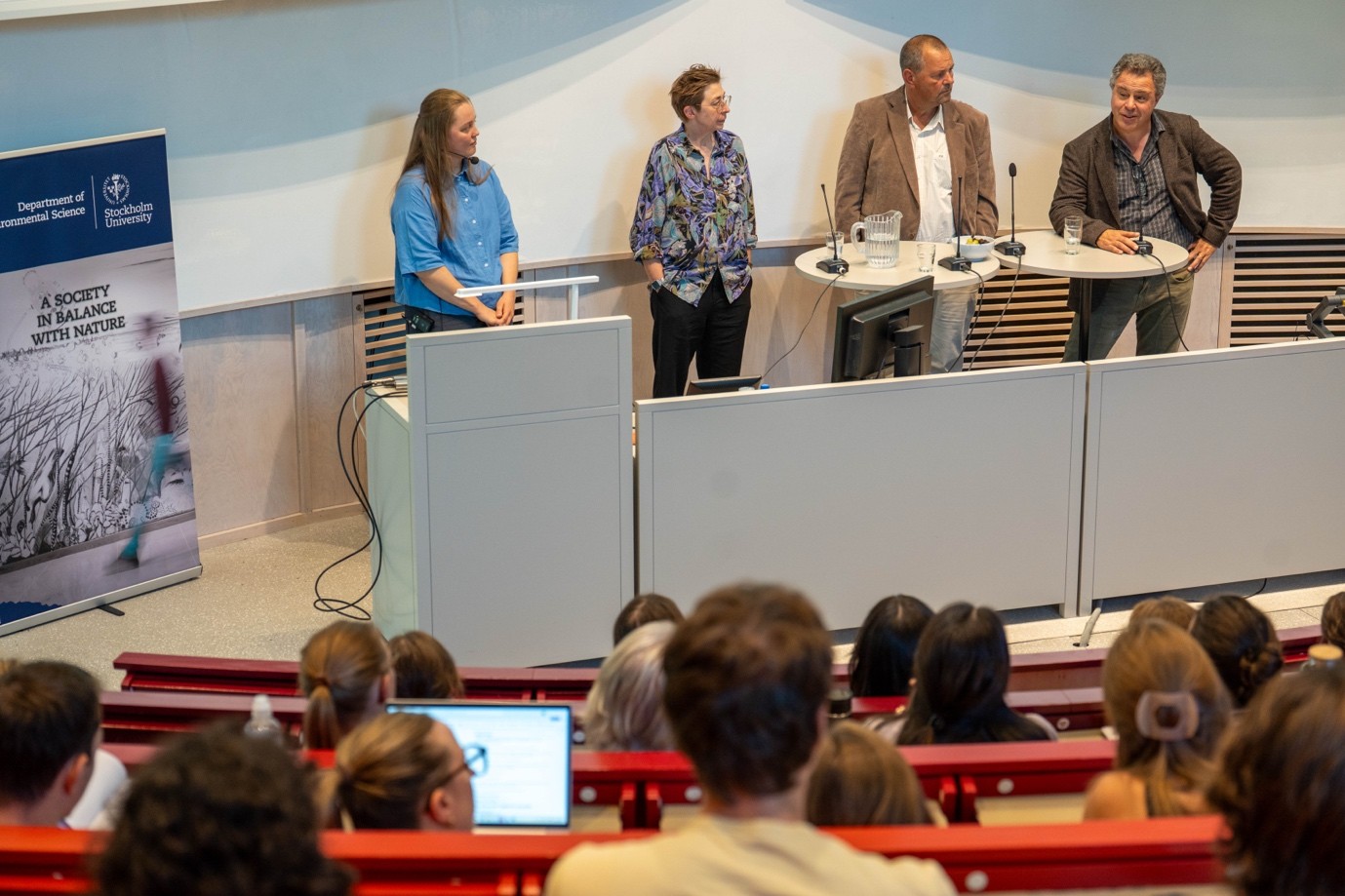
From the left: Amanda Rensmo, Stéphane Horel, Björn Gullefors and Ian Cousins. Photo: Anette Gärdeklint Sylla/Stockholm University
Stéphane Horel, Amanda Rensmo, Björn Gullefors and Ian Cousins closed the seminar with a panel discussion on solutions and next steps.
Cousins explained that his decision to collaborate with Horel came down to a relationship of mutual respect and trust.
When Stéphane Horel came in, she was already at a high level of understanding and was asking the right questions (…) when she publishes something, she always lets you check exactly what she's going to publish (…),
he said.
Gullefors reflected on the similarities between the projects presented that day.
I see parallels in them all - a legal perspective, a journalistic perspective, and a scientific perspective. And science is in the midst of them all,
he said.
Rensmo added that another common thread across journalism, research and law is the importance of critical thinking.
When we hear something (…) one common question that we’ve all had in our different roles is 'is this true?' (…) what is the evidence for this claim? And if there is no evidence, can we really say that this is the case?
Rensmo said.
Horel discussed an underwhelming response from government authorities to her work. When she approached regional health authorities based near a site of suspected PFAS contamination in France, she learned that they had received no training despite two years of front-page national coverage of PFAS. The lack of biomonitoring schemes hinders government actions, allowing a “no data, no problem” mindset to take hold. Horel also reflected on the public outrage that would result from more awareness on the pervasiveness of PFAS pollution.
If everybody could get their blood tested and know their PFAS levels, I think there would be a revolution. Horel said.
Cousins praised the close collaboration between researchers and regulators in Sweden in the Toxicology Council, which is chaired by the Swedish Chemicals Agency's (KEMI), and suggested that it could serve as a model for other countries.
Researchers from all of Sweden and regulators get together four times a year and talk about new problems coming up with chemicals,
Cousins said.
Horel also discussed the limitation of the polluter pays principle. 3M's Zwijndrecht site near Antwerp, is possibly Europe's most polluted known site. However, the Flemish government negotiated a €571 million settlement against an estimated €3 billion needed for surrounding soil remediation. Further, 3M disputed responsibility for the pollution in the Scheldt River’s sediments.
It's the perfect crime, because molecules don't have a logo. Horel said.
Department head Anna Sobek’s closed the seminar by reflecting on the role of Horel’s work in upholding democratic decision-making.
In a democratic society, political leaders need to make decisions based on the best available knowledge (…) to clarify that truth, we need not only scientists, but also science journalists who go digging and who dig deep,
Sobek said.
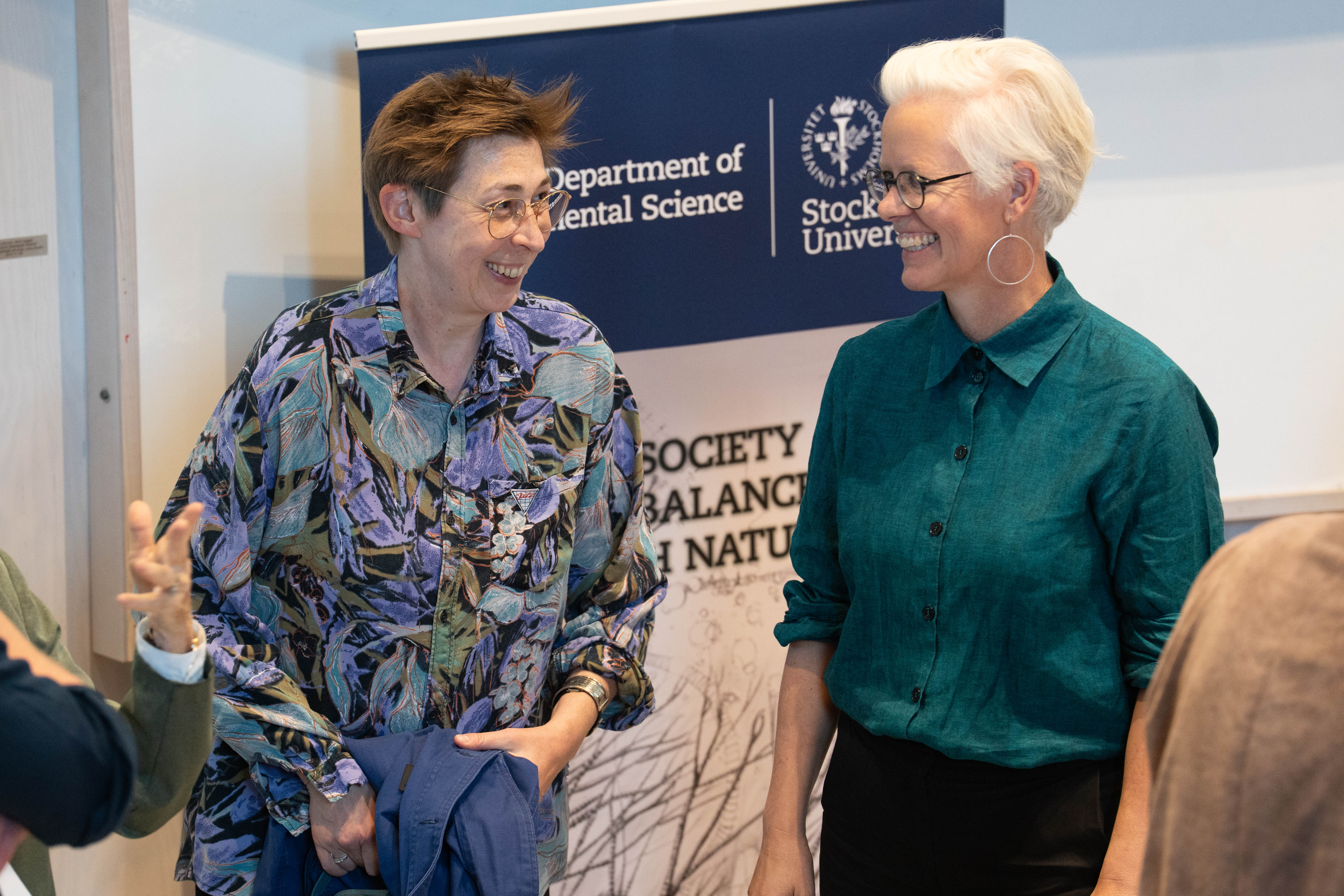
Stéphane Horel and Anna Sobek. Photo: Anette Gärdeklint Sylla/Stockholm University
Last updated: 2026-10-06
Source: Department of Environmental Science