


Understanding Earth’s energy balance: the science behind the 2026 Crafoord Prize
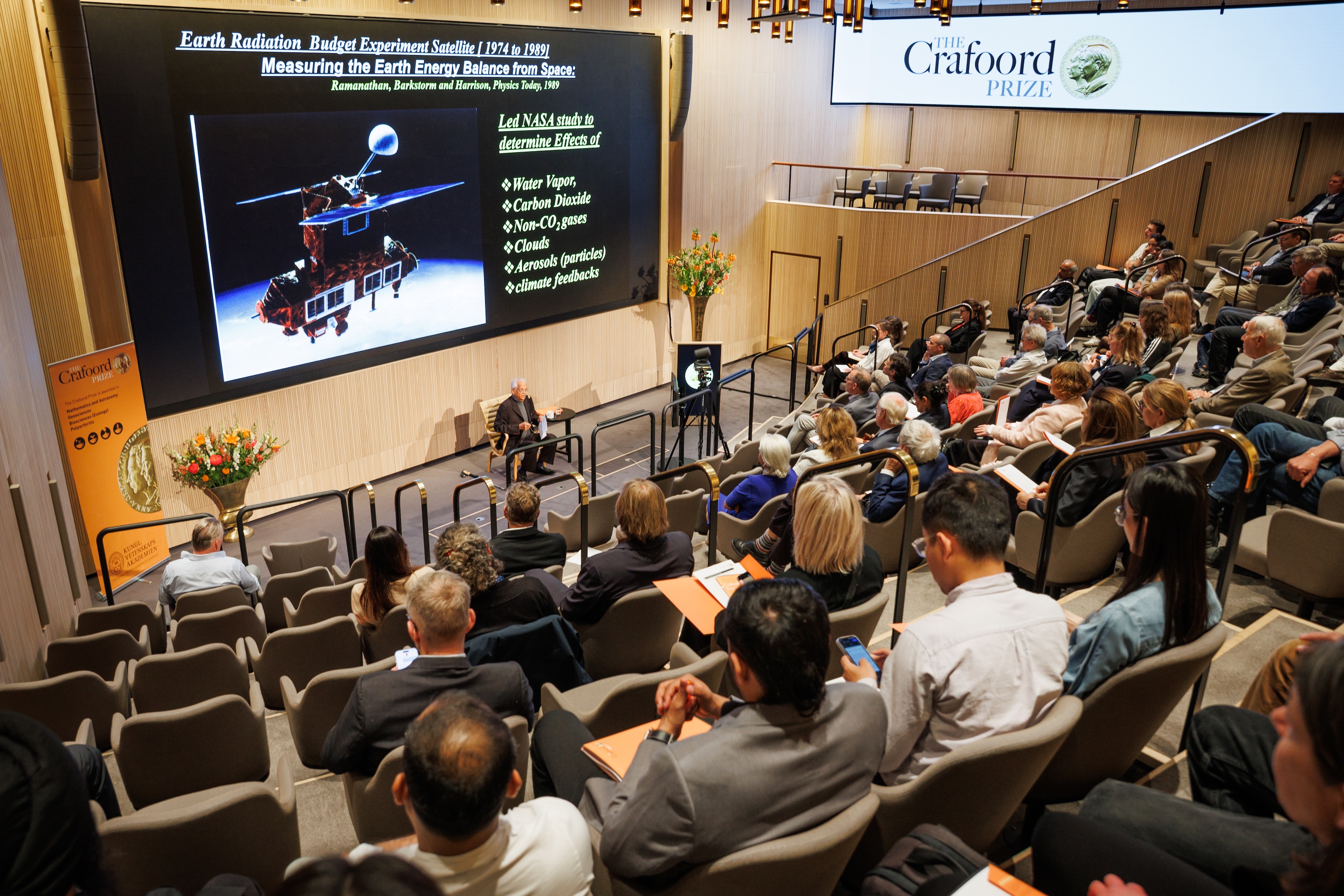
Prof. Veerabhadran Ramanathan, recipient of the 2026 Crafoord Prize in Geosciences, delivers the keynote lecture at the Crafoord Symposium on climate pollutants and Earth’s energy balance at the Royal Swedish Academy of Sciences in Stockholm. Photo: Fredrik Stål
Clouds above the Pacific, soot drifting from agricultural fires, polluted sea spray rising from warming oceans. At this year’s Crafoord Prize Symposium in Geosciences in Stockholm, leading climate researchers gathered to explore one of the defining scientific questions of our time: how aerosols, clouds and other climate pollutants are reshaping Earth’s energy balance, and what that means for societies around the world.
Held at the Royal Swedish Academy of Sciences in Stockholm, the symposium gathered leading atmospheric researchers from around the world under the theme Earth system impacts of climate pollutants. The 2026 Crafoord Prize in Geosciences was awarded to Professor Veerabhadran Ramanathan, distinguished professor at the Scripps Institution of Oceanography, “for fundamental contributions to our understanding of how aerosol particles and other climate pollutants influence the atmospheric energy balance and the earth system”.
Aerosols, black carbon, and clouds
Introducing the laureate, Henning Rodhe, professor emeritus at Stockholm University, described Ramanathan as “a true pioneer and world leader in climate change science”.
Rodhe traced Ramanathan’s scientific legacy from his groundbreaking work on chlorofluorocarbons (CFCs) in the 1970s to major international atmospheric experiments that transformed understanding of clouds, aerosols and climate pollutants.
Ramanathan’s own lecture moved between atmospheric physics, planetary science and questions of global inequality. Reflecting on more than five decades in climate science, he warned that warming is accelerating faster than society’s response.
“There are 3 billion poor who have suffered 75% of the losses so far from climate extremes, but their contribution is minimal, just five to 10%,” he said.
He also stressed the importance of engaging younger generations and strengthening public understanding of climate science.
“We need tremendous support for the people working on the aerosol cloud issue,” Ramanathan said during the audience discussion.
Yet the symposium was not defined by pessimism. Again and again, speakers returned to the idea that deeper scientific understanding also creates opportunities for action.
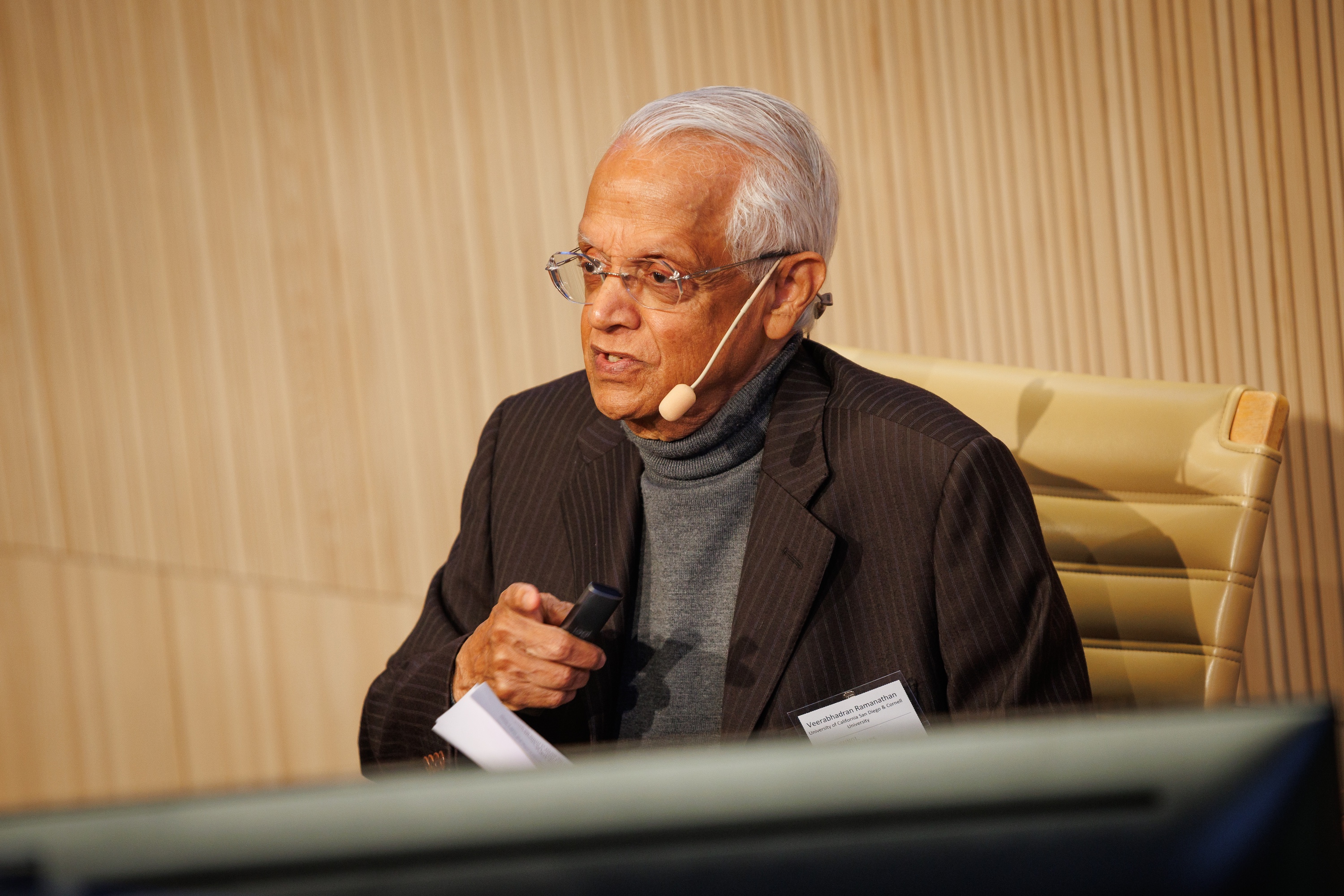
Prof. Ramanthan during his keynote lecture. Photo: Fredrik Stål
Örjan Gustafsson, professor at Stockholm University, focused on black carbon — soot particles produced by incomplete combustion from vehicles, biomass burning and household fuels. Tiny and chemically complex, black carbon affects climate, ecosystems and human health simultaneously.
“Black carbon is a wicked challenge,” Gustafsson said, describing it as one of the most difficult substances in atmospheric science because it behaves less like a single compound and more like a continuum of particles with different physical and chemical properties.
His talk drew on decades of atmospheric observations in South Asia and the Maldives, including work connected to the Maldives Climate Observatory Hanimaadhoo, which helped reveal how pollution travels across regions and oceans.
Clouds, still one of the greatest uncertainties in climate projections, became the focus of the final talks before lunch.
Climate scientist Sandrine Bony of CNRS and Sorbonne University explored how satellite observations and climate models have transformed scientists’ understanding of cloud feedbacks and climate sensitivity over the past three decades.
“The science is not done yet,” she said. “There are still many challenges.”
Earth’s energy imbalance, pollution, and health
After lunch, the symposium shifted focus toward Earth’s energy imbalance, cloud dynamics, air pollution and human health. Frida Bender, professor at Stockholm University, examined how cloud systems are already shifting in response to warming temperatures and human activity. Using satellite observations, neural networks and new high-resolution climate models, her research investigates how subtle changes in cloud structure alter the amount of solar radiation reflected back into space.
“Clouds matter,” Bender said.
The afternoon session also featured Gunnar Myhre of the CICERO Center for International Climate Research, whose research focuses on radiative forcing, aerosols and Earth’s energy imbalance. His presentation returned to one of the symposium’s central questions: how much excess heat the planet is now retaining, and how interactions between greenhouse gases, clouds and aerosols continue to shape the pace of global warming.
Atmospheric chemist Kimberly Prather of the Scripps Institution of Oceanography presented emerging research investigating how polluted sea spray aerosols may transport pollutants and biological material into the atmosphere as oceans warm and marine ecosystems change.
“We breathe 11,000 litres of air a day, and we don’t filter it like we do our water,” she said.
Her team’s experimental wave channel facility at Scripps Institution of Oceanography recreates ocean conditions in the laboratory to study how warming seas, algal blooms and pollution influence atmospheric chemistry and air quality.
Climate science beyond the laboratory
Throughout the day, speakers repeatedly returned to Ramanathan’s influence on modern climate science, not only through his discoveries in atmospheric physics, but through his efforts to connect climate research with public health, policy and social justice. The discussions moved constantly between molecules and societies, from cloud microphysics and aerosol particles to food security, inequality and the people most vulnerable to a warming world.
By the symposium’s close, one message lingered above all others: climate pollutants are not isolated environmental problems. They are woven into food systems, public health, inequality, energy production and the stability of the Earth system itself.
For professor Ramanathan, the challenge is ultimately measured not only in degrees of warming or atmospheric chemistry, but in human lives.
“Success should be measured in how many people we can save and protect,” he said.
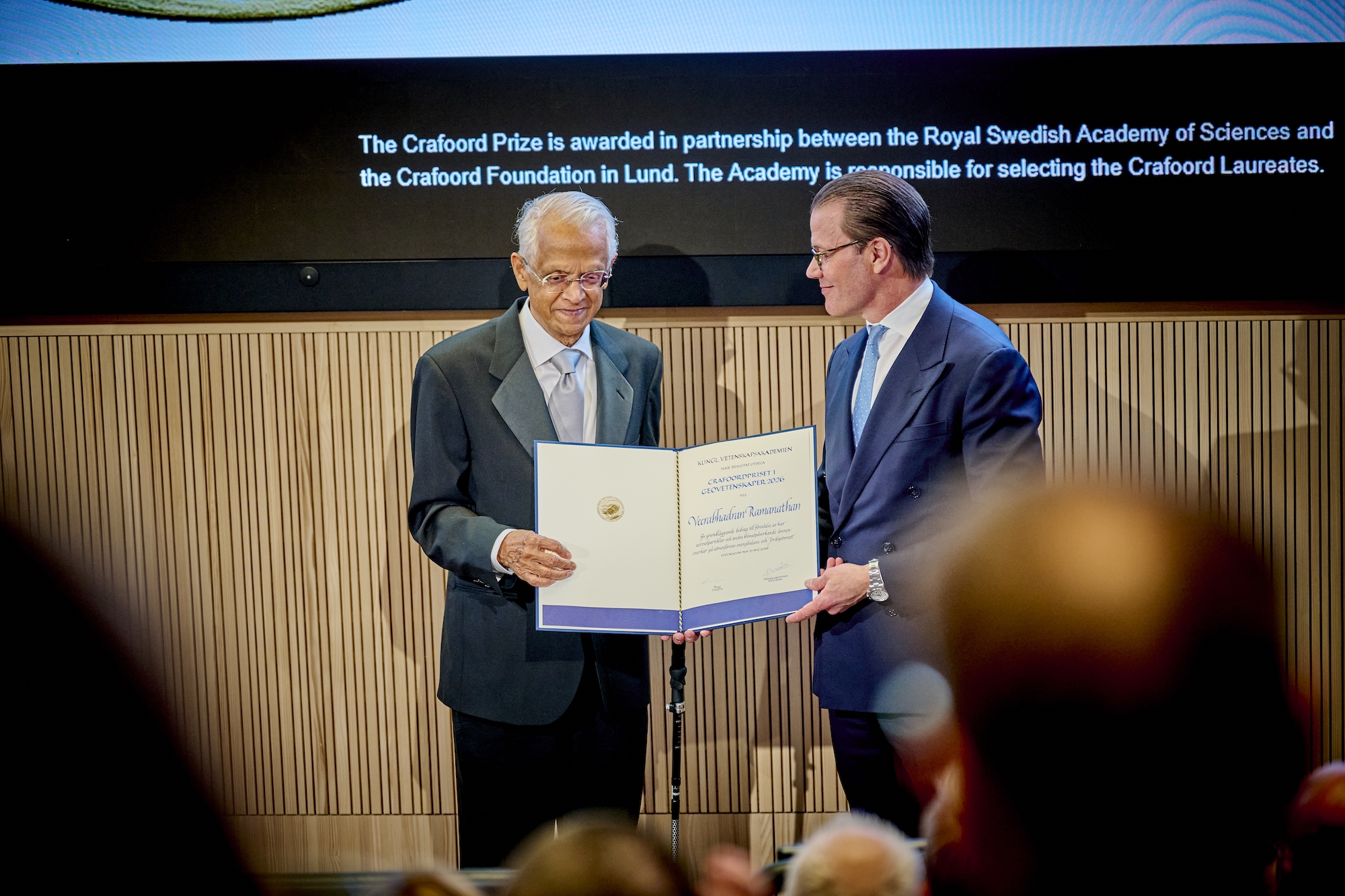
H.R.H. Prince Daniel presents the 2026 Crafoord Prize in Geosciences to climate scientist Veerabhadran Ramanathan during the award ceremony at the Royal Swedish Academy of Sciences in Stockholm. Photo: Patrik Lundin
Prize ceremony honours Prof. Ramanathan and young atmospheric researchers
The day after the symposium, researchers, academy members and invited guests gathered once again at the Royal Swedish Academy of Sciences in Stockholm for the official Crafoord Prize ceremony.
During the ceremony, Professor Ramanathan received the Crafoord Prize from H.R.H. Prince Daniel in a ceremony marked by musical performances and speeches reflecting on the significance of climate research in a rapidly changing world.
The event also recognised six early-career researchers who received fellowships and research grants in atmospheric science from the Anna-Greta and Holger Crafoord Fund, including Stockholm University researchers Sophie Haslett, Manoj Remani and Liine Heikkinen.
The Crafoord Prize is awarded jointly by the Royal Swedish Academy of Sciences and the Crafoord Foundation.
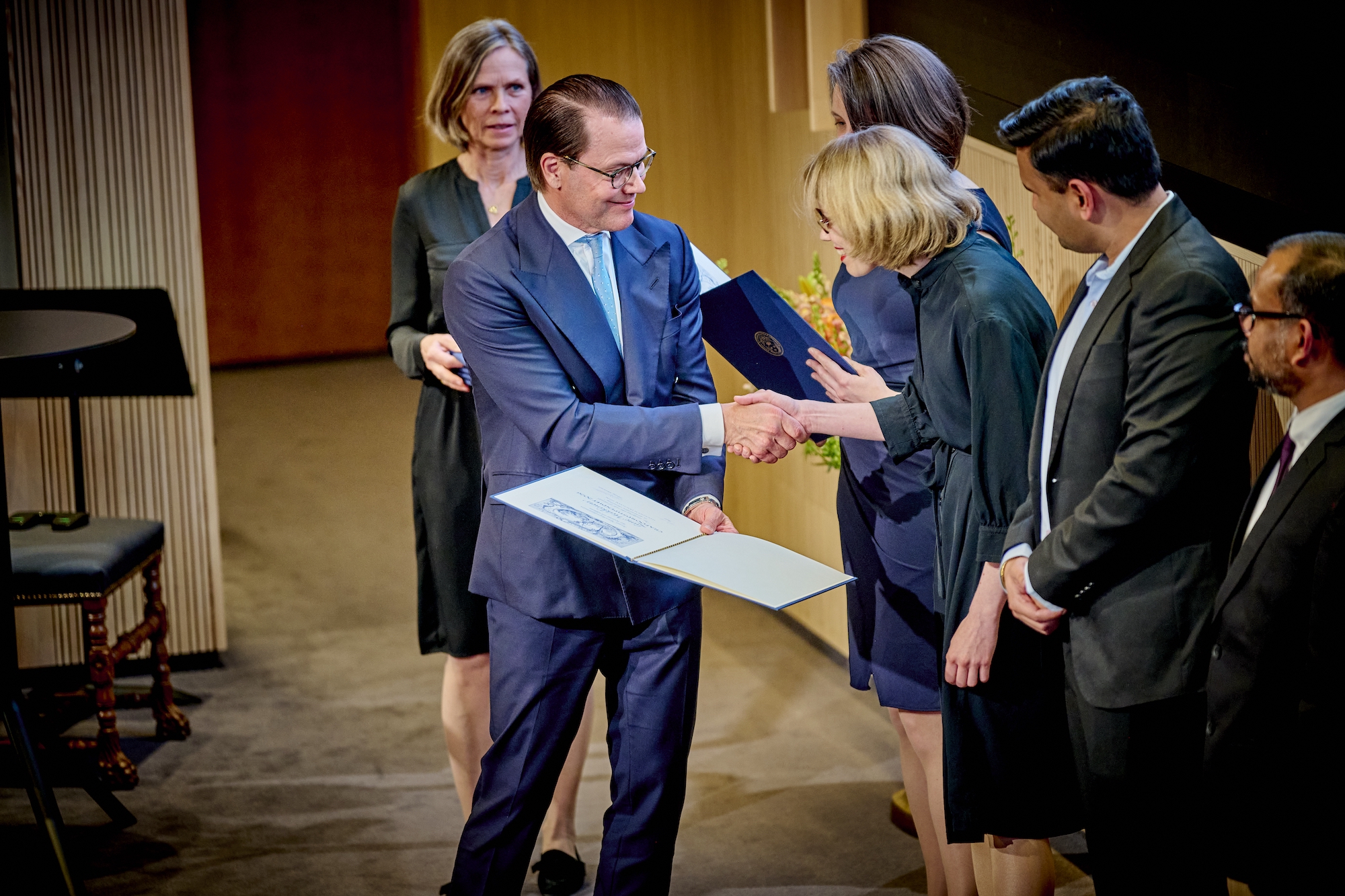
H.R.H. Prince Daniel presents fellowships and research grants in atmospheric science from the Anna-Greta and Holger Crafoord Fund to six early-career researchers during the Crafoord Prize ceremony. Photo: Patrik Lundin
A lonstanding connection to Stockholm University
The Bolin Centre for Climate Research at Stockholm University has collaborated closely with Ramanathan over the years. In 2018, he visited Stockholm as the Bert Bolin Climate Lecturer, delivering his widely recognised lecture ”Bending the Curve: Climate Change Solution,” which highlighted science-based pathways for addressing climate change and the importance of connecting research with policy and societal action.
The lecture later inspired the interdisciplinary Stockholm University course “Climate Change Solutions: Bending the Curve,” coordinated through the Department of Environmental Science and developed in collaboration with the University of California system. The course focuses on climate solutions across scientific, political, technological and societal dimensions, with the aim of helping students explore pathways toward a climate-neutral and sustainable society.
Ramanathan later served as a member of the Bolin Centre’s External Science Advisory Group during 2020 and 2021, contributing scientific advice and strategic perspectives that supported the Centre’s research development and international collaborations. Over the decades, he has also collaborated with several Stockholm University researchers through joint projects, publications and scientific exchange.
About the Bolin Centre for Climate Research
About the Crafoord Prize on the Royal Swedish Academy of Sciences's homepage
Last updated: 2026-06-01
Source: Department of Environmental Science