


Using new knowledge to hone future climate models
There is a pressing need for more accurate climate models to be able to predict future climate change. Ilona Riipinen is taking a new step toward refining climate models based on observations and experiments from recent decades.
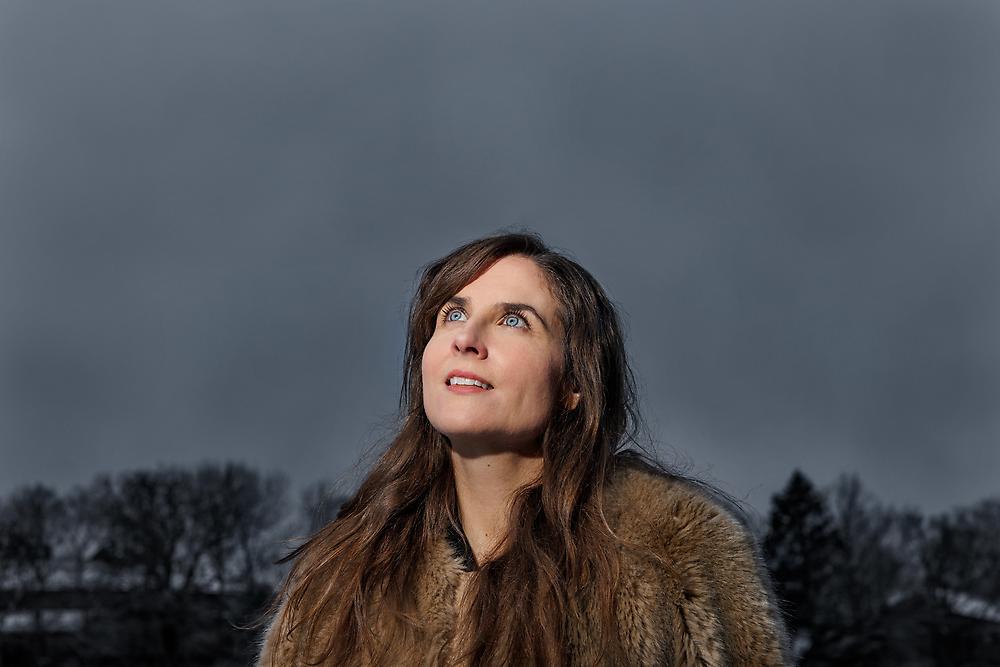
Ilona Riipinen, Professor of Atmospheric Science. Photo: Magnus Bergström
Ilona Riipenen, who is a Wallenberg Scholar, has gathered her research team around the task of coordinating more than twenty years of research on the atmosphere. She has been conducting research in atmospheric science at Stockholm University since 2011. In 2017 she became one of the university’s youngest professors.
“We have built cutting-edge expertise over the past 20 years – always with the goal of improving current climate models and the regional models that measure air quality,” says Riipinen, professor of atmospheric science.
She and her team are updating current climate models so they better describe how clouds, precipitation and particles affect the planet’s future.
Atmosphere full of activity
The atmosphere is the thin but life-sustaining layer of gases and particles that surrounds the Earth. Numerous chemical and physical processes take place in the gas layers, impacting everything from energy balance and climate to air quality.
Particularly important are the minute particles, aerosol particles, which contribute to cloud and ice formation in the atmosphere.
“When we talk about atmospheric aerosol particles and cloud formation, we often stress how complicated it is – it’s a very challenging field. Our goal is therefore to collate and simplify the knowledge we have about phase transitions in the atmosphere into useful numerical models.”
Even though the knowledge is simplified, she emphasizes that the research team is very keen not to lose scientific accuracy.
But there are numerous difficulties, not least the challenge of mathematically taking into account the differences between particles and gases of various kinds. The particles vary in size, reflect radiation to varying degrees, and also differ chemically. Gas molecules also vary in size and move in individual ways through the layers of the atmosphere.
“In principle, we ought to take all of this complexity into account. But that is not possible, so it’s important to be able to simplify the process in order to describe it numerically and mathematically. It’s an intellectually very exciting task,” she says.
Read full article at Knut & Alice Wallenberg Foundation´s website
Last updated: 2026-03-26
Source: Department of Environmental Science