


How a red locker at Stockholm University became a test of equality
A so-called RedLocker now sits near the entrance of the Geoscience Building at Stockholm University. Its bright red colour and deliberate placement work as an attention grabber as you walk past. What is it for, and what is the story behind it?
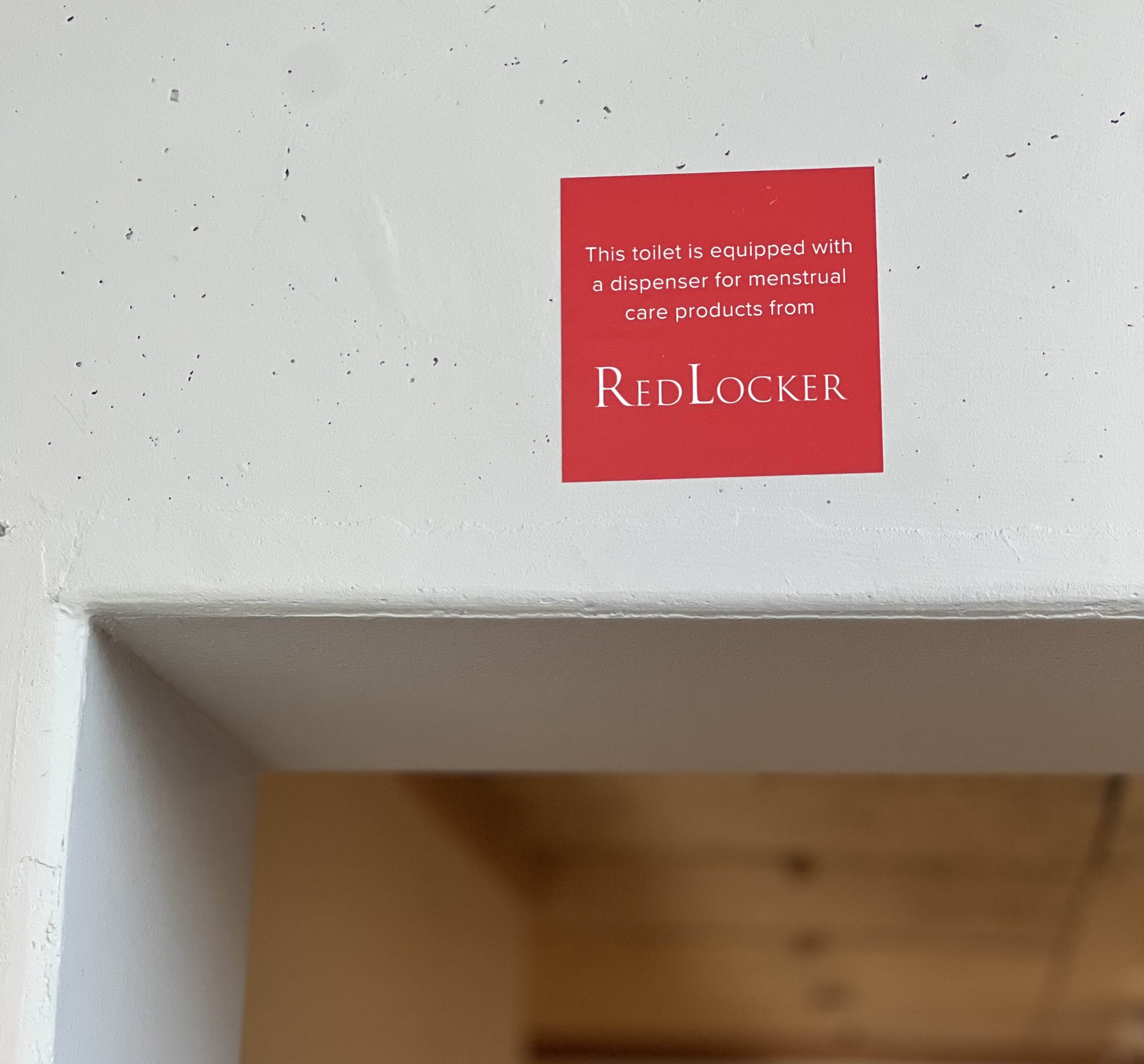
The RedLocker at Geosciences building is located near the washrooms on the ground floor. Photo: Stella Papadopoulou
Inside the locker are pads and tampons that are free to take, one at a time, whenever they’re needed. For months, it has had to be refilled almost every week.
At first glance, it looks like a small thing.
But the locker exists because a group of students refused to accept that menstruation—experienced by women, trans men, non-binary people, and others who menstruate—should remain a private inconvenience inside a public institution.
On International Women’s Day, under this year’s theme “Give to Gain”, the RedLocker offers a quiet example of what that exchange can look like in practice. Give something modest and practical, and what you gain isn’t abstract at all: focus, dignity, and an inclusive learning environment that works better for more people.
It began with a plastic bag
Long before the locker arrived, there was something far simpler.
“Someone had put up zip-lock bags with tampons and pads in the toilets,” says Isabelle Freijd-Olofsson, a master’s student in Environmental Management and Physical Planning at the Department of Physical Geography. She’s also the former chair of the student council SCEG, and was involved in the council’s RedLocker project group. “There was a small note on the zip-lock bags that said, ‘take one if you need one, leave one if you can’.”
No one knows who put them there. But they worked.
“They were never empty. There were always some products left. So obviously, it worked,” Isabelle continues.
That quiet act of care raised an obvious question. If students were already taking care of each other in this way, why wasn’t the university doing it openly—and properly?
In December 2022, students within SCEG began trying to turn the informal solution into something permanent. The initiative was started by the then vice-president Annie Garnell, who reached out to RedLocker, a Swedish company that provides lockable dispensers for free menstrual products. A project group within SCEG was formed so several students could work together toward the goal and apply for grant financing. What followed was a long stretch of meetings, applications, and uncertainty.
Agreement was never the issue
No one, Isabelle recalls, argued that the idea itself was wrong.
“It was never that people said this was a bad initiative,” she says. “It was more like: yes, this is great, but who should be responsible?”
That question proved harder to answer than expected. Student councils couldn’t be invoiced. The student union SUS traditionally funded social activities and initiatives rather than services to students. Departments hesitated. Responsibility moved in circles.
“We spent a long time just contacting people and trying to figure out who could actually pay,” Isabelle says. “And who was allowed to.”
At one point, funding from the student union SUS was approved. Later, it was denied again.
“We realised we couldn’t rely on grants that had to be renewed yearly,” she continues. “So we had to become an organisation ourselves.”
Then SCEG applied for an organisational number—something none in the group had imagined would be necessary just to provide menstrual products. They also carried out a petition, gathering more than 170 signatures from students across the university, and wrote and presented a motion to the SUS Representative Assembly.
“We wanted to show that this wasn’t just us,” Isabelle says. “That students actually wanted this on a broader scale.”
Short-lived solution
Eventually, RedLocker proposed a temporary fix: a private sponsor would fund one dispenser and supplies for three years.
“We didn’t even know who the sponsor was at first,” Isabelle says. “We were just told we’d need to put a sticker on the locker.”
The sponsor turned out to be another Swedish company working with personal safety products. The locker was finally installed. Supplies arrived. And students were using it constantly.
Then, almost as quickly, it unravelled.
“The email came the day after I’d talked about how we might move forward,” says Niccolò Mattiotti, a master’s student in Environmental Toxicology and Chemistry at the Department of Environmental Science and current vice chair of SCEG. “They told us we had ten days to decide whether we’d start paying monthly or remove the locker.”
For a student council, neither option was realistic.
“That’s when it became very urgent,” he says.
Something finally shifted
This time, the students contacted SUS again—directly at leadership level—as they had also been granted a locker through the same sponsorship.
“The response was immediate,” Niccolò says. “They just said yes. They said they would fund it.”
After years of uncertainty, the simplicity of the answer mattered.
“It felt like the wind had changed,” he says.
What changed wasn’t the need. It was the recognition that giving something small could return something much larger.
More than an emergency
Officially, the RedLocker is meant for emergencies. A built-in timer limits how often products can be taken.
But its steady use tells another story. Cultural preferences play a role. So does cost.
“Menstrual products are a fixed expense,” says Alva Åkerlind, a master’s student in Marine Geology at the Department of Geological Sciences and current chair of SCEG. “You can’t opt out of that cost.”
The locker doesn’t eliminate economic inequality. It doesn’t pretend to. But it does remove stress from moments that are already charged.
“If it happened during a lecture and I didn’t have anything with me,” Isabelle says, “I would completely lose focus. I’d feel very stressed and insecure, just wanting to leave and go home as quickly as possible.”
For some students, that moment is even lonelier.
“I’ve been the only person who menstruated in a classroom before,” Alva says. “Then there’s not even someone you can ask for a product if you need one.”
Why visibility matters
The locker’s placement is no accident.
“It’s a big red locker in everyone’s face,” Isabelle says. “And I think that’s important.”
Its visibility sends a message not only to people who menstruate, but to everyone else as well. Menstruation exists. It’s normal. A reality for much of the human population.
“I hope it signals that this is okay to talk about openly,” Isabelle says. “That it’s not something you should feel ashamed of or embarrassed about.”
For Niccolò, who does not menstruate, the value of the locker lies in the environment it helps create.
“It’s not something I can experience myself,” he says. “So it’s about understanding people around you and supporting them.”
That support, he argues, has immediate effects.
“If people feel more comfortable in their environment,” he says, “they’re more social. They’re more present.”
What Give to Gain looks like on the ground
There are still only two RedLockers across the university.
“This is very limited,” Alva says. “A lot of people still miss out.”
No one involved claims the locker is a complete solution. But they do see it as proof of concept.
“This is a small thing,” Isabelle says. “But that’s exactly why it matters. Small things often have a big impact.”
International Women’s Day often invites institutions to speak in broad terms about equality, opportunity, and progress. The RedLocker’s response to “Give to Gain” is that sometimes, giving doesn’t look like policy reform or a long-term strategy. Sometimes, it’s as simple as demystifying a basic bodily function and making sure no one’s studies are negatively impacted because of it.
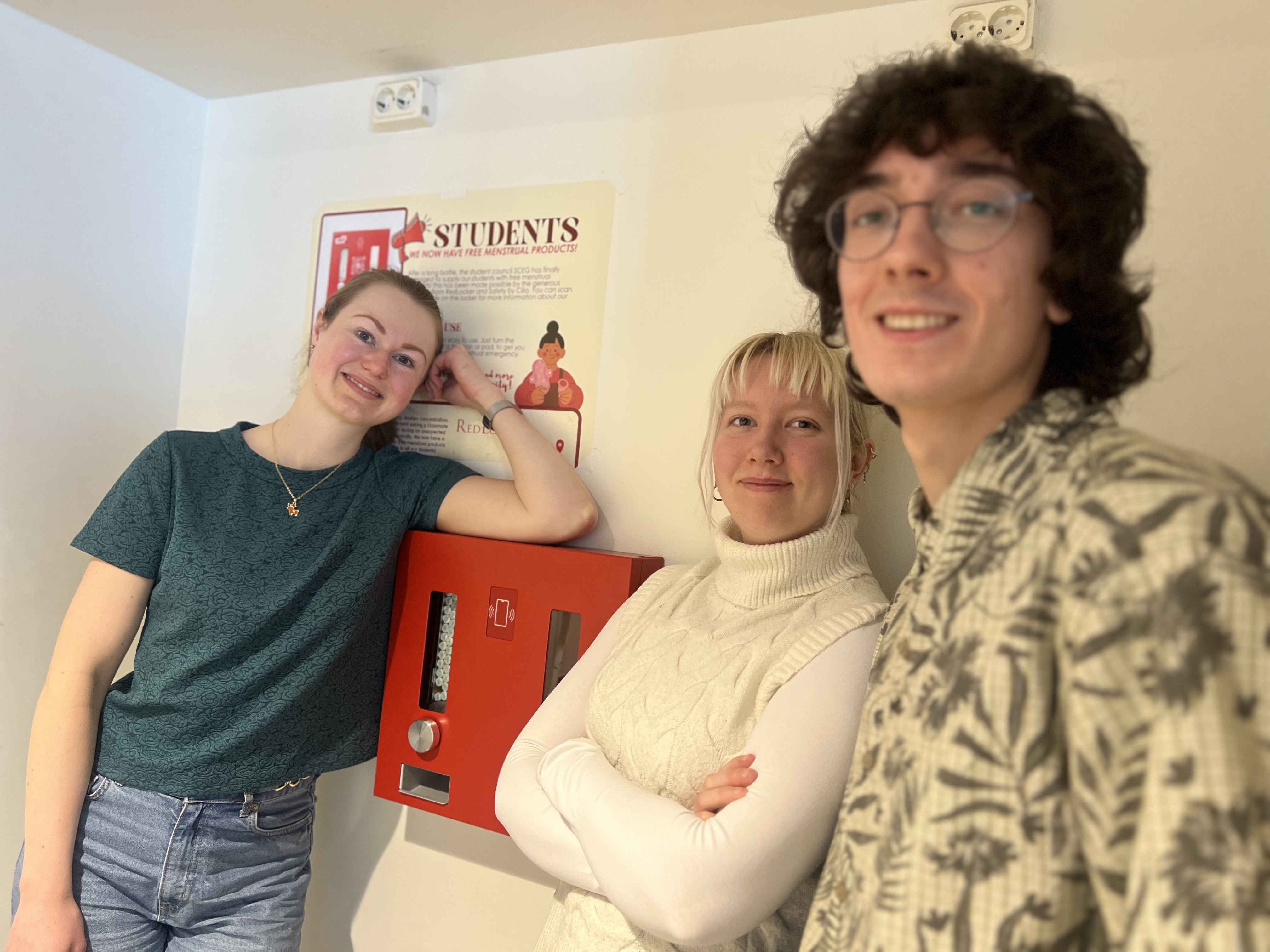
Isabelle Freijd-Olofsson (left), Alva Åkerlind (centre), and Niccolò Mattiotti by the RedLocker at the Geosciences Building. Photo: Stella Papadopoulou
Last updated: 2026-03-08
Source: Department of Environmental Science