


Tiny organisms play a big role in transporting carbon to the depths of the Baltic Sea
Tiny photosynthetic organisms in the Baltic Sea can contribute substantially to the transport of carbon from surface waters to deeper parts of the sea. A new study from the Department of Ecology, Environment and Plant Sciences (DEEP) at Stockholm University shows that their ability to form colonies and aggregates is an important factor determining how much of their biomass sinks.
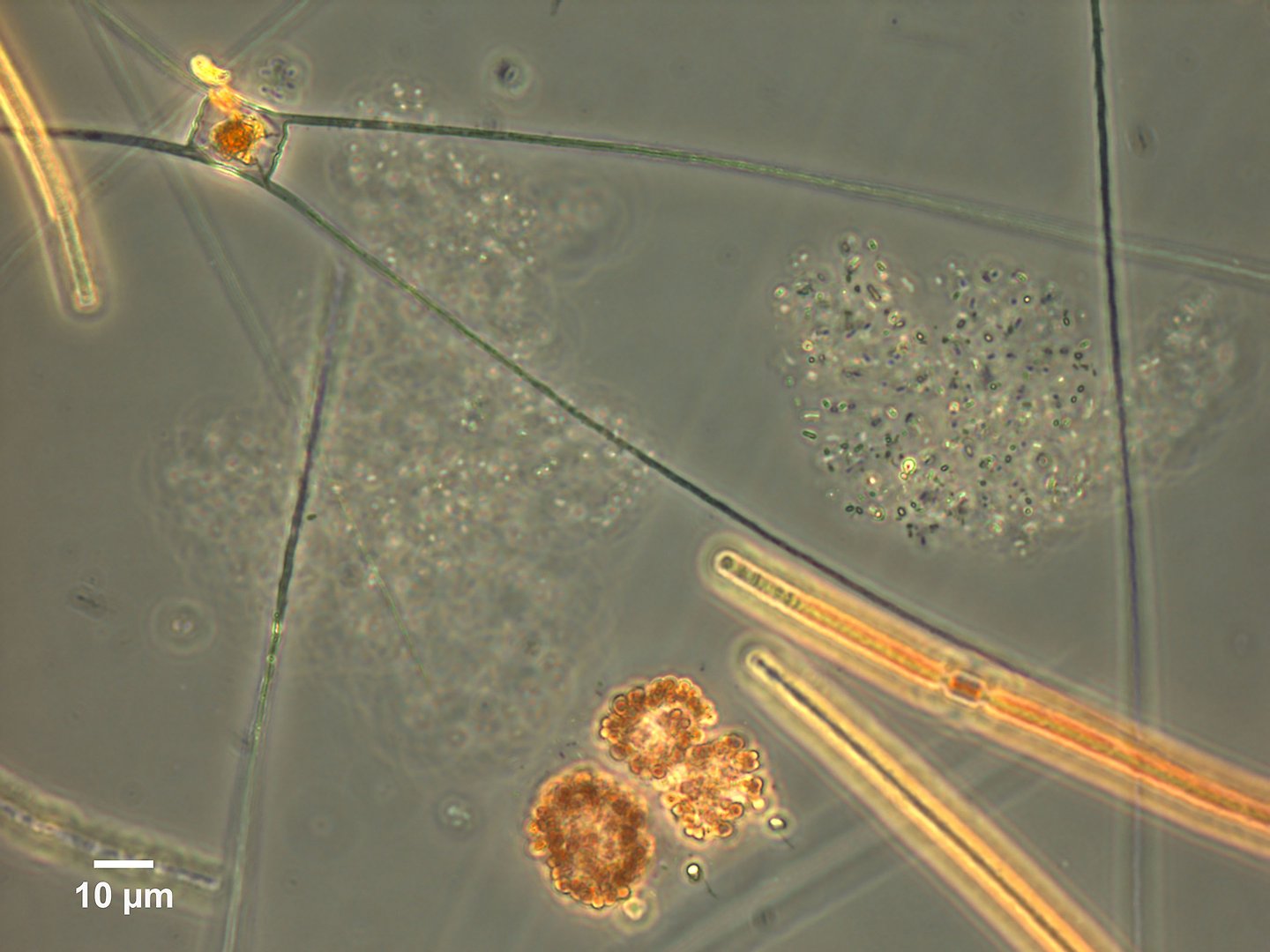
Micrograph of phytoplankton from Landsort Deep, BY31, the long term monitoring site of the Baltic Sea where samples were taken for the reported study. In the upper left corner is a large diatom, Chaetoceros danicus, distinguished by its long spines protruding from the cell, a few large colonies and aggregates of picocyanobacteria lie in the background, and in the bottom middle are two pigmented and compacted colonies of the cyanobacteria Woronichina next to two filaments of the N2-fixing cyanobacteria Aphanizomenon. Image: Helena Höglander, co-author and researcher at the Marine Ecological Laboratory (MEL) at DEEP.
Phytoplankton play a central role in the ocean’s carbon cycle by taking up carbon dioxide through photosynthesis – approximately half of global photosynthesis is attributed to phytoplankton. When this biomass sinks from surface waters towards the depths below, carbon is transported with it. This process, known as the biological pump, is an important part of the global carbon cycle, and has a major role in regulating atmospheric CO2 levels. In addition, remineralization of sinking phytoplankton is the direct cause of anoxic bottom waters in coastal seas such as in the Baltic Sea. Lead author Martin Ekman explains:
Martin Ekman. Photo: Stefan Zimmerman
In this study we have shown that in situ aggregation properties vary among picocyanobacterial strains, and that the degree of aggregation directly determines the magnitude of export. Given that picophytoplankton are expected to increase in abundance in a warmer and more nutrient poor (stratified) ocean, understanding mechanisms allowing their biomass to be exported to the deep ocean is important for predicting future atmospheric CO2 levels.
Different strains behave differently
In collaboration with the Marine Ecological Lab (MEL), the researchers followed picocyanobacteria in the Baltic Sea during spring and summer, sampling surface waters as well as water at 25 and 75 meters depth. Additionally, they took samples using sediment traps, which were moored below the surface sunlit zone and collect particulates that are sinking. They combined microscopy and flow cytometry with genetic analyses of water samples and material collected in sediment traps. Key to their study was the sampling strategy of separating the particulates in the water samples by size fractionation. Larger cell diameters (>10µm , large fraction) were collected on one filter, and the small cells passed and were collected in a second in line filter (0.2 µm, free fraction). Both fractions were prepared for sequencing.
Professor Rachel Foster, co-author of the study. Photo: Delphine Ménard
They found that picocyanobacteria made up a large proportion of the phytoplankton community and that their contribution to exported biomass was broadly proportional to their abundance in surface waters. But the researchers also found clear differences between strains of the picocyanobacterium Synechococcus.
Some strains were more frequently found in the larger fraction and in material collected by sediment traps, indicating that they were more prone to form colonies or aggregates and subsequently sink. A strong relationship between aggregation and sedimentation suggests that the tendency to form larger colonies/aggregates directly determines how much of a particular strain is exported from surface waters.
The study also found seasonal differences between colony-forming and predominantly single-cell strains. This suggests that the ability to aggregate may be an important ecological trait, potentially affecting how different strains respond to changing environmental conditions.
Important for understanding a changing ocean
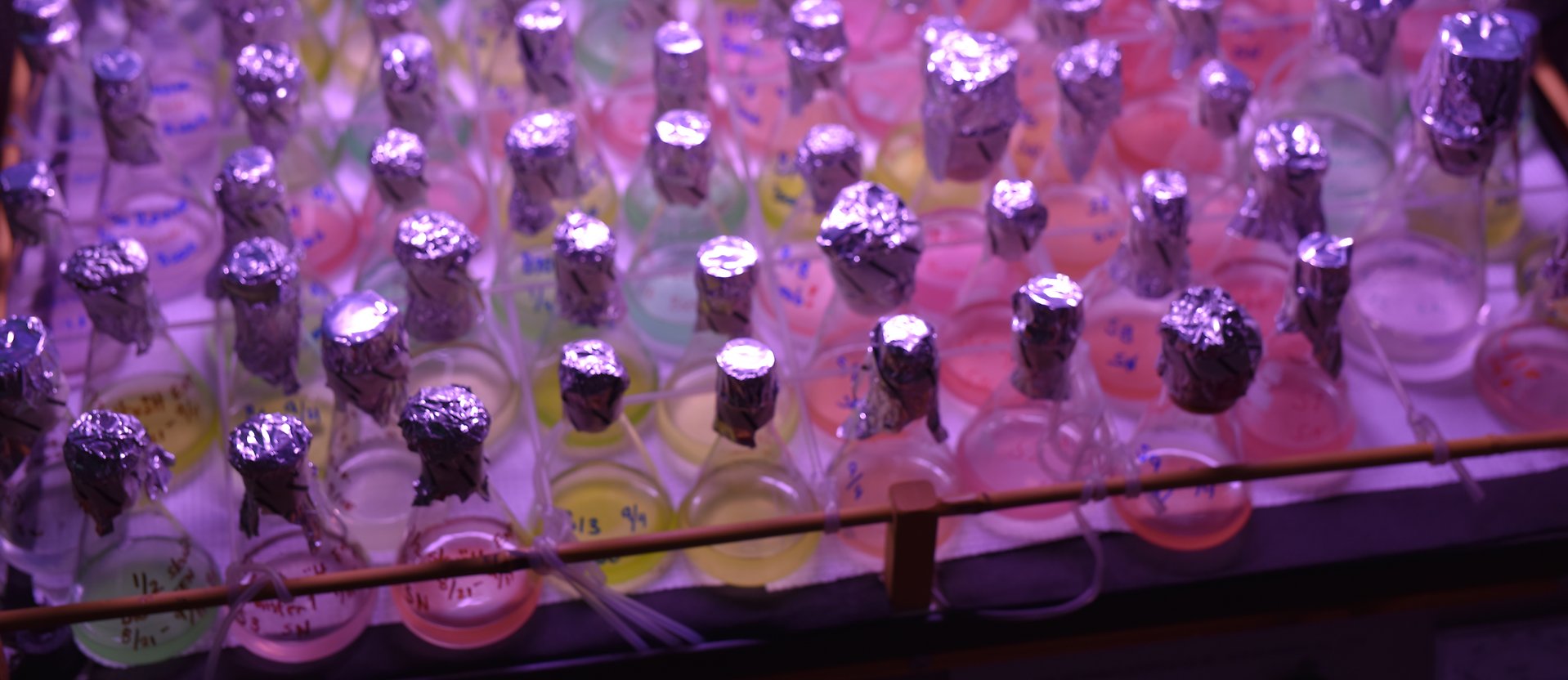
Photo: Delphine Ménard, research engineer at DEEP.
The researchers point out that picophytoplankton are expected to become more abundant in warmer, more strongly stratified and nutrient-poor oceans, conditions which are predicted in the future oceans. Understanding how their biomass is exported is therefore important for predicting how marine carbon cycling may change in the future.
The study was carried out at Landsort Deep in the Baltic Sea, where long-term monitoring has provided more than 30 years of observations. The researchers suggest that similar aggregation processes should be investigated in other regions where picophytoplankton are abundant, including the open ocean. Co-author Professor Rachel Foster comments:
An important part of the work was the opportunity to find consistency in our results with the long-term trends from the monitoring data of the MEL, these datasets are such an invaluable resource, especially in the context of climate change. We are excited to look to new regions of the ocean for similar trends.
more iNFORMATION
Read the press release on EurekAlert and AlphaGalileo.
For media requests, please contact the DEEP press contact Laila Islamovic.
Last updated: 2026-10-07
Source: Department of Environmental Science,Department of Ecology, Environment and Plant Sciences