


Long-term SNSA funding secures Sweden’s role in global satellite validation and climate research
Stockholm University has been awarded continued funding from the Swedish National Space Agency (SNSA) to operate the AERONET-OC station at Pålgrunden in Lake Vänern (Figure 1) through 2029. The project is led by Associate Professor Susanne Kratzer (DEEP) and secures the long-term operation of a key reference stations for satellite-based remote sensing in optically-complex waters. The station is part of the global AERONET-OC network coordinated by NASAand the Joint Research Centre, and provides highly standardised reference measurements used to validate ocean-colour data from all major space agencies operating aquatic Earth-observation missions, including ESA, EUMETSAT, JAXA, KIOST and CNSA (See Table 1 at the end of this article).
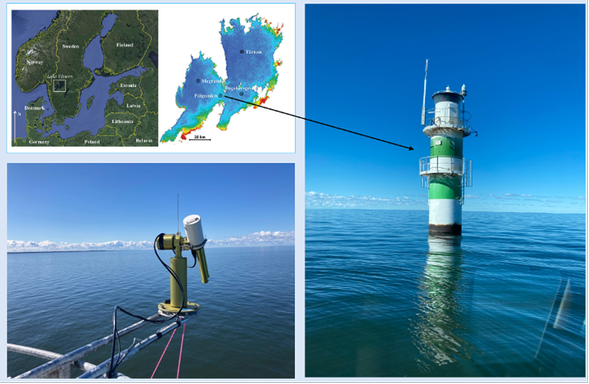
Figure 1) The Palgrunden AERONET-OC station has been operational since 2008 on the light house Pålgrunden in Lake Vänern (right picture). The CIMEL CE-318-T above-water autonomous sun photometer (left picture) is installed on the light house at about 5 m height. The water depth around the tower is about 9 m. Photos by Niklas Strömbeck (site manager); map by Petra Philipson.
Palgrunden: a strategically important high-latitude observatory for climate research
The Palgrunden station is unique as the only AERONET-OC site located in a boreal, highly absorbing freshwater lake and one of very few stations at high northern latitudes. In addition to its essential role in validating Copernicus Sentinel-2 and Sentinel-3 products for Nordic and Baltic waters, the station provides long, high-quality time series of atmospheric and aquatic optical measurements that are increasingly important for climate-change research. These data support the detection of long-term changes in aerosols, light climate, and water-colour characteristics, and contribute to international efforts to establish aquatic reflectance as an Essential Climate Variable.
A broader contribution to Swedish research
Beyond its scientific and societal relevance, the award is also notable in a broader structural context: recent SNSA statistics indicate that only around 13 % of projects within the Agency’s commitments to international space missions are led by women as principal investigators. The Palgrunden grant therefore represents both a strategic investment in national research infrastructure and a visible contribution to strengthening leadership diversity within Swedish space-related research.
Without long-term, quality-assured validation, satellite time series cannot be reliably used to study ecological change. The Palgrunden station allows us to investigate potential climate-driven shifts in phytoplankton dynamics and underwater light conditions in Nordic waters.
– Susanne Kratzer, Associate Professor, Department of Ecology, Environment and Plant Sciences, Stockholm University
| Acronym | Full name |
|---|---|
NASA | National Aeronautics and Space Administration (USA) |
ESA | European Space Agency |
EUMETSAT | European Organisation for the Exploitation of Meteorological Satellites |
JAXA | Japan Aerospace Exploration Agency |
KIOST | Korea Institute of Ocean Science and Technology |
Last updated: 2026-01-15
Source: Department of Environmental Science,Department of Ecology, Environment and Plant Sciences