


DEEP Advanced Seminar Series (DASS) with Prof. Brian Enquist
Welcome to the DEEP Advanced Seminar Series (DASS) with Prof. Brian Enquist from the University of Arizona. This time on Wednesday the 27th of May in Vivi Täckholm, followed by a fika in the lunchroom.
The Megabiota set the pace of the biosphere: a scaling theory of resilience under global change
The Anthropocene removes the upper tail of life. The largest animals and plants—the megabiota—concentrate a large share of biomass and regulate a large fraction of energy and nutrient flux. I argue that they set the pace of the biosphere and function as control variables of ecosystem state. I develop a synthesis that links macroecological regularities and recent work that formalizes a theory of resilience. Ecosystems occupy a feasible region defined by size spectra, abundance distributions, and flux–biomass relations. Disturbance is size-selective. It mainly truncates the upper tail of the size distribution and shifts the diffusion of states toward lower biomass and lower throughput. This framework yields numerous predictions regarding extinction risk, abundance, turnover and how reductions in the megabiota reduces system-level metabolism and fertility because flux scales nonlinearly with body size and total biomass. Lastly, extensions of the theory show how size distribution provides a quantitative signature of change and resilience. Truncation of the upper tail, steepening of the spectrum, and reduced variance signal loss of function and slower recovery. There are several implications for rewilding efforts. This synthesis replaces qualitative stability metaphors with a quantitative, size-structured theory. It positions the size spectrum as both mechanism and metric, and identifies megabiota as the primary levers of biosphere function. The implication is direct. Manage the upper tail of size distributions, protect and restore large trees and animals, to stabilize ecosystem services, increase resilience, and improve recovery under global change.
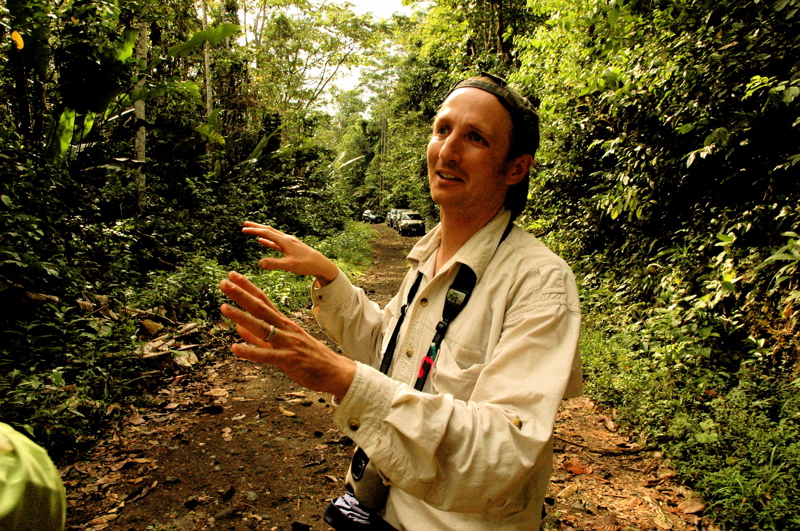
Professor Brian Enquist. Photo: Edward Gray
About the speaker
Dr. Enquist is a broadly trained ecologist and botanist whose research investigates the origin, organization, and maintenance of plant diversity and the functioning of the biosphere. His work integrates plant functional traits, macroecology, and ecological theory to develop predictive frameworks that link plant form, function, and environment across scales.
He and his collaborators have helped propose and advance Metabolic Scaling Theory, a mechanistic and trait-based framework that explains how biological rates and fluxes scale from cells and organisms to ecosystems. This work provides a quantitative foundation for understanding how plant size, architecture, and resource-use traits shape growth, carbon cycling, and ecosystem functioning. Applications of this research are used to assess how climate change propagates through biological systems to influence biodiversity patterns and ecosystem processes. His lab also leads the Botanical Information and Ecology Network (BIEN), an international collaboration that develops open-source workflows to integrate global plant distribution and trait data. BIEN enables large-scale analyses of plant biogeography, extinction risk, and ecosystem responses to global change.
He has published over 300 scientific papers. He is the recipient of a Fulbright Scholarship, the Ecological Society of America’s MacArthur Award and Mercer Award. He was the receipient of the National Science Foundation CAREER Award, and was named one of Popular Science’s Brilliant 10 young scientists. He has held fellowships at Charles University in Prague, the CNRS in Montpellier, France and the Oxford Martin School fellow, Oxford University, UK.
Dr. Enquist received his PhD in Biology from the University of New Mexico with James H. Brown. He is currently a Professor in the Department of Ecology and Evolutionary Biology at the University of Arizona and an External Faculty Member of the Santa Fe Institute.
Last updated: 2026-05-05
Source: Department of Environmental Science,Department of Ecology, Environment and Plant Sciences