


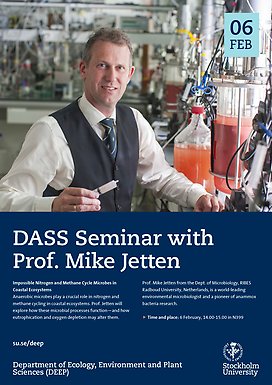
DASS Seminar with. Prof Mike Jetten from RIBES at Radboud University
The Department of Ecology, Enivronment and Plant Sciences (DEEP) at Stockholm University warmly welcomes you to the spring term of the DEEP Advanced Seminar Series (DASS), which is open to all and is first come first seats. Always at 14-15:00 in N399. A fika follows in the lunchroom.
We are excited to announce that the February DASS Seminar will be presented by Prof. Mike Jetten from the Department of Microbiology and RIBES at Radboud University, Nijmegen, Netherlands. The title of this seminar will be: "Impossible Nitrogen and Methane Cycle Microbes in Coastal Ecosystems."
Abstract
During the evolutionary history of our planet, a set of microbial processes that evolved exclusively in the absence of oxygen changed the chemical speciation of all major elements. In the past 20 years, we aimed to discover and elucidate the role of these anaerobes in the microbial nitrogen and methane cycle in several dynamic coastal ecosystems (Bothnian Sea, Stockholm Archipelago & Marine Lake Grevelingen) where terrestrial and marine systems converge. However, these ecosystems face increasing challenges, including eutrophication and oxygen depletion, potentially causing shifts in the nitrogen and methane transformation processes. We explored the intricate microbial pathways governing microbial nitrogen and methane cycling by integrating metagenomic analyses, pore water profiling, sediment incubations, and bioreactor enrichment strategies. Molecular studies showed that anammox bacteria occur in many oxygen-limited ecosystems, and that they can make the rocket fuel hydrazine by novel protein complexes. Depending on the nutrient status, the anammox process can contribute significantly to the loss of reactive nitrogen. Using sediment of the Gullmar Fjord, we were able to enrich and characterize marine anammox bacteria. Lastly, we are exploring the removal of ammonium and methane from anoxic sediments with solid electron acceptors, in an attempt to find and enrich one of the remaining elusive impossible chemolithotrophic N and CH4 cycle microbes missing in nature.
Short CV MSM Jetten
Prof Jetten (1962) is a world leader in the field of environmental microbiology. He did his PhD (1991) on aceticlastic methanogens, followed by a post doc at MIT on metabolic engineering of amino acid producers. From 1994-2000 he was assistant professor at TU Delft on Nitrogen cycle microbiology. Since 2000 he is professor of Microbiology at Radboud University, Nijmegen. He received the prestigious ERC Advanced Grant in 2008 for his research on anammox bacteria, the Spinozapremie in 2012, and a second ERC Advanced grant in 2013 to study the ecology of methane oxidizers. Since 2013 he has been scientific director of the Gravitation excellence consortium on anaerobic microbiology (Soehngen Institute of anaerobic microbiology).
He is a member of the Royal Netherlands Academy of Sciences, the European Academy of Microbiology and EMBO. In 2013 he was bestowed with a knighthood for his exceptional services to science and society. In 2017, he was recognized as an exceptional mentor and awarded with best PhD supervisor of the year by the National PhD council in the Netherlands. In 2019 he was awarded an ERC Synergy grant, and in 2022 he received an honorary doctorate from the Delft University of Technology. He has published more than 600 papers that have been cited more than 90000 times. FWIW H index is 145. He has supervised 72 PhD theses and 43 post docs, and 5 PhD students and 2 post docs are currently working at the Raboud University laboratories. In September 2015, his team started the first Microbiology master education in the Netherlands. In 2022, the Royal Netherlands Society for Microbiology named an award after him for the best master’s thesis in microbiology. He has been invited more than 300 times for keynote lectures and organized many international meetings and conferences. He holds several patents.
Last updated: 2026-01-15
Source: Department of Environmental Science,Department of Ecology, Environment and Plant Sciences