During your studies

For students at the Department of Culture and Aesthetics.
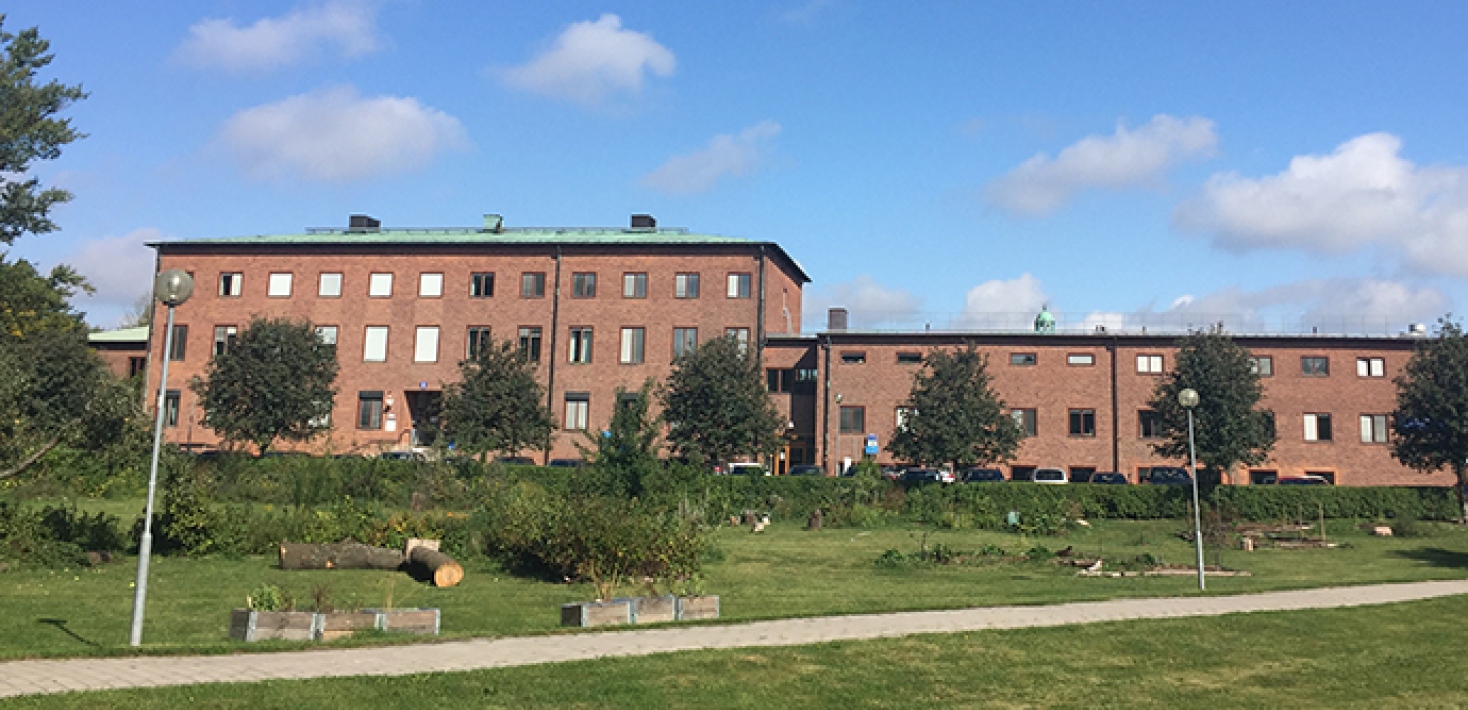
The department is housed in three-storey brown brick buildings.

The main entrance to the Department of Culture and Aesthetics.

Location

The Department of Culture and Aesthetics is situated in the Manne Siegbahn Buildings at Campus Frescati, on Frescativägen 22B-26.

During the Semester, our opening hours are
Monday–Thursday 07:45–20:00
Fridays 07:45–17:00

Find us

University premises are specified, with a few exceptions, by a letter followed by three numbers. The letters and the first number signify which house and which floor the room is located on. The last two numbers specify which room it is. For example; MSH A 119 means the Manne Siegbahn houses, house A, 1st floor and room 119. 

The majority of all our lectures and seminars are held in the Manne Siegbahn houses at Frescativägen 22B-26. The following rooms are located there:

Frescativägen 24E MSH A, main entrance

  • The auditorium (215), House A, 2nd floor, (ground level). Accessibility: Use the entrance on Frescativägen 24D (entrance on the side of the building). Wheelchair ramp is available.
  • The Library (300), House A, 3rd floor Accessibility: Use entrance on Frescativägen 24F. Stairlift to 1st floor and then lift from there to the 3rd floor. 
  • Conference Room (328), House A, floor 3 Accessibility: Use entrance on Frescativägen 24F. Stairlift to 1st floor and then lift from there to 3rd floor. 

Note that the stairlift only take up to 225 kilograms. People with heavier mobility aids, like an electric wheelchair, should use Frescativägen 24B at the back of the building. The entrance leads directly to 1st floor where you will find a lift to the rest of the building.

Frescativägen 24F MSH A-B

  • Class room 101, house A, 1st floor (basement floor) Accessibility: Use the entreance at Frescativägen 24F. Stairlift down to 1st floor. 
  • Class room 119, house A, 1st floor (basement floor) Accessibility: Use the entreance at Frescativägen 24F. Stairlift down to 1st floor.
  • Seminar room 159, house A, 1st floor (basement floor Accessibility: Use the entreance at Frescativägen 24F. Stairlift down to 1st floor.
  • Class room 144, house A, 1st floor (basement floor) Accessibility: Use the entreance at Frescativägen 24F. Stairlift down to 1st floor. 

Note that the stairlift only take up to 225 kilos. People with heavier mobility aids, like an electric wheelchair, should use Frescativägen 24B at the back of the building. The enterence leads directly to 1st floor where you will find a lift to the rest of the building.

Frescativägen 26 – MSH C

  • Seminar room 509, house C, 5th floor (top floor) Accessibility: The lift from ground level can be reached via the entrance on the right-hand side of the building. The lift is at the end of the corridor.
  • Room 508, house C, 5th floor (top floor) Accessibility: The lift from ground level can be reached via the entrance on the right-hand side of the building. The lift is at the end of the corridor.

Frescativägen 22B – The Manne Sieghban villa

  • The Musicology Library (305), 3rd floor, (upper floor)

Accessibility: Only by staircase. Possible route could be via Frescativägen 24B, lift to the 3rd floor in the A building and then via walkway to the villa. This route doesn’t have any door openers which means that assistance is needed. 

Study spaces.

Social areas at our department.

There are several areas, both at the Department and around campus, where you can sit down and study, alone and in a group.

There are working places outside of our seminar rooms 101 and 119, as well as outside of seminar room 144. There is a sofa and table on floor 4 in the Manne Siegbahn Building A. 

There are study places outside Aula Magna and couches and tables in Södra huset. The University Library offers a lot of study and reading places and separate rooms to book. 

The University Library

Stockholm University has free wireless networks all over campus.

Information and how to log on

Kitchenette.

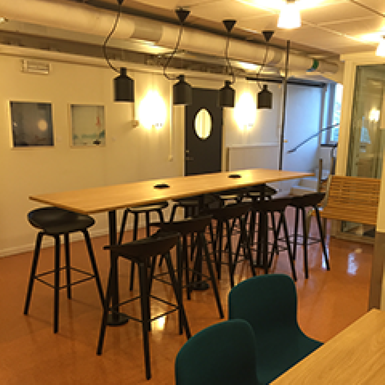
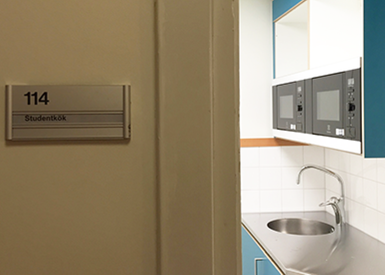
Kitchenette for students.

On floor 1 in Manne Siegbahn Building A is a small kitchen where our students can heat their lunch box. This pentry is placed between seminar rooms 101 and 119.

Right outside of the kitchen are seating areas suitable for dining. There is also a coffee machine and a snacks vending machine.

Examination

Exams are given after each completed course unit, which means that you will be examined with some weeks apart throughout the semester.

For information on the format of your examination, please see the specific course site for your course. 

For each module and/or course, at least one retake opportunity is offered per semester.

Dates for retakes are announced in connection with the start of the course and are thereafter available via the course platform. For more detailed information, please contact the department's Students Affairs Office or consult the Course Administrator.

If you have unfinished courses from previous semesters, you can contact the Study Counsellor in your subject for information about if and how you can complete the course. Older or discontinued courses cannot normally be completed. Credit transfers of older study results might however be possible. Contact your Study Counsellor for more information.

You must be aware of what plagiarism means to avoid it. Here are some tips for how to think when writing a text at university. Plagiarism means copying someone else’s text or ideas without citing the source. This also applies if you paraphrase a text or thought that you have found in a book, a newspaper or on the web. If the idea comes from someone else, it does not matter if you have put it in your own words and have not indicated the source – it is still plagiarism. The report should also be written in your own words. This means that there must be no borrowed (stolen) formulations from the referenced text.

When you write an academic text, you should both present the relevant research on the subject and argue for your own positions. It is therefore very important that you can distinguish between your own opinion and someone else’s. It is not wrong to tell what others think and feel about the subject − quite the opposite − but you must make it clear whose opinions you are expressing. To avoid plagiarism, it is better to cite a little too much than too little, and you can cite in different ways depending on the information you are passing on.

  • You can use quotes when you reproduce the exact text from your source within quotation marks or in block quotes.
  • You can use notes that refer to your source.
  • You can mention the source in the body of the text.
  • You can refer to the source in parentheses.

If you feel unsure about what counts as plagiarism, you can contact the study councellor for your subject.

Read more about Plagiarism and regulations for disciplinary matters

The use of AI has become increasingly common in society, in everything from everyday life to work and studies. While Generative AI (such as ChatGPT, Google Gemini and Microsoft Copilot) can function as a good pedagogical tool, it is important to be aware that it can also hinder your learning. There are also situations where unauthorised use of AI, such as when submitting examination tasks (e.g. written assignments, theses), may result in disciplinary sanctions. Unauthorised use of AI is investigated according to the same procedures that apply to cheating and plagiarism and can thus lead to disciplinary measures such as suspension from the university. It is therefore important to only use AI in ways that are beneficial to learning and in line with good academic practice.

Below you will find the recommendations and rules that apply when studying at the Department of Culture and Aesthetics. These have been designed to support your learning and help you, where applicable, use AI in a pedagogical manner. Some courses at the department may have other, specific rules, including a total ban on the use of AI. In such cases, this is stated in the instructions for the examination assignment. Always pay close attention to the instructions you receive for your course and its examinations.

Generative AI can function as a good pedagogical tool and is permitted when it comes to the following situations:

  • To language-check your text after you have written it.
    It can be instructive to use AI to make minor linguistic corrections to your text. However, you must be careful that AI does not change the meaning of your text.
  • To ask AI to provide feedback on the clarity and structure of your text, after you have written it.

This can help you develop your writing. However, you should make your own, independent assessment of the feedback you receive. Generative AI is not always reliable, and the advice can make your text worse.

  • Discussing the meaning of a text with generative AI, after you have read it.
    It can be productive to use generative AI to discuss what a text means after you have read it and are in the process of trying to interpret and understand the literature. Like seminar discussions, this can be an excellent way to deepen your understanding of the literature.

The use of AI in the following situations is inappropriate and should be avoided:

  • Using generative AI to summarise the literature for you instead of reading it yourself.
    An AI-generated summary only gives you a superficial understanding of the course content. It may lack detail, be vague, and even contain incorrect and misleading interpretations of the literature. Using AI to summarise the literature means that you are not appreciating the knowledge that the course conveys. Active reading of scientific texts also helps you develop your own ability to express yourself in speech and writing.
  • You should avoid uncritically using analyses and arguments delivered with the help of generative AI in a seminar discussion or similar.
    This is because it hinders your development in critical and creative thinking. You will assimilate the course content less well if you do not process the question independently. Also, do not expect AI always to deliver a factually sound analysis or strong arguments, or that the references will be correct.

The following uses of generative AI are prohibited:

  1. Using generative AI to write a paper/examination assignment in whole or in part and submit it as your own.

Asking AI to write a text, produce an analysis or an argument for you limits your ability to think critically and to convey your thoughts in text. It limits your ability to think independently, creatively and critically. Asking questions and formulating problems yourself is crucial for critical thinking at university level. Developing these skills is an important goal of your education. Submitting a text that was produced in whole or in part by AI is considered to be submitting someone else’s work as your own. This is considered a form of plagiarism and is investigated according to the same procedures as cheating and plagiarism, and can lead to disciplinary action such as suspension from the university.

IT for students

On these pages you can find information about IT for students. Learn about digital tools and services, how to get access to wifi, IT support, computer rooms and a lot more.

IT for students

Students looking at a mobile phone

Photo: Viktor Gårdsäter / Stockholm University

Stockholm University offers different kinds of disability study support to students with long-term disabilities. The aim is to give all students the opportunity to study on equal terms.

The purpose of the support provided is to facilitate your studies and it should be reasonable with regard to the disability, course requirements, and intended learning outcomes. Your application for disability study support is administered by staff at Disability Services.

More information and how to apply

Here you will find tips on tools you can use if you need to study from home.

Athena, Zoom, Office365

Male student working on a laptop

Photo: Niklas Björling / Stockholm University

Publish a student paper, essay, degree project or thesis from Stockholm University in DiVA.

DiVA (Digitala Vetenskapliga Arkivet), a publishing system developed by Uppsala University, is used for electronic registration, publishing, and archiving of dissertations and other work from from 33 universities and colleges of higher education.

You can publish your master thesis in the online catalogue DiVA by logging in with your University account and password.

Login DiVA

If you have any questions about your publishing in DiVA, pleace contact the DiVA adiminstrator at the Department of Culture and Aestethics, Mattias Arreborn:

mattias.arreborn@su.se.

Photo: Niklas Björling

A student council is a group of students representing the student body at various meetings within the department. There should preferably be two student representatives per subject attending that subject’s councils (“ämnesrådsmöten”), as well as two representatives each at meetings of the departmental board and the Council for Work Environment and Equality (“RALV”, Rådet för Arbetsmiljö och Lika Villkor in Swedish).

The Student Council is for all students at the department. The student representatives voice students’ concerns and perspectives on various aspects to the department, thus shaping future courses, addressing current issues, and improving study conditions. In addition, the student council can organize social events and other activities for students. Both we at the Department of Culture and Aesthetics and the Student Union offer practical and financial support for this.

Examples of activities that previous student councils have carried out are a book-exchange pub and a mentorship programme for new students. The fanzine “Ordförande” (president, leader of a group) also has its roots in the student council's activities.

The Student Council always wants more members

Are you interested in getting involved and support the interest of your fellow students? Do you have ideas for how the department’s courses can be improved? Do you want a fun and educational experience on your CV? Get involved in the student council. Contact the us if you are interested in a vacancy (see the list of representatives below) or if you want to know more about how you can get involved.

Get in touch with the student council and student representatives

The department provides an information site for the student council on the university platform Athena (ItsLearning). The site is called "SIKE – Studentrådet vid IKE" (Student council at Institutionen för Kultur och Estetik, the Department of Culture and Aesthetics) and everyone enrolled in a course at our department have access to it.

The information site on Athena is used by both the student council and the department to inform students about activities on campus or in connection with the studies. You can also find information on students' rights, official meetings of the student council etc. Within the site there is also a forum that all students can use as a meeting place and notice board. The Student Council also has a Facebook group where all students at the department are welcome to participate. The group's purpose is to create a community by offering a simple and quick way to connect with other students outside the framework and tools of the university.

The student council is part of the Stockholm University Student Union. The student union offers support in study related issues.

Contact the student council:

studentrad.ike@gmail.com

As a registered student at the Department of Culture and Aesthetics you can each semester pick up a Green Card that gives you discounted offers to some of Stockholm's cultural institutions.
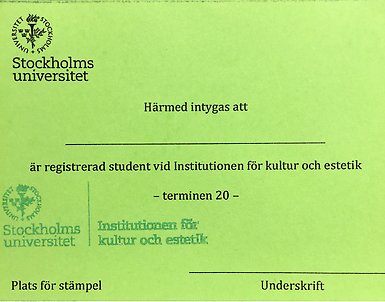
The Green Card.

In order to qualify for a green card, you must first be registered on a course with us this semester. When you pick up your card you will also get a list of the offers that apply during the semester.

The following cultural institutions are partnered with the green card:

  • Berwaldhallen
  • Drottningholms slottsteater
  • Konserthuset
  • Kungliga Operan
  • Liljevalchs
  • Scenkonstmuseet
  • Spritmuseum
  • Turteatern
  • Weld
  • Årsta Folkets Hus

Additional offers may be added during the semester, so please check out the website and our Facebook-page occasionally to keep updated.

Offers are always subject to availability and valid upon presentation of a green card and valid identification.

For questions regarding admission, registration, study certificates, etc., please contact our course administrators. Please remember to always provide your personal details and the name of the course when contacting us to facilitate the handling of your case.

Study councellors

Our study counsellors will give you advice about our courses and can answer questions that you may have about your current or future studies, career and study related issues.

The director of studies is responsible for planning course offerings, course syllabi, teacher staffing, and more. The director of studies also makes decisions on certain student issues, such as credit transfers and exemptions.

Last updated: 2026-09-02

Source: Department of Culture and Aesthetics