


Automation can create new jobs – but tech governance is crucial
Automation saves time, improves accuracy and allows employees to take on more advanced tasks. But to unleash the full potential of the technology, the organisation must build a governance structure to support their employees. This is not always the case.

Automation can free employees from repetitive tasks and unleash their creativity.
Evrim Oya Güner, Department of Computer and Systems Sciences, has studied how public organisations in both Sweden and Turkey adopt automation technology to improve their processes.
“I’m interested in the enormous amounts of repetitive administrative work that municipalities, government agencies and universities do every day. For example, they handle data entries, process applications and manage records. I have studied the automation of these processes using a technology called Robotic Process Automation, or RPA,” says Evrim Oya Güner.
The robots involved are not humanoids that are physically pushing buttons – automation robots are hidden in the software. They are programmed to, for instance, identify and move data that should be imported from one system to another.
“RPA uses software robots to mimic your moves on the keyboard. The robots operate on a computer screen just like a person would – clicking, reading and entering data – but automatically, without human involvement, and without requiring changes to existing IT systems.”
“It is a simple technology that has been in use for several years. Swedish municipalities are actually in the lead,” Evrim Oya Güner explains.
New skills are needed
Her research examines how public organisations adopt this technology as a routine capability, and how they govern it as it scales.
“I found that automation does not simply replace tasks – it creates new ways of working, new skills, new roles and build new organisational capabilities that go well beyond the original efficiency gain.”
“Imagine an employee whose job is to take information from one government system and enter it into another – every day, hundreds of times. A software robot can do exactly that, automatically. It never makes a typing error, it can run 24/7, and it does not require rebuilding the entire IT system. You simply place the robot on top of what already exists.”
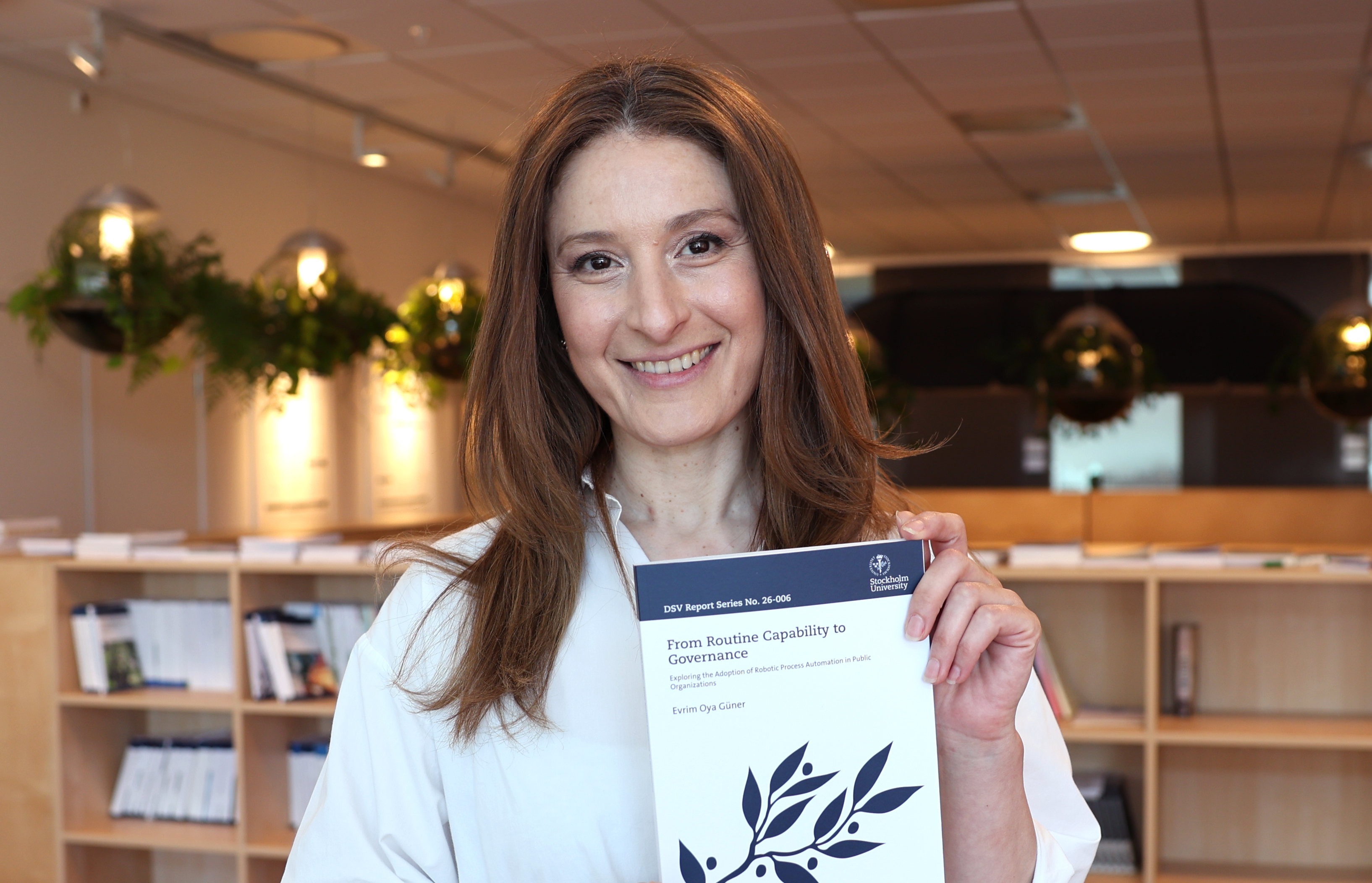
Evrim Oya Güner successfully defended her PhD thesis at DSV on 10 June 2026.
When most people think about technology, they think about devices – tools that perform a function. But Evrim Oya Güner’s research is grounded in a theoretical perspective that sees technology differently:
“It argues that technology derives its real meaning not from the device itself, but from the routines it enables: the new ways of working it generates, the practices it changes, and the capabilities it builds over time.”
Her studies show that when an organisation introduces RPA, employees don’t just hand over their old tasks. Instead, they start building new routines and capabilities which can spread across organisations and improve the public administration practices.
Employees are freed from mundane and time-consuming tasks
Many fear that jobs will be lost as automation, AI and other types of digital technologies are adopted. But Evrim Oya Güner has a more positive view – tech changes how we work, and it creates new roles and jobs. These new roles are more dependent on human curiosity, creativity and innovation.
“What I found across all the organisations I studied, is that when repetitive tasks are automated, employees are freed from mundane and time-consuming tasks. They are redirected to handle more complex cases that require human judgment, experience and expertise. Their responsibilities transition from manually performing tasks to supervising automated processes, managing exceptions and ensuring everything runs as it should. Beyond that, new roles emerge such as RPA ambassadors, coordinators and developers. Some employees who have never worked in IT become active designers of automation processes. The workforce moves toward a more technology-oriented profile.”
“My research suggests that the real risk lies in adopting automation technologies without preparing people, and without building the governance structures to support them. Without that investment, the technology does not deliver its potential. Organisations risk losing the very return they were hoping to gain.”
Invest in people
As long as it’s programmed right, RPA can’t fail, explains Evrim Oya Güner. RPA is not “thinking”: it can’t act on its own and it does not have AI’s ability to hallucinate. But tech governance is still a crucial topic, and public organisations need to plan ahead.
“We are already seeing organisations move beyond RPA, toward AI and more advanced forms of automation. That trajectory is accelerating. My research points to a governance gap – many public organizations are adopting automation and AI faster than they are developing the structures to manage it responsibly. And as the technology becomes more complex, that gap becomes more consequential.”
“It’s important to invest in employees, build internal expertise over time and develop governance that match with organisational contexts. That is the model worth learning from – not only for RPA, but for whatever comes next,” says Evrim Oya Güner.
More about Evrim’s research
Evrim Oya Güner successfully defended her PhD thesis at the Department of Computer and Systems Sciences (DSV), Stockholm University, on 10 June 2026.
The title of the PhD thesis is “From Routine Capability to Governance: Exploring the Adoption of Robotic Process Automation in Public Organizations”. It is a compilation of six scientific papers.
The PhD thesis has a mixed-methods approach, integrating a national survey of Swedish public organisations with case studies from Sweden and Turkey.
Download the thesis from DiVA
Leif Sundberg, Umeå University, was the external reviewer at the defence.
Shengnan Han, DSV, is the main supervisor and Gustaf Juell-Skielse, University of Borås, is the co-supervisor.
Contact Evrim Oya Güner
Contact Shengnan Han
Last updated: 2026-06-15
Source: Department of Computer and Systems Sciences