


Thesis defence: Evrim Oya Güner
Welcome to a thesis defence at DSV! Evrim Oya Güner explores the adoption and governance of bots to automate processes in the public sector.
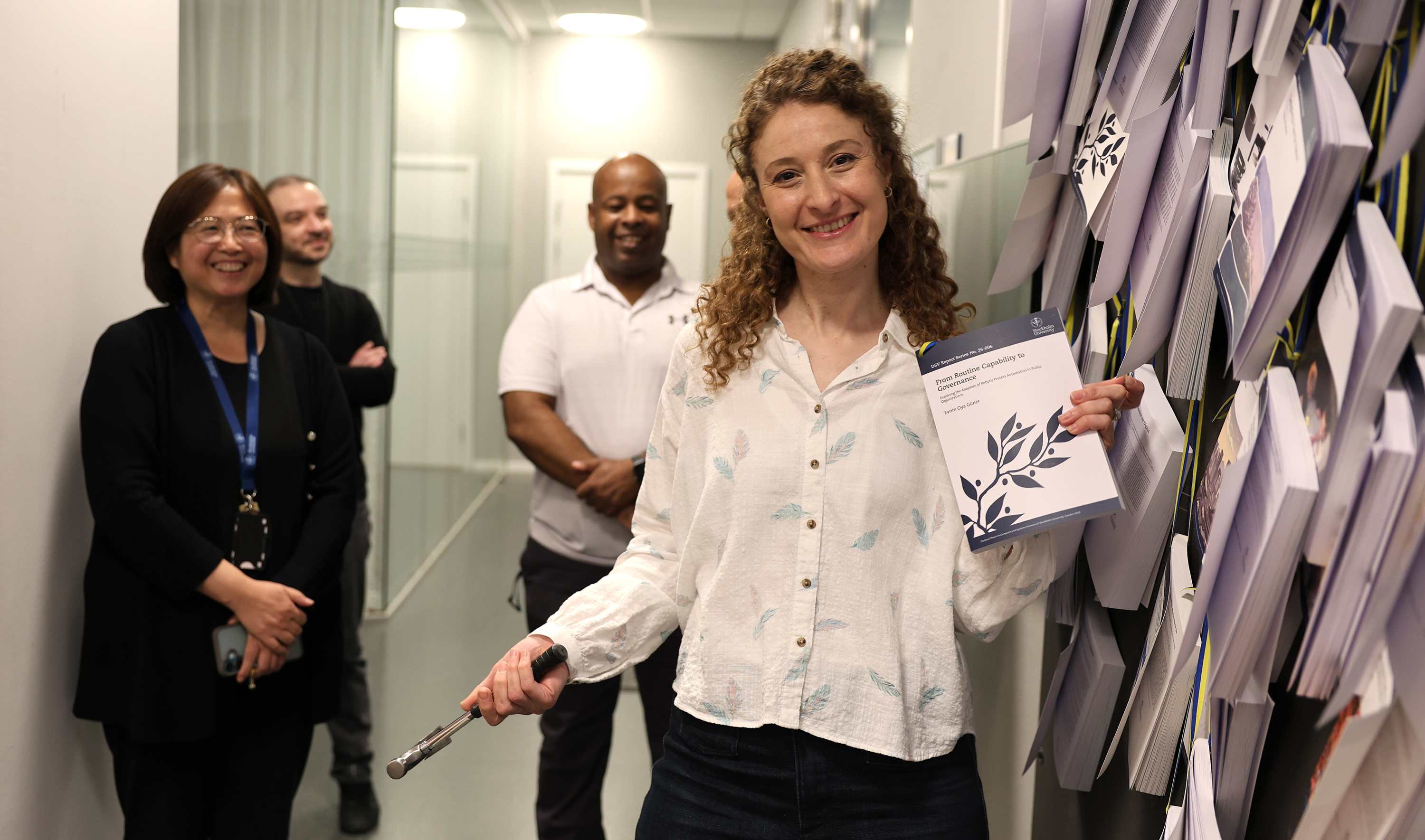
Evrim Oya Güner and DSV colleagues during the “nailing ceremony”.
On 10 June 2026, Evrim Oya Güner will present her PhD thesis at the Department of Computer and Systems Sciences (DSV), Stockholm University.
The title of the thesis is “From Routine Capability to Governance: Exploring the Adoption of Robotic Process Automation in Public Organizations”.
PhD student: Evrim Oya Güner, DSV
External reviewer: Leif Sundberg, Umeå University
Main supervisor: Shengnan Han, DSV
Supervisor: Gustaf Juell-Skielse, University of Borås
The thesis can be downloaded from DiVA
Abstract
Public organizations are increasingly adopting Robotic Process Automation (RPA) to enhance their operational efficiency and service delivery. This dissertation investigates the adoption and governance of RPA within the public sector, exploring how this technology builds routine capabilities and advances organizational practices. Grounded in the theory of Technology as Routine Capability and informed by IT governance frameworks, the dissertation addresses research gaps by examining how RPA cultivates new organizational practices and configures governance models in different public administration contexts.
The research employs a mixed-methods approach, integrating a national survey of Swedish public organizations with case studies from Sweden and Turkey. This methodology validates the use of a rigorous design to bridge generalizable, macro-level trends with the nuanced, qualitative insights required to address the research gaps.
The findings reveal that RPA acts as a catalyst in terms of advancing organizational routines and capabilities across four distinct dimensions: design, execution, diffusion, and shift. The dissertation underscores the indispensable role of IT governance in developing and scaling new capabilities, emphasizes a transition toward balanced, context-specific models that integrate centralized and decentralized approaches through robust relational mechanisms.
This dissertation contributes new knowledge to the fields of information systems and digital government research. Theoretically, it extends the technology as routine capability framework to the context of RPA across different public administration settings, and advances IT governance research by demonstrating the contextual nature of RPA governance.
Empirically, it expands the geographical scope of RPA research by providing evidence of RPA adoption in the Turkish public sector and offering cross-national insights from Turkey and Sweden, broadening the institutional scope of this field. Methodologically, it demonstrates the value of a mixed-methods design for studying complex technological phenomena in public organizations. Practically, it provides actionable guidance for public organizations on governing RPA, and on scaling and sustaining automation capabilities as part of broader digital transformation efforts.
Keywords
Robotic Process Automation (RPA), Technology as Routine Capability, RPA Governance, IT Governance, Public Sector, Digital Government, Mixed Methods
Last updated: 2026-05-21
Source: Department of Computer and Systems Sciences