


What's happening at DEEP?
Ecology is about understanding complex relationships in nature. But how do you teach that in practice? In this instalment of BIG’s interview series on research underpinning teaching, we meet Peter Hambäck, Professor at the Department of Ecology, Environment and Plant Sciences.
He discusses wetlands, ecological thinking, and the close relationship between teaching and research, as well as what it means to study ecology at a time when climate change, biodiversity and ecosystem restoration are high on the agenda.
Learning to think ecologically
For Peter Hambäck, teaching ecology is not primarily about conveying factual knowledge, but about helping students develop a scientific way of understanding the natural world.
– Ecology can be a very fact-intensive subject, but fundamentally it is about adopting a particular perspective, learning to think ecologically.
This involves understanding why species occur where they do, how they interact, and how they change over time. Evolutionary theory provides the foundation that links these ecological processes.
– The aim is for students to be able to reason about nature in a more informed and nuanced way, beyond the simplified picture often found in media or public discussions about the environment and sustainability.
This type of understanding is particularly important for students who go on to work in areas such as nature conservation, public authorities or other roles linked to environmental management.
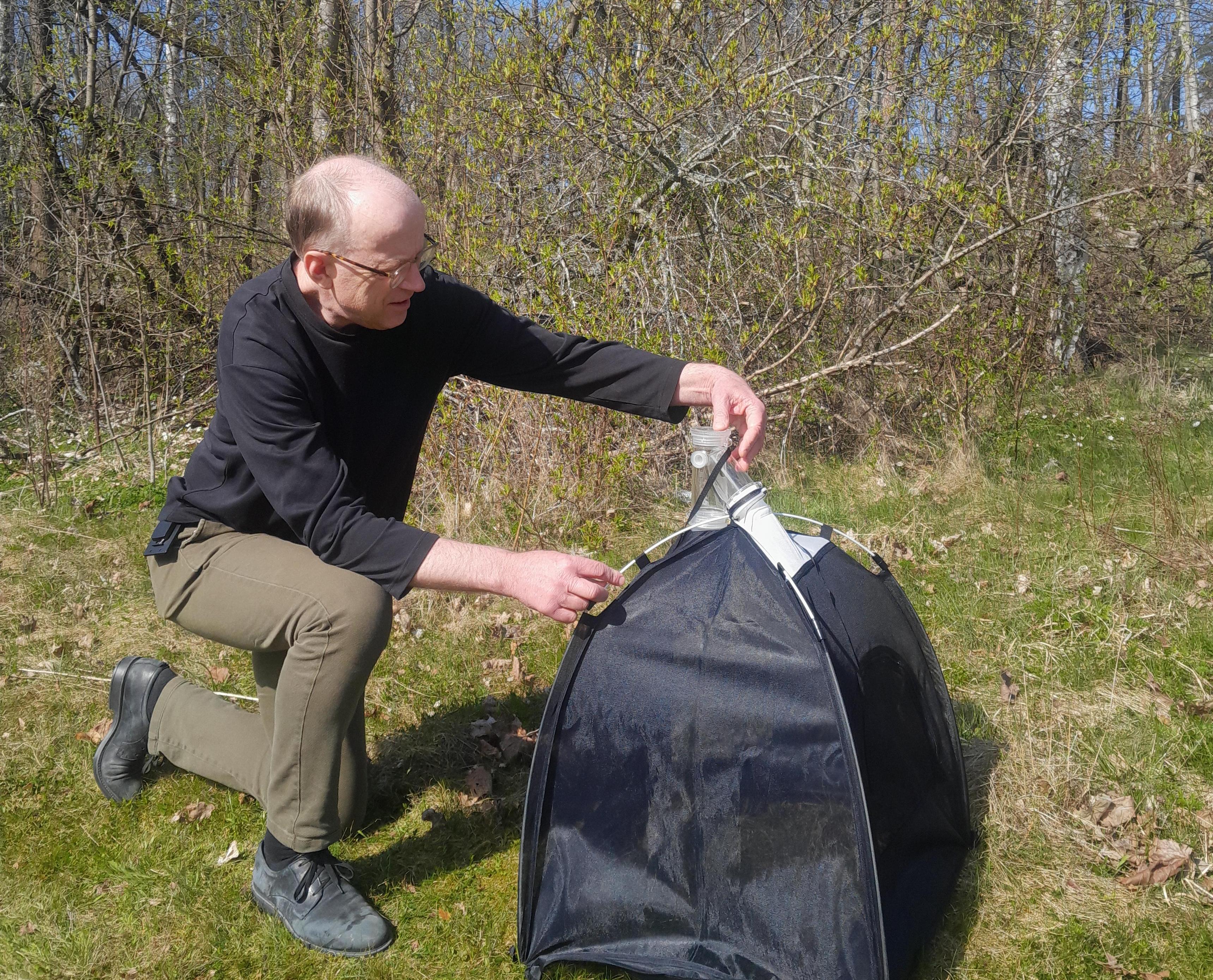
Crouching beside an emergence trap, Peter Hambäck collects data on which insect species occur in different types of environments.
Making theory tangible through research
In his teaching, Peter Hambäck draws on his own research to make theoretical concepts more concrete.
– When teaching, you often start from a theoretical concept. For it to be meaningful, it needs to be connected to concrete examples, such as field studies or real-world systems.
By using examples from his research, students gain a clearer understanding of how ecological processes function in practice. At more advanced levels, teaching also becomes more dialogical.
– When I supervise degree projects or work with Master’s students, it becomes more of a dialogue. Their interests meet mine, which can also lead to new ideas in my own work.
A reciprocal relationship between research and teaching
Combining research and teaching is, according to Peter Hambäck, beneficial not only for students but also for research.
– As a researcher, you can work on something for a long time without receiving much direct feedback. In teaching, you get immediate responses.
Interaction with students brings new perspectives and questions.
– It is a reciprocal relationship. Students gain insight into how research is conducted, while also contributing new ways of thinking and taking on questions that I may not always have time to pursue myself.
Students as part of the research environment
At the Department of Ecology, Environment and Plant Sciences, students have good opportunities to take part in research through degree projects and placements, including work related to wetlands and biodiversity.
– I usually supervise one or two degree students at a time. It is very rewarding, both for them and for us.
Several former students have continued to doctoral studies, both in Sweden and internationally.
– It is always rewarding to see students develop further and find their own path within research.
Wetlands in focus
A significant part of Peter Hambäck’s current research focuses on wetlands and the ecological processes that influence species composition. A key area is rewetting, that is, restoring previously drained wetlands.
– Historically, many wetlands in Sweden were drained, particularly in agricultural landscapes. There is now a strong interest in restoring them, both for climate-related reasons and to support biodiversity.
Wetlands play an important role as carbon sinks, but restoration is a complex process and the effects take time to become evident.
– There is a delay in the system. It can take decades before a restored wetland functions fully as a carbon sink.
At the same time, wetlands remain relatively understudied in terms of biodiversity, particularly with regard to insects.
– Much of the focus has previously been on birds and larger animals. However, there is a vast diversity of other species that we still know relatively little about.
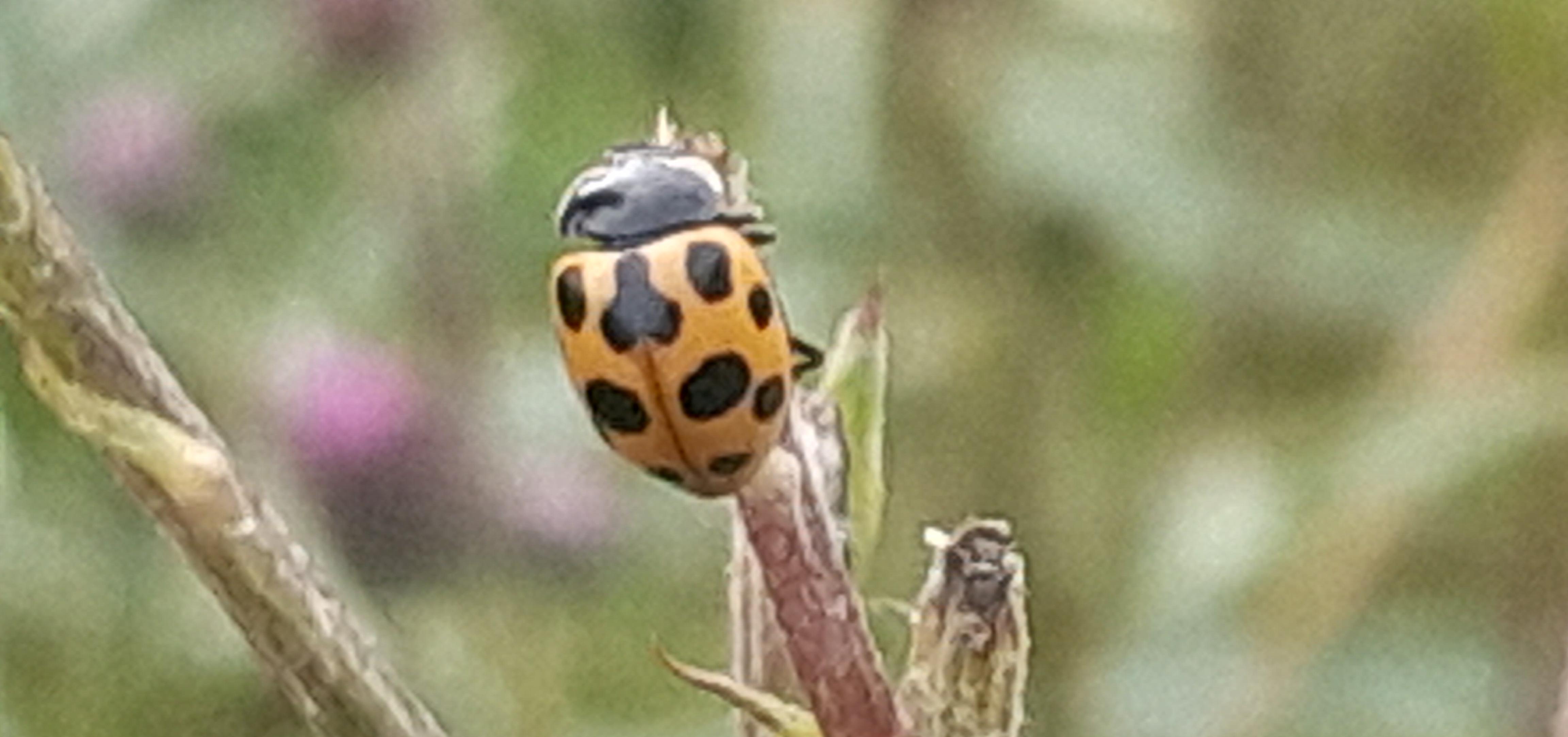
The ten-spot ladybird (Calvia decemguttata) is an aphid-feeding species often found on nettles in forests and open habitats near wetlands – an example of the many smaller species that play an important role in ecosystems.
A field shaped by societal change
Ecological research is increasingly influenced by societal developments and policy initiatives. Restoration and ecosystem recovery are growing areas of focus.
– There is currently a strong emphasis on restoration, both nationally and within the EU. This also influences the types of research questions we address.
Wetlands also illustrate the complexity of natural systems and the challenges involved in achieving rapid results.
– You do not always receive immediate confirmation that a measure is effective. It can take a long time before the effects become clear, which is also a pedagogical challenge.
Advice for future ecologists
For students interested in pursuing research, Peter Hambäck offers clear advice:
– Focus on what genuinely interests you. That is where you are most likely to develop.
At the same time, he emphasises the importance of building a broad knowledge base, regardless of whether one aims for an academic career or a role outside academia.
– The most important thing is to make the most of your time as a student and to study what you find engaging. That is often where it all begins.
Research at DEEP
The Department of Ecology, Environment and Plant Sciences (DEEP) conducts research on how organisms interact with each other and with their environment, from the level of individuals to entire ecosystems.
The research includes, for example:
- ecological processes and biodiversity
- the effects of climate and environmental change
- conservation, restoration and ecosystem services
Last updated: 2026-04-16
Source: Department of Biology Education