


What’s happening at MBW?
What does teaching look like when it is grounded in active research, and what does that mean for students? In BIG’s new interview series on research-based education, we meet Kristina Jonas, Professor of Microbiology and Director of Doctoral Studies at the Department of Molecular Biosciences, The Wenner-Gren Institute (MBW).
For Kristina Jonas, the connection between research and teaching is self-evident. As a lecturer and course leader, she works actively to ensure that the knowledge developed through research is also reflected in teaching, at both undergraduate and advanced levels.
When research enters the classroom
Kristina explains how students are introduced to the research environment at an early stage, and why this is so important.
– I continuously update my lecture material and often include new research articles – for example, things I’ve read myself or encountered at conferences. Students should engage with knowledge that is actually being developed right now.
On the Master’s course in Microbiology, students carry out laboratory work using methods that are applied in ongoing research. They read scientific articles, formulate their own research questions and analyse data in the same way as in a real research project.
– In some parts of the course, students carry out experiments that are very closely linked to our own research, which gives them a completely different understanding of how knowledge is produced.
Kristina also highlights the value of teaching that takes place close to the real research environment.
– When students get to work in our labs, use advanced equipment and meet PhD students and postdocs, research becomes something tangible and not just something you read about.
Learning to think like a researcher
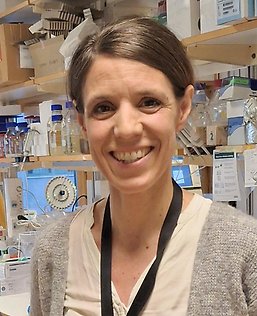
Kristina Jonas.
Teaching is not just about factual knowledge, Kristina emphasises, but about developing a scientific mindset. This involves being willing to try new methods, thinking flexibly and letting the research question determine the approach.
– I hope students take with them the importance of combining methods and not being afraid to learn something new. You should choose your method based on the question – not the other way around.
Another key aspect is critical analysis. By actively working with scientific articles, data and figures, students practise evaluating results and interpretations and gain a deeper understanding of how scientific knowledge is actually built.
Students at the heart of research
The link between teaching and research becomes particularly clear in the lab. At the time of the interview, several students were working on their degree projects in Kristina’s research group, fully integrated into the group’s regular research activities.
MBW welcomes students for Bachelor’s and Master’s degree projects as well as research internships, and Kristina’s group currently hosts several degree project students.
– Joining a research group can be absolutely crucial. For me personally, that’s when I really realised how fun research is. It’s completely different from just reading about research in a book.
Kristina’s advice to students who are curious about research is clear:
– Get practical experience as early as possible and take the opportunity to try different environments. Moving to another university or another country can be incredibly rewarding and it’s often easier to do as a student than later in life.
Research that deepens our understanding of bacterial diversity
Kristina’s own research focuses mainly on bacteria and how they adapt to changing and often demanding environments, such as starvation, temperature shifts or exposure to antibiotics. A large part of the research takes place at the molecular level, where her group investigates how different proteins interact within the bacterial cell.
– For a long time, we have worked with so-called model bacteria, which allow us to understand fundamental cellular processes – for example, how a cell regulates its growth or how cell division can lead to different cell types.
With the help of modern sequencing techniques, the research has also expanded to include bacteria in natural environments, which has changed our understanding of biological diversity.
– Today we can see just how incredibly diverse bacteria are and how they have adapted to their specific habitats. It has really transformed the whole field of microbiology.
Although the research is fundamental in nature, it can have broad relevance. For example, studies of a protein-degrading enzyme in bacteria, which Kristina’s group investigates, have been shown to be linked to similar processes in human cells, where they are associated with disease.
– Knowledge gained from bacteria can contribute to a better understanding of how more complex organisms function.
RESEARCH AT MBW
MBW conducts research within three main focus areas:
- Infection and immunobiology
- Integrative biology
- Molecular cell biology
The research spans from studies of fundamental molecular processes to complex biological systems and forms the basis for teaching at both undergraduate and advanced levels.
On MBW’s research pages, you can read more about the three research areas, the different research groups, and current research projects at the department.
Last updated: 2026-02-02
Source: Department of Biology Education