


The Bachelor's Program in Molecular Biology is Changing
A new name, new courses, and deeper collaboration between biologists and chemists – these are the outcomes of discussions in the Program Council.
Four years ago, program councils were established for all faculty programs where more than one department is responsible for courses. The role of these councils is to develop the programs by exchanging information, following up on evaluations, and proposing changes.
The Program Council for the Bachelor's program in Molecular Biology is led by Björn Birgersson, Director of Studies at BIG, and includes teachers from the three biology departments – DEEP, MBW, and Zootis – as well as from the three chemistry departments – DBB (Biochemistry and Biophysics), MMK (Materials and Environmental Chemistry), and Organic Chemistry. Student representatives are also part of the council.
Discussions in the Molecular Biology Program Council
For several years, the Program Council for the Bachelor's program in Molecular Biology has discussed how to develop the program, make it more attractive, and strengthen the collaboration between the chemistry and biology departments. Various proposals have been considered, and now they have finally resulted in a new curriculum, which was approved on February 11.
The changes include both a new name for the program and the replacement of some mandatory courses. The new curriculum will take effect from autumn 2025.
New Name and New Main Field of Study
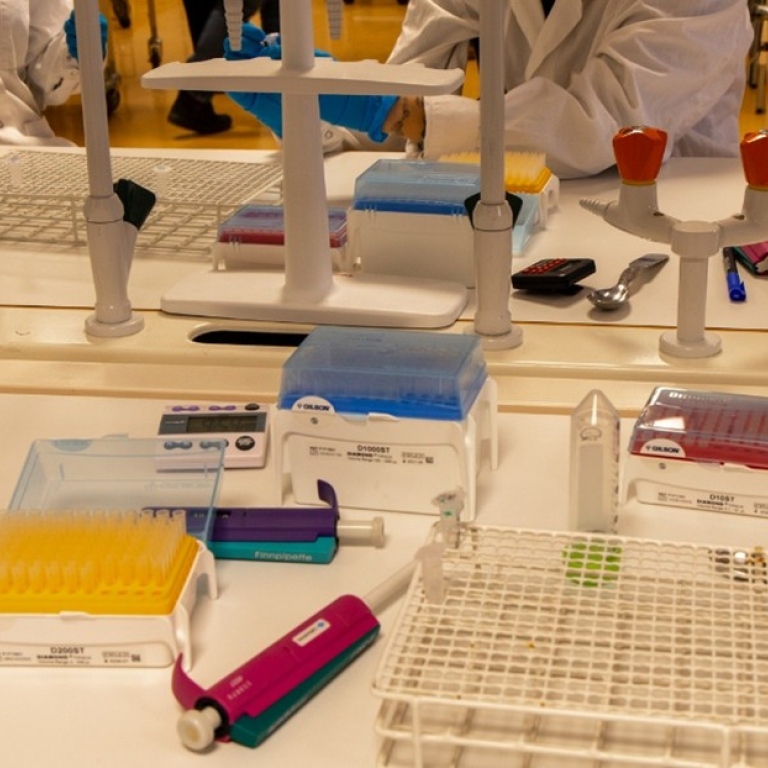
In the new program structure, the biological perspective is more clearly emphasized. Photo: Margareta Ohné
The program's name has been changed from Molecular Biology to Cell and Molecular Biology. The aim is to clarify the program’s content and highlight the biological perspective in the education. Hopefully, this change will also attract more applicants.
At the same time, Cell and Molecular Biology is being established as a new main field of study within the faculty. The local degree description defines it as follows:
"Studies in cell and molecular biology provide insights into the molecular mechanisms that govern the function of cells and organisms. The field covers the study of various model organisms such as bacteria, plants, insects, and mammals at the molecular level, as well as human molecular biology. Topics include microbiology, cell biology, immunology, genetics, developmental biology, and physiology. The studies are closely linked to research and include practical knowledge of modern methods for studying genome expression and dynamics."
New Mandatory Courses
Three new mandatory courses are being introduced: Basic Cell Biology (5 ECTS), Statistics for Biologists (5 ECTS), and Programming for Biologists (5 ECTS). The statistics course already exists, but the other two are entirely new. The Basic Cell Biology course will be placed in the first year to emphasize the biological content of the program early on.
These new courses align the program with the faculty's new local degree objectives, which require all students to have basic knowledge of sustainability, statistics, and programming. Statistics and programming will be covered in dedicated courses, while sustainability aspects will be integrated into the Basic Cell Biology course.
To make room for the new courses, two mandatory chemistry courses will be removed from the program: Analytical Chemistry (10 ECTS) and Neurochemistry (5 ECTS). However, these courses will still be available as elective options.
Subject Integration at the Course Level
The discussions within the Program Council have also resulted in greater subject integration at the course level. Molecular biologists will be responsible for a one-week module in the Experimental Chemical Methods course (5 ECTS), while biochemists will be responsible for a one-week module in the Methods and Concepts in Molecular Life Sciences course (15 ECTS). This integration has already been implemented for students who started the program in autumn 2024.
Mattias Mannervik, a teacher at MBW and a member of the Program Council, believes that these changes will lead to a stronger Bachelor's program, better preparing students for a career in cell and molecular biology – whether they continue to a PhD or pursue a career outside academia.
Last updated: 2025-03-03
Source: Institutionen för biologisk grundutbildning