


Ecologists need to be able to write!
What do you need to know to work as an ecologist outside academia? How different is it from staying at university? This was discussed at a meeting of BIG's ecology network for ecologists, Future Ecologists, on 8 October.
The Future Ecologists network was established in autumn 2023 and consists of teachers and students of the Master's programme in Ecology and Biodiversity as well as a number of alumni. The meeting on 8 October was about the skills needed to get a job outside academia.
BIG had invited two alumni who have both worked at large consulting companies for many years. Jonas Rune works with permits for power lines at WSP and Martin Isaeus is a marine biologist who works with offshore wind power at Niras. They were asked to share their experiences of the skills required for jobs in consultancies.
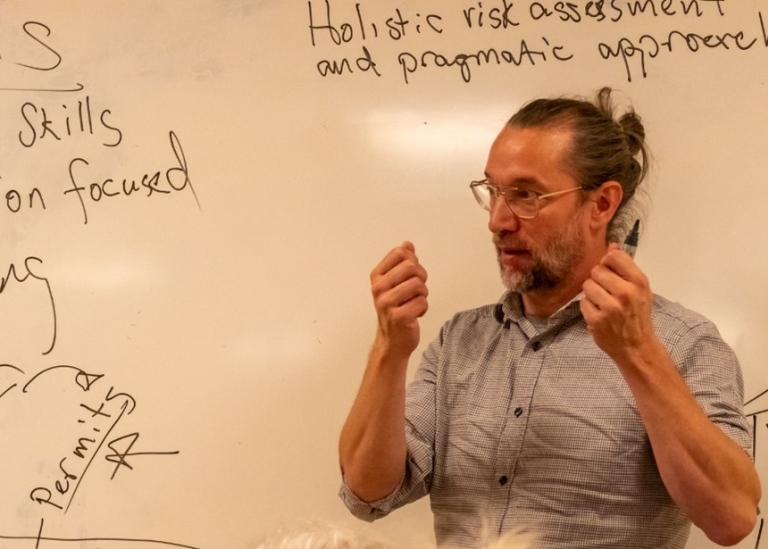
Jonas Rune. Photo: Margareta Ohné.
In the ensuing discussion, two more alumni participated: Cathy Hill, who has her own consultancy company, and Maria Bergström, who works at the Swedish Society for Nature Conservation. Both also have experience of working at county administrative boards and other authorities, and the discussion therefore centred on the competence requirements outside academia more generally.
It turned out that the four alumni were in remarkable agreement on what is required for a job outside academia and there was really no difference whether they were discussing consultancy assignments or work at a government agency - the skills required are more or less the same. The following therefore does not report what the individual participants said but summarises their collective views.
What skills do you need?
As an ecologist, you are naturally expected to have a solid knowledge of ecology.
It's also good if you have knowledge of a few other subjects, such as environmental law and GIS. You are welcome to specialise in something you are particularly interested in, but don't expect to be able to continue working in that particular field.
As in academia, you will be expected to understand and use data in a scientifically correct way.
For the most part, you will need to speak Swedish. The working language at government agencies is Swedish and consultancy reports are usually written in Swedish. However, if you do not speak Swedish, the consultancy sector is not closed; there may be other tasks than report writing and you may be able to work in international environments. Machine translation tools are also improving.
Be prepared to continue learning throughout your professional life - the learning doesn't stop just because you finish your training!
What skills are important?
The most important skill is the ability to communicate. At university, you are in an environment where everyone speaks the same scientific language as you. But outside academia, you need to be able to communicate with social scientists, economists, engineers, politicians, journalists, etc.
Above all, you need to be able to write so that others understand what you mean. This means expressing yourself clearly and avoiding terms that only other ecologists are familiar with. It also means that you need to understand what is relevant and interesting in the specific context.
The ability to communicate and write for a specific audience was highlighted and emphasised by all four alumni.
How different is it to work outside the academy?
One key difference is that outside of academia you are usually working to tight deadlines. This means that you probably won't be able to immerse yourself as much as you think you need to, and you might not be fully satisfied with your contribution.
If you are working as a consultant, you must not get bogged down in the problems; your task is to find solutions.
You must be aware of the purpose of the activity. At the university, the purpose is to produce new knowledge and pass it on to others. Outside academia, the purpose is different: a company needs to make a profit to survive and a public authority should serve citizens.

Martin Isaeus. Photo: Margareta Ohné.
Finally, why work outside academia?
I'll now hand over to Martin. He talked about why you should become a consultant, but what he said can also be applied to other parts of the labour market. In his words: you should work outside academia to get out into the real world, because you are needed there and because you will be able to make a difference!
Next network meeting
The next meeting will be on 27 November and the theme is ‘Start your own business’. The Innovation Office, Drivhuset and SU Holding will participate. The venue is E306 and the time is 16:00-17:30. Welcome to the meeting!
Last updated: 2024-10-30
Source: Margareta Ohné