


How did the start of the semester go?
All places on the Bachelor's programmes were filled and overall we have about as many students as in autumn 2023.
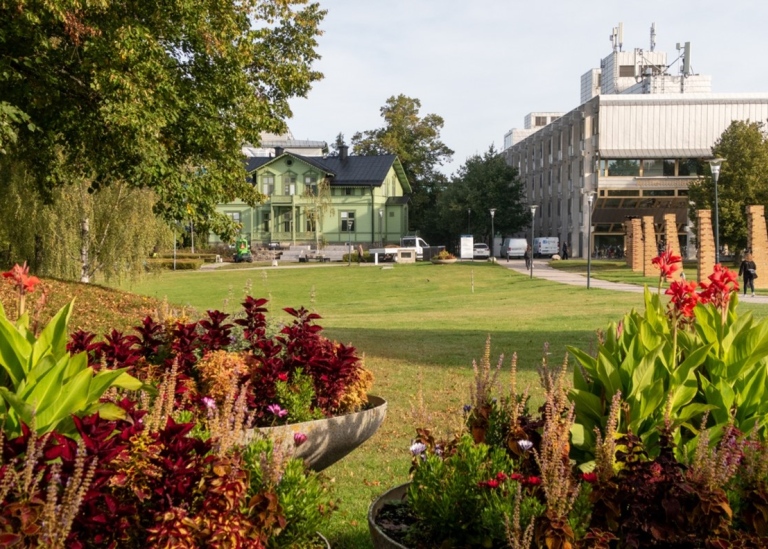
Campus Frescati. Photo: Margareta Ohné.
The Bachelor's programmes
BIG offers three Bachelor programmes with a total of 72 places (48 places in Biology, 12 in Marine Biology and 16 in Molecular Biology).
The Bachelor's programme in Biology is divided into two tracks, each with 24 places. The Biology with Chemistry programme comprises 30 credits in chemistry and courses in cell and molecular biology and physiology based on chemistry. The biology programme does not have compulsory chemistry and thus the courses in cell and molecular biology and physiology are not based on previous studies in chemistry.
At the start of this year's autumn term, all places were filled. It is worth noting that the Biology with Chemistry programme is the only one of BIG's Bachelor's programmes where all eligible applicants were admitted; the other three programmes had reserves at the start of the programme.
The Master's programmes
As far as the Master's programmes are concerned, the number of students registered was similar to last year. A total of 84 students have been registered as beginners on BIG's Master's programmes this autumn, of which 14 are paying students.
The Marine Biology, Molecular Life Sciences and SERSD (Social-Ecological Resilience for Sustainable Development) programmes have the most students, all with 14 registered students. The broad programme Biology has 8 students and is thus the smallest.
Exchange students
The number of incoming exchange students has increased compared to last year. This year we have a total of 33 exchange students studying courses at BIG, in autumn 2023 there were only 23. Some of the students come to us through the faculty's or BIG's own agreements. This year these students come from Belgium, the Netherlands, Switzerland, Germany, Austria, the USA and Singapore. In addition to these, we have students who do their exchange studies through CIVIS, through central agreements or agreements at other institutions. This year, these students come from institutions in France, Spain, Germany, Argentina and South Korea.
BIG also has six outgoing students this term (last autumn term there were seven). Three students are on exchange programmes in Spain, Australia and the USA, while three are doing research placements in France and Spain through Erasmus+.
Content-rich induction weeks
The semester started on 2 September, but by then the newcomers had already had a week's introduction, both Bachelor and Master students. Not everyone was able to attend, but more than half were able to participate.
The introduction weeks had slightly different designs depending on which students they were aimed at, but certain elements were included for all, such as information about the programmes, study techniques and various practical information. A lecture by alumnus Henrik Ekman, an environmental journalist and author, was also common to all new students. He talked about the National City Park and its creation, and described what you can see and hear in the park during different seasons, illustrated with his own excellent photos.
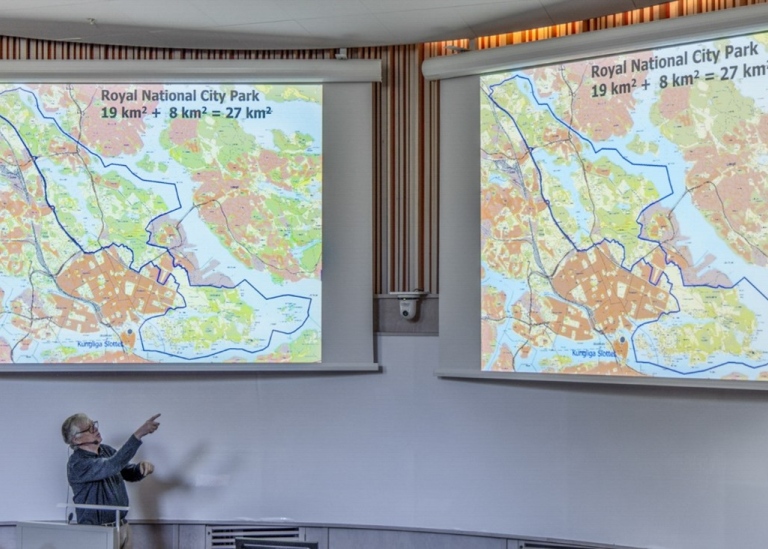
Henrik Ekman lecturing about the National City Park. Photo: Margareta Ohné.
An important element of the introduction week for the MSc students was alumni meetings in small groups. Some students visited the Baltic Sea Science Centre at Skansen or WWF in Ulriksdal. Others stayed on campus and met alumni from the Swedish Chemicals Agency, the Swedish Museum of Natural History, Astra Zeneca or the consulting firm WSP. The alumni meetings were then reported to the entire student group.
As the majority of the Master's students are international, their introduction was held in English. It included special elements to help the new students settle in, such as a tip walk in BIG's premises and a long walk in the National City Park in unusually warm late summer weather.
An important aim of the induction is, of course, for the students to get to know each other before they become fully immersed in their studies. All information about the programme was therefore facilitated with various social activities such as brännboll and lunch with senior students. The fact that the Natural Sciences Association participated in the introduction contributed to the good atmosphere.
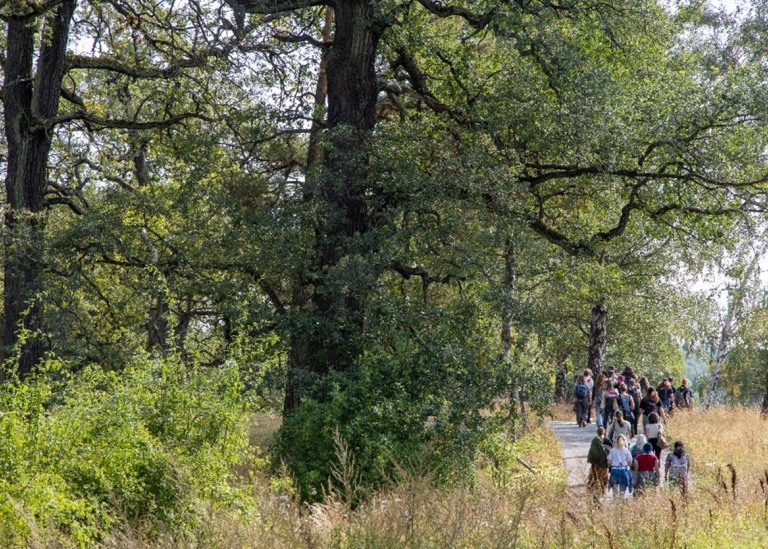
Walking in the National City Park: Photo: Margareta Ohné.
Last updated: 2024-10-11
Source: Margareta Ohné