


Nicklas Österlund awarded a four-year Starting Grant from VR
Nicklas Österlund, former PhD student at the Department of Biochemistry and Biophysics (DBB), will come back to DBB next year with a Starting Grant from the Swedish Research Council (VR).
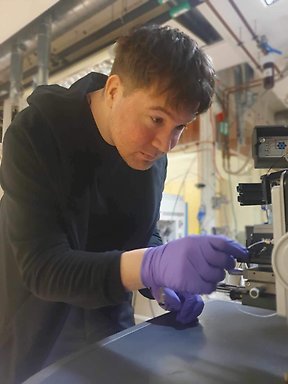
Niklas Österlund. Photographer: Lina Larsson
Nicklas Österlund has been awarded a four-year Starting Grant from the Swedish Research Council (VR), to establish an independent research programme at DBB.
Nicklas completed his PhD at DBB in 2023 and has since conducted postdoctoral research in leading mass spectrometry groups at Karolinska Institutet and Freie Universität Berlin, Germany. His research in Germany has been supported by a Wenner-Gren Fellowship, which also provides funding for his return to Sweden to pursue independent research.
The new VR Starting Grant complements this funding and will enable him to establish his research group at DBB next year.
“I’m really looking forward to returning to Stockholm University and DBB, where I very much enjoyed my time as a PhD student. The department offers an excellent environment for my research, particularly through its unique combination of experimental and theoretical biophysics with expertise in cellular neurochemistry. I also hope to contribute the perspectives, expertise and approaches I have gained during my postdoctoral years in other research environments”, says Nicklas.
VR and Wenner-Gren Foundations support research of diseases like Alzheimer’s
His research focuses on the early stages of protein aggregation linked to neurodegenerative diseases such as Alzheimer’s disease.
Over a 4 year period, Nicklas will receive 4 800 000 SEK for the project “Decoding the biophysical basis of toxicity in transient protein assembly intermediates”
Using advanced mass spectrometry, the project aims to detect rare, short-lived intermediates in protein folding and assembly that have been very difficult to study using other experimental methods. These experimental data will be used to guide and test computational models of their structures and dynamics. An important part of the research will involve comparing protein variants, including mutations linked to inherited forms of Alzheimer’s disease, to investigate how they affect oligomer formation and toxicity in cells. Ultimately, these insights could guide new therapeutic strategies, particularly the design of selective binders using emerging deep-learning approaches.
“Thanks to the generous support from VR and the Wenner-Gren Foundations, I’m excited to get started and recruit a PhD student and a postdoc to help develop this research further. Our hope is to identify molecular properties that make certain protein assemblies toxic to cells. Beyond research, I also look forward to teaching and supervising undergraduate students, both of which I have always enjoyed and consider important and rewarding parts of academic life!”
Full list of awarded grants from VR
To download the full list of awarded grants, please see the Swedish Research Council’s website:
Naturvetenskap och teknikvetenskap (in Swedish)
Last updated: 2026-11-09
Source: Department of Biochemistry and Biophysics