


Julian Wagner presented his research at the Nobel Prize Museum
The Department of Biochemistry and Biophysics’ PhD student Julian Wagner was one of the speakers at the scientific after-work Science Today: The Cell at the Nobel Prize Museum on Friday, May 22.
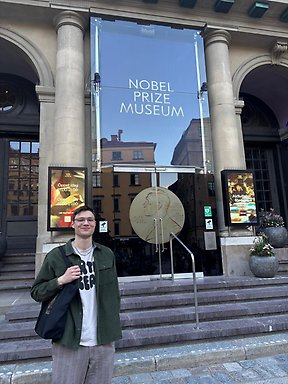
Julian Wagner. Photo: Larissa Kahnwald.
On Friday, May 22, the Nobel Prize Museum organized an after-work, Science Today: The Cell, where Julian Wagner, PhD student at the Department of Biochemistry and Biophysics, presented his research.
"It was a wonderful experience to participate in the most recent edition of "Science Today" at the Nobel Prize Museum! The theme of the evening was "The Cell", aligning with the museum's new exhibition, "Cells, nerves, genes", which visitors could explore during the event. In the course of the evening, three popular science talks on topics related to the cell were given by PhD students and Postdocs from SU, KTH and KI. The goal was to present their research in an accessible, engaging and enjoyable way”, says Julian.
The Nobel Prize Museum wrote the following about his talk, The Cell Membrane: Why Setting Barriers is Essential for Life:
“In this talk, Wagner will delve into the fascinating world of cell membrane biophysics. We take a closer look at the structure and function of the cell membrane and address the puzzling question of membrane asymmetry by combining computer simulations with hands-on experiments, creating synthetic membrane systems that mimic real cell membranes.
Finally, we will explore how this research not only deepens our understanding of how cells work, but how it might also help us better understand and treat diseases.”
“Since the Doktorova lab is an interdisciplinary lab combining computational approaches and experiments to study an essential cellular structure called the cell membrane, I was excited to present our work on cell membrane properties and membrane asymmetry in this context. I believe that events like this help bridge the gap between the public and science, especially when discussing fundamental research like ours, which can often feel abstract and disconnected from everyday life. Overall, it was a successful evening in a welcoming and conversational atmosphere with a diverse, curious crowd, and I truly enjoyed the opportunity to explain why our research matters”, says Julian.
Learn more about all the speakers and the scientific after-work at the Nobel Prize Museum’s page:
Last updated: 2026-06-03
Source: Department of Biochemistry and Biophysics