


Virus protein could protect cheese from Listeria
A piece of cheese may seem harmless, but in some cases it can carry a deadly stowaway: Listeria monocytogenes. As unpasteurized cheeses become increasingly popular, the need for new methods to ensure food safety is growing. Traditional ways of combating Listeria have limitations, so researchers are turning to an unexpected ally: viruses that attack bacteria.
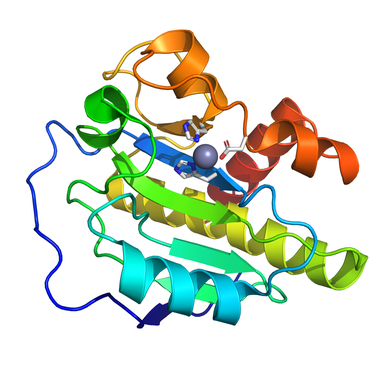
X-ray crystal structure of the PlyP100-D1 domain. The catalytic zinc ion is shown as an grey sphere. Illustration: Pål Stenmark
An article in ASBMB Today refers to a study published last year in the Journal of Biological Chemistry where researchers from Pål Stenmark’s research group at Stockholm University and Michael Miller’s group at the University of Illinois Urbana–Champaign investigated the structure and function of PlyP100, an endolysin from the bacteriophage P100. Endolysins are proteins that some bacteriophages use to break down bacterial cell walls.
“Because Gram-positive bacteria have an exposed cell wall layer, endolysins can attack them directly. That makes endolysins an interesting tool for preventing the growth of unwanted bacteria such as Listeria” says Michael Miller, professor at the University of Illinois Urbana–Champaign.
“Bacteriophage P100 is already used in food production, so PlyP100, an endolysin from this bacteriophage, could be an even better tool to prevent Listeria from growing in queso fresco,” say Emma Scaletti Hutchinson and Karson Bateman, co–first authors of the study.
By combining structural biology, biochemistry, and microbiology, the researchers showed that PlyP100 consists of three domains with different functions. The first domain is crucial for antibacterial activity, while another binds to the Listeria cell wall. A third domain turned out to be necessary for full function, despite lacking a clearly defined role. This new structural knowledge can be used to identify and develop more effective endolysins for food safety.
“Food safety affects everyone, from farmers to families around the dinner table. By studying PlyP100, we are moving toward precision tools that can stop deadly outbreaks before they even begin. If successful, this will not only protect queso fresco lovers, the tools we develop can be used to prevent Listeria in many types of sensitive foods where traditional preservation risks destroying flavor or texture” says Pål Stenmark, professor at Stockholm University.
To read the perspective by ASBMB Today, please see ASBMB Today's article:
Bacteriophage protein could make queso fresco safer
To read the full study, please see Journal of Biological Chemistry's webpage:
Last updated: 2026-01-26
Source: Department of Biochemistry and Biophysics