


New space telescope for mapping the sky in ultraviolet light approved by NASA
On October 27th NASA announced its commitment to launch UVEX, the UltraViolet EXplorer, a new space telescope that will survey the sky in ultraviolet light. The project is led by Caltech in the United States, and the launch is planned before 2031. At the Department of Astronomy assistant professor Ylva Götberg is involved in the project and plans to use the data to look at hot and massive stars.
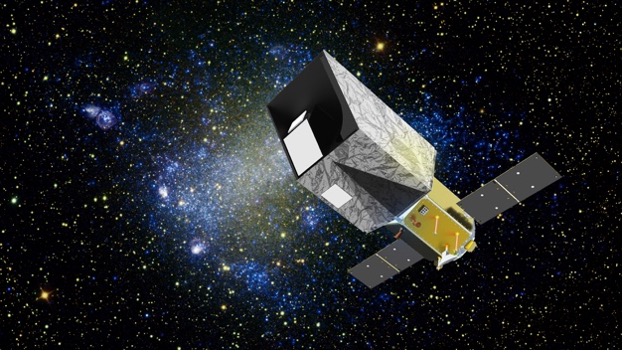
Artwork of NASA's Ultraviolet Explorer, or UVEX.
To the casual observer, the starry sky offers a picture of tranquility. In reality, stars flare, explode, and occasionally crash into each other in cataclysmic collisions that bathe the universe in heavy elements and light. On October 27th, NASA announced its commitment to launch, by 2031, the Ultraviolet Explorer (UVEX) mission—a new space observatory that will provide unprecedented views of our dynamic universe. The mission will also, for the first time, identify millions of tiny galaxies and make the very first deep all-sky maps in ultraviolet light. With NASA's commitment in place, the UVEX team, which is led by Caltech in the United States, will begin building and executing the mission.
The space telescope stands out in its ability to capture the dynamic ultraviolet skies, and to make very deep pictures of large areas of the sky. Ultraviolet light, which most people know for its ability to cause sunburns, is invisible to human eyes; its energies are up to several dozen times higher than those of visible light. With its superb ultraviolet vision, UVEX will detect stars, galaxies, and other explosive events too faint to be seen before. It will deepen our understanding of the evolution of stars and galaxies and provide new insights into the mechanisms behind some of the most powerful blasts in the cosmos.
“The mission will advance fundamental frontiers in astrophysics, from understanding the smallest galaxies to diagnosing the aftermaths of neutron-star mergers and other cosmic explosions," says Fiona Harrison, the mission's principal investigator and the Harold A. Rosen Professor of Physics at Caltech, US.
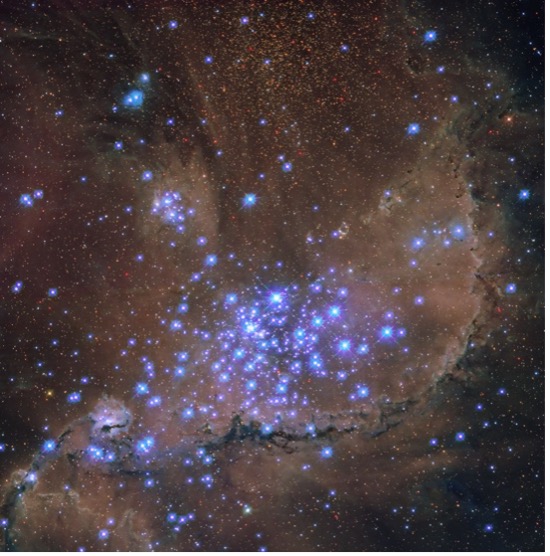
A star cluster named NGC 346 is seen here in this image taken by NASA's Hubble Space Telescope. The view shows ultraviolet light from massive young stars, along with some visible light. Ultraviolet light helps scientists understand star formation and evolution. NGC 346 sits 210,000 light-years away within the Small Magellanic Cloud, a satellite galaxy to our own Milky Way.
A New Look at Stripped Stars
At the Department of Astronomy assistant professor Ylva Götberg is part of the UVEX science team. Her UVEX research interest is the study of "stripped" stars whose outer hydrogen-rich layers have been torn off by orbiting stellar companions. As the hydrogen is removed, the helium layer beneath is exposed, and they are thus also known as helium stars. Until now, only a few helium stars have been found, but UVEX will reveal thousands of them. The telescope is also equipped with a spectrograph instrument which will enable detailed investigations into the surroundings of the stars, including measuring properties of their stellar winds.
“The exquisite UV sensitivity of UVEX will allow us to find a wealth of hot helium stars that are too faint to be detectable in other wavelengths. Spectra of them from UVEX will also allow us to figure out how their stellar winds affect how they end their lives”, says Ylva Götberg.
With data on thousands of helium stars, over a previously unexplored range of masses and heavy element abundances, the scientists can build a model for how the winds from the stars work. The detailed stellar wind physics directly affects what type of supernova the stars turn into once they run out of material to burn but can also set the stage for how the original stellar pair merges and possible gravitational wave emission from this event.
“The ultraviolet multi-epoch imaging campaign that we are planning will not only allow us to create the deepest UV map ever made of the Magellanic Clouds, revealing a direct bridge between subdwarfs and Wolf-Rayet stars, but we also expect to find unusual binaries composed of helium stars and neutron stars - the direct progenitors of binary neutron stars that merge with a burst of gravitational waves”, says Ylva Götberg.
Facts
A spectrograph is an instrument that splits light into its component wavelengths, so astronomers can determine important properties of astronomical objects, such as their chemical composition or temperature.
The colour of a star is mainly determined by its temperature, which is closely related to its mass: low-mass stars are cooler and appear red, medium-mass stars like the Sun appear yellow, and high-mass stars are much hotter and appear white or blue. The most massive stars thus emit most of their light in the ultraviolet.
Stellar winds are streams of charged particles, driven by radiation from the star and its magnetic fields, which can carry away significant amounts of mass from the star. Stellar winds influence the evolution of stars and can shape the surrounding interstellar environment.
Last updated: 2026-11-05
Source: Department of Astronomy