


Large research grant awarded to investigating how the first galaxies formed
Oscar Agertz (Lund University) and Angela Adamo at the Department of Astronomy have been awarded a research grant from the Knut and Alice Wallenberg Foundation to find out how galaxies, such as our own Milky Way, formed. They will use the grant to make a joint study of extremely distant galaxies and stars with both telescopes and supercomputers.
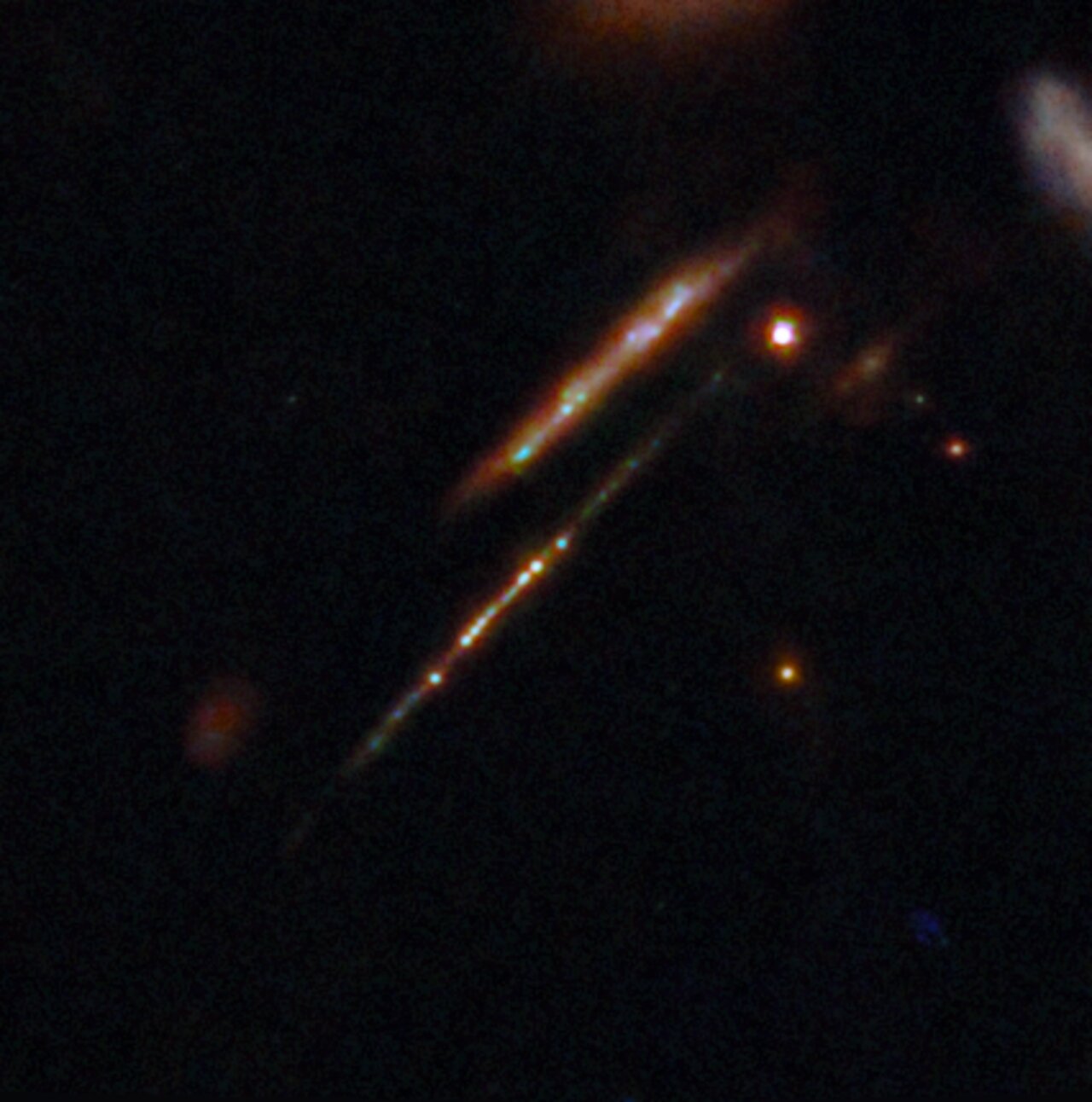
An example of how stars are formed in clumps inside galaxies in the early Universe. The image was taken with the James Webb Space Telescope and shows the galaxy Cosmic Gems (the lower of the two galaxies) which emitted its light more than 13 billions years ago. The light from the galaxy was magnified through so called gravitational lensing, which makes it possible to detect the small clumps of stars.
The galaxies found in the early universe have turned out to be a diverse crowd. The James Webb Space Telescope (JWST) have discovered disk galaxies (such as the Milky Way) surprisingly early in the history of the universe. Many of these galaxies also seems to consist of dense stellar clumps. Why are the first galaxies built like this? And could these compact clumps be predecessors of the ancient globular stellar clusters found in modern time galaxies?
The research grant totals 24 million Swedish crowns over five years and will enable Angela Adamo (Department of Astronomy, Stockholm University) and Oscar Agertz (Department of Physics, Lund University) to to find the answers to these questions. In Stockholm Angela Adamo uses JWST to study dense clumps of stars inside the earliest galaxies we know of. These clumps are so faint that not even the powerful Webb telescope is enough to detect them. Only through the phenomenom of gravitational lensing, nature’s own magnifying glass, can these clumps be found.
Oscar Agertz was the lead applicant for the grant and his research comes at these unsolved problems from a different direction. He uses top-of-the-line computer simulations to build models of galaxies and the stars in them. In these simulations he can follow the formation and evolutions of galaxies in the early universe. In this new project the research groups will collaborate to combine the JWST observations with the simulations in many different ways, which will lead to answers to the questions.

Angela Adamo
I'm really excited and grateful, this project is a unique opportunity to bridge expertise across the Swedish astronomical community. By combining our strengths in observing and analyzing early galaxies with JWST with advanced galaxy simulations, we will unlock the physical conditions that lead to star formation in the first galaxies, says Angela Adamo.
The project has three main goals. The first is to understand which physical processes that cause the galaxies to fragment and compact stellar clumps to be formed in these galaxies. The second goal is to investigate the relation between the evolution of stellar clumps and that of the galaxies; and thereby understand how these compact clumps affect how the galaxies grow. The third one is to start building a framework where observations and simulations can be compared and used together. This framework can then be used to formulate scientific hypotheses to be tested by next generation telescopes, such as the Extremely Large Telescope, which will start observing around 2030.
The awarded grant will be used to build a joint PhD program where young researchers will be given the opportunity to engage with observational data and theoretical simulations and find solutions to the unsolved puzzles in galaxy formation.
This grant is also a way to create strong bonds between the PhD programs of our two Universities, enabling students working on this project to join educational activities in both institutes, says Angela Adamo.
More information
Press release from KAW about the grant (in Swedish).
Press release from Lund University about the grant.
Contact
Angela Adamo, angela.adamo@astro.su.se, +46855378556
Last updated: 2026-10-26
Source: Department of Astronomy