


When the clouds clear – the emergence of young star clusters
The Hubble and James Webb Space Telescopes have revealed thousands of young star clusters emerging from their birth clouds. The observations, published in Nature Astronomy, show that more massive clusters clear away their natal gas faster than lower-mass clusters. The result has important implications for our understanding of star formation and how the young stars affect their surroundings.
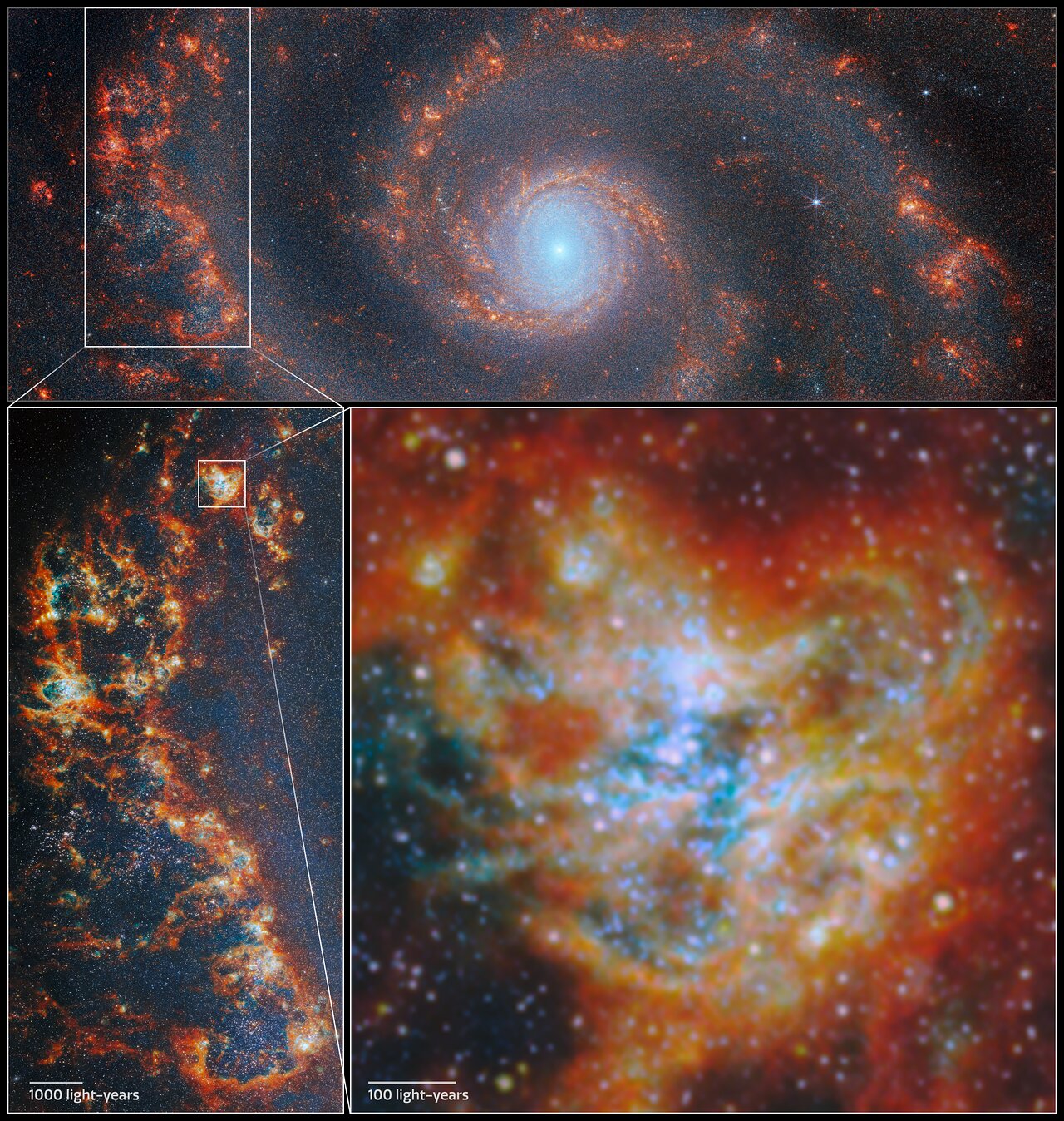
Three images of spiral galaxy M51. The top image spans the spiral arms and the galactic centre. A large upright portion of the spiral arm on the left is highlighted in a box, which expands to the image on the left, showing the area in more colour and greater detail. Blue colours, especially in the centre of the galaxies show the location of bright stars. Orange and yellow show emission from hot, ionized, gas and red colours come from complex molecules and dust grains.
I was excited to see that the emerging timescale of a star cluster is related to its mass in stars. This has implications on a range of research fields, from planet formation to galaxy evolution, says Alex Pedrini, PhD student at the Department of Astronomy at Stockholm University and first and corresponding author of the study.
Alex Pedrini is part of the Galaxy group and the FEAST* team at the Department of Astronomy and Oskar Klein Centre (OKC) at Stockholm University, where he studies how stars are born and how they influence their host galaxies. Most stars form in clusters hidden inside dusty gas clouds, where massive young stars release energy that blow away this material and slow down further star formation.
Estimating the timescale for emergence
The research team used the James Webb and Hubble Space Telescopes to measure the emission at ultraviolet to infrared wavelengths of thousands of young star clusters in four nearby galaxies: M51, M83, NGC 628 and NGC 4449, which are all in the Local Volume, that is within 30 million light years of our Galaxy, the Milky Way.
Different wavelenghts of light reveal different stages in the process as young star clusters emerge from their dusty birth clouds. Infrared light allows us to see through warm dust and detect the newborn clusters during the emergence process, while visible light reveals the stars after the gas has been dispersed.
By comparing how many clusters we see in each stage, we can estimate how long it takes for young star clusters to emerge and how this depends on their mass in stars, says Alex Pedrini.
The authors detected around nine thousands young star clusters in all the four galaxies, finding that more massive clusters emerge, on average, quicker than lower mass clusters.
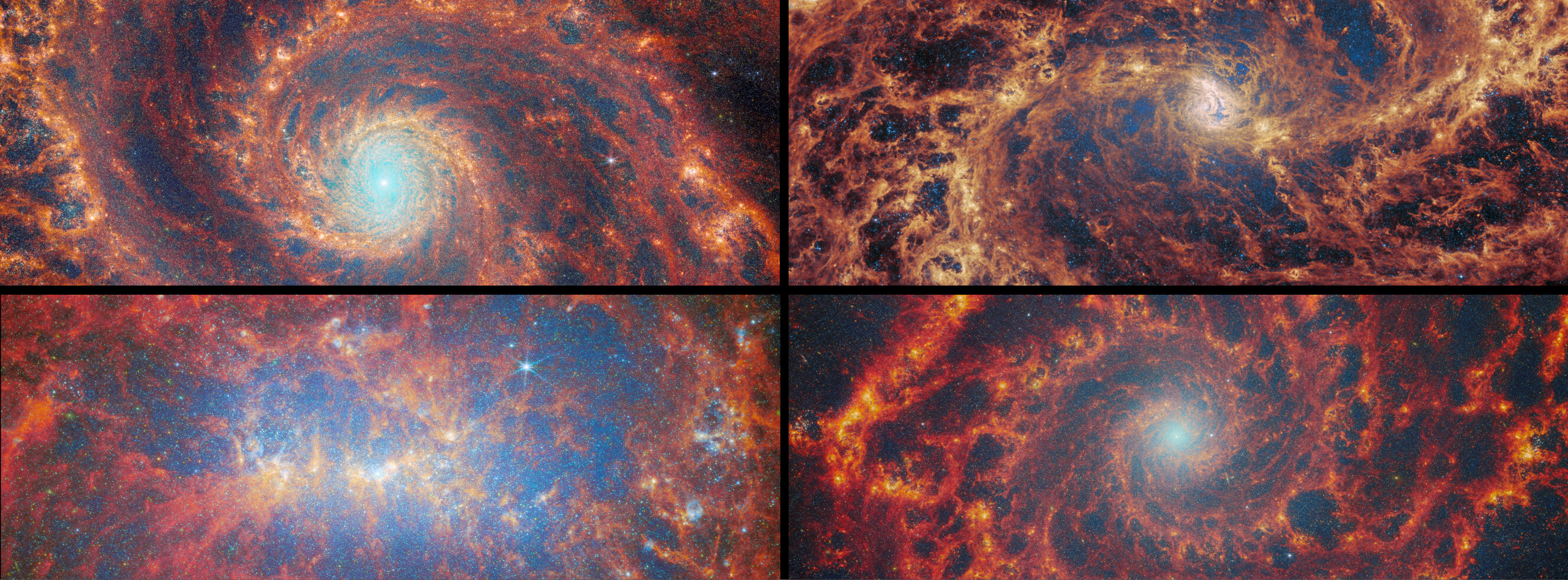
A collage featuring images of the four spiral galaxies observed by Webb in the FEAST programme, Messier 51 (top left), Messier 83 (top right), NGC 4449 (bottom left), and NGC 628 (bottom right). The colors traces the same processes as the first image. The pattern of vivid colors trace out the spiral arms of each galaxy as a network of filaments with cavities in between.
Understanding of early stages
The findings suggest that massive star clusters may form in very dense regions where gas is more efficient at forming new stars than in environments where low-mass clusters form. Together with results from simulations, this work provides a more complete understanding of the early stages of star cluster emergence.
Because massive star clusters disperse their birth gas more quickly, more of their energetic and ionizing radiation can escape into the galaxy, making them important sources of ionizing radiation in galaxies, says Alex Pedrini.
Synergy between observations
This study is a team effort enabled by the unique synergy between HST and JWST observations. Understanding how star clusters form and affect their environment is one of the main goals of the FEAST team”, says Angela Adamo, associate professor at the Department of Astronomy and leader of FEAST.
The FEAST project is a large JWST observational programme which addresses fundamental questions related to star formation and stellar feedback across a wide range of galactic environments.
Setting the stage for further discoveries
Understanding the emergence process in detail can help in figuring out how galaxies re-ionized the early universe, even though the galaxies in this study are in our local universe. The results also have implications for planet formation: in regions dominated by massive clusters, faster gas dispersal may reduce the time available for planets to form.
With upcoming JWST observations, we will be able to study a wider variety of galaxies and more extreme cosmic environments, helping us uncover how young star clusters emerge and how stars and planets begin their lives across the Universe, says Alex Pedrini.
The FEAST project
FEAST (Feedback in Emerging Extragalactic Star ClusTers) is a James Webb Space Telescope Cycle 1 international program led by Angela Adamo and involving several researchers from Stockholm University: Alex Pedrini, Arjan Bik, Giacomo Bortolini, Helena Faustino Vieira, Göran Östlin, and Jens Melinder. Together with a team of about 30 astronomers from around the world, the collaboration aims to address fundamental questions related to star formation and stellar feedback across a wide range of galactic environments.
More information
Research paper in Nature Astronomy.
Read more about the study in a Press release from ESA.
Contact
Alex Pedrini, first author and PhD Student at the Department of Astronomy, Stockholm University & Oskar Klein Centre, alex.pedrini@astro.su.se
Angela Adamo, Associate professor at the Department of Astronomy & Oskar Klein Centre, and leader of FEAST, angela.adamo@astro.su.se
Last updated: 2026-05-07
Source: Department of Astronomy