


Study astronomy at Stockholm University
The 15th of April is the last day to apply for studying at Stockholm University starting in autumn 2026. If you’re interested in astronomy and want an education that can lead to a research career or other jobs in natural sciences and data analysis, we are very happy to welcome you to the Department of Astronomy.
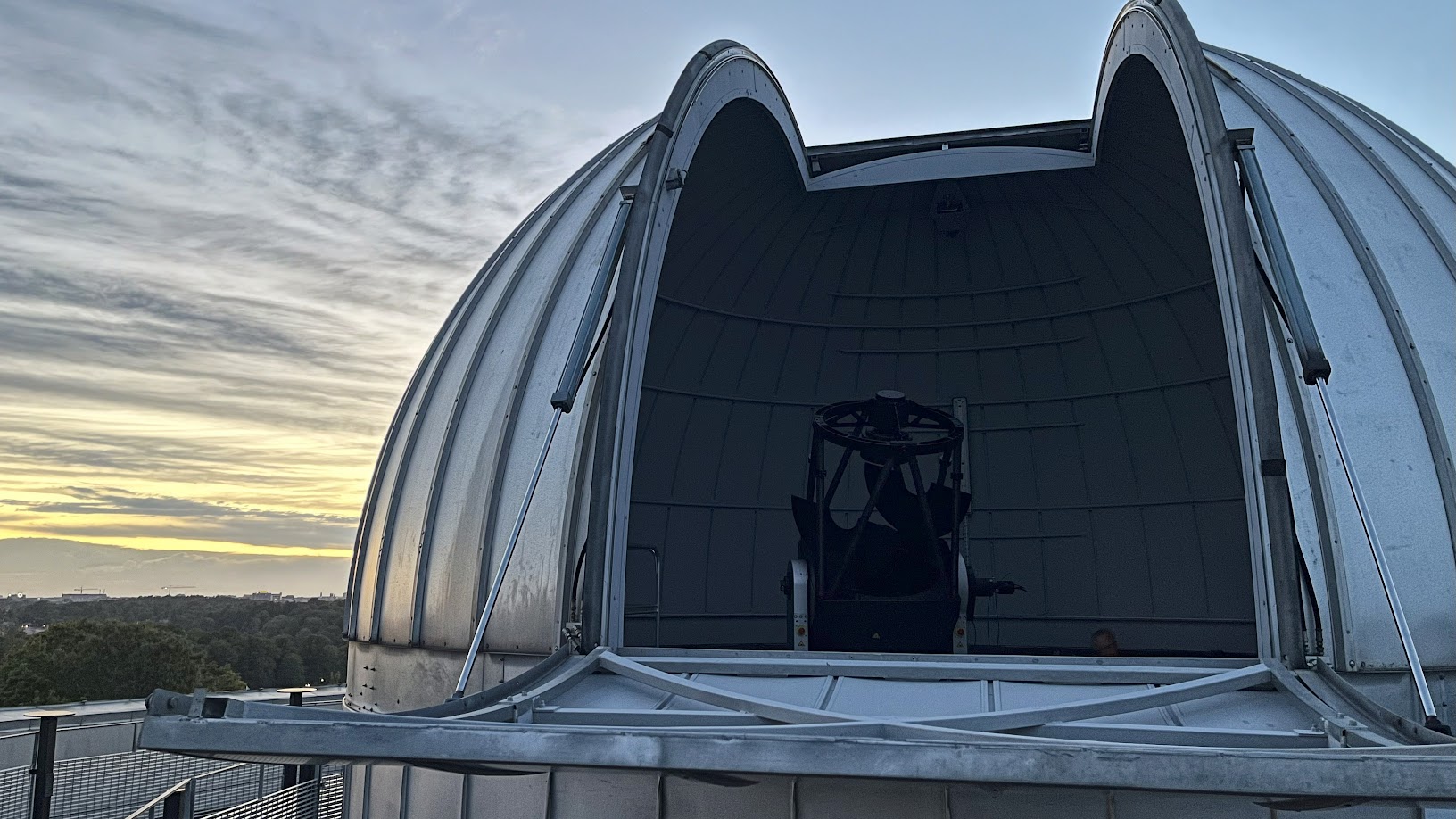
The Department of Astronomy manages the AlbaNova telescope which is used primarily for teaching and public shows.
We offer stand-alone courses on different levels of expertise, but most of our students are a part of our bachelor or master programs in astronomy and astrophysics. During the bachelor studies, the students strengthen their knowledge of advanced math and physics while also learning about fundamental concepts related to astrophysics. Towards the end of the bachelor program, our students take courses in fundamental astronomy, such as how stars form and evolve. The bachelor program is for the most part shared with the programs in physics, meteorology, and medical physics.
Our master program is closely connected with the research conducted at our department. We offer a broad and interesting program where we cover the latest research in exoplanets, galaxy formation and evolution, stellar explosions, solar physics, and observational cosmology. Our master program enrolls national and international students from all over the world, giving the chance to students to broaden their perspectives. We also offer a double-master degree together with the University of Milan-Bicocca in Italy, in which the students get the chance to broaden their knowledge in the subjects of black hole physics, gravitational waves, and large-scale structures in the Universe.
As a bachelor or master student with us you will learn the underlying physics of astronomical phenomena – such as stars, galaxies, black holes, supernovae, and exoplanets. You will study fundamental theories and conduct observations with astronomical telescopes. In your studies of astrophysical phenomena, you will combine many types of knowledge and will learn to solve complex problems. In modern astrophysics, numerical problem solving is required, which means that programming and interpretation of data using statistical methods is an important part of what you will learn. The education thus paves the way for qualified work roles in industry or for further research studies within astrophysics.
Our program students have access to their own group room, within the department premises, for group studies or for working on bachelor/master thesis projects. As an astronomy student, you’re also welcome to attend our research seminars where new astronomy discoveries are presented by invited researchers from all over the world.
Studying astronomy is challenging and demands discipline, but because of that it’s also very rewarding. It’s stimulating to study and discuss the unintuitiveness of quantum physics, the beginning of the universe, and how these connect to what we can observe, says Klara Nager, bachelor student at the Department of Astronomy.
It’s also possible to study astronomy at the department by taking stand-alone courses, but most of the courses have prerequisites in mathematics and physics university studies. The exception to this is our orientation courses which do not require any university education and are given in Swedish. In autumn 2026, two such courses are given.
Welcome to the Department of Astronomy!

Last updated: 2026-03-27
Source: Department of Astronomy