


The Odin satellite celebrated after 25 years in space
The Odin satellite is one of the most successful Swedish space projects ever. It was launched on February 20th, 2001, and has now been in operation for more than 25 years. On February 19th the satellite’s 25th anniversary was celebrated at the Swedish National Space board’s offices in Solna with a day of presentations on the contributions of Odin to research in aeronomy and astronomy. During its lifetime, Odin’s orbit has slowly declined and will, sadly enough, burn up during re-entry into the atmosphere in 2026.
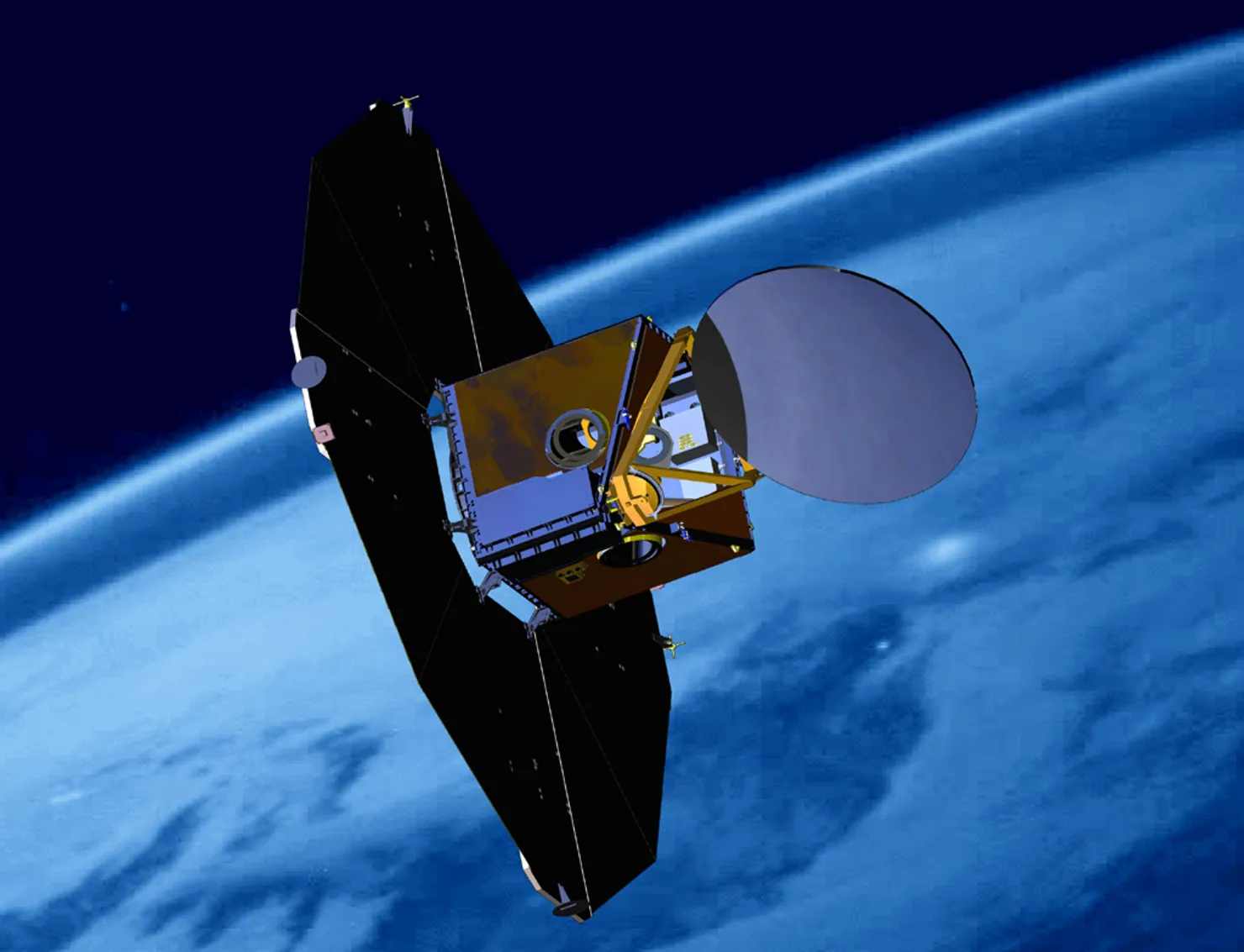
Illustration of the Odin satellite in orbit.
Odin was launched from Svobodny in Russia in February 2001 and have since then been in a so-called polar orbit at (in the beginning) around 600 km altitude. The project started as a collaboration between Sweden (covering 60% of the cost), Canada, Finland, and France, but data from Odin has been used in roughly 400 scientific articles by over 1000 authors from more than 30 different countries. The satellite itself and one of the two instruments on board it were built in Solna, Gothenburg and Linköping by Swedish scientists and space engineers. The project was developed by scientists from Stockholm University (at the Department of Astronomy and MISU) and Chalmers (Onsala Space Observatory) and began already in 1989.
The satellite was built to observe both our own atmosphere (aeronomy) and out into space (astronomy). In the field of aeronomy, observations from Odin have been used to study the ozone layer and how climate change affects the upper layers of the atmosphere. Its long lifetime has made it possible for scientists to follow changes in the atmosphere over a long period of time.
In astronomy Odin was the first telescope to detect molecular oxygen (the oxygen we breathe) outside the Solar system. The discovery was presented in a scientific article, led by Bengt Larsson at the Department of Astronomy, in A&A in 2007. In this study the interstellar gas cloud Rho Ophiuchi, situated around 500 light years from us, was observed and it was shown that the abundance of molecular oxygen was much smaller than previously believed. This led to the conclusion that most of the oxygen was bound in other phases, for example as ice attached to small dust grains in the gas cloud.
It was very exciting to see how all the work we put into the satellite finally yielded results, says Bengt Larsson. The unique observations from Odin have meant a lot to the understanding of the chemical processes active in interstellar gas clouds.
Odin was also specifically designed to measure the abundance of water vapor in interstellar gas clouds with high precision. The telescope has, among other things, observed water in interstellar gas clouds, in gas close to the supermassive black hole in the center of our galaxy, in the atmosphere of Mars, and in material ejected from comets. The last discovery of these was combined with radio observations of comets to find alcohol and sugar molecules. The article on the cocktail comet Lovejoy was published in 2015 (lead by Nicolas Biven, Aage Sandqvist, professor emeritus at the Department of Astronomy, was one of the co-authors) and attracted quite some attention at the time.
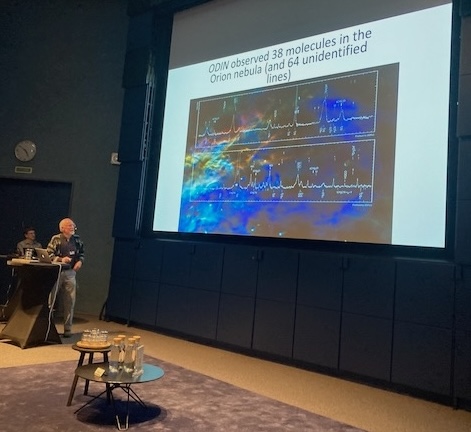
Aage Sandqvist shows one of the astronomical discoveries made by Odin during the event.
Scientists and engineers who worked with Odin both before and during its lifetime attended the 25th anniversary event arranged by the Swedish National Space Board last week. At the event, several groundbreaking discoveries made possible by Odin were presented. One of the speakers was Aage Sandqvist who was one of the original proposers of the satellite. Aage has also been responsible for scheduling the observations with Odin from the beginning to the end, despite his age of 86 years. He was one of the last scientists to use Odin for astronomical observations, obtained on February 23rd this year.
Sadly, the life of Odin is coming to an end. Because of the inherent air resistance in the upper atmosphere, the altitude of its orbit has slowly declined since the launch and according to the latest projections Odin is expected to re-enter the atmosphere and burn up during the third quarter of 2026.
I have worked with Odin since the project started more than thirty years ago, so it’s of course a bit sad that the satellite is now facing its end, says Aage Sandqvist. But at the same time, I’m proud of all the discoveries that I and other researchers have made with the telescope.
More information
Odin webpage at the Swedish National Space Board (in Swedish)
Contact
Aage Sandqvist, aage@astro.su.se
Bengt Larsson, bem@astro.su.se
Last updated: 2026-03-02
Source: Department of Astronomy