


First light images from the new AlbaNova Telescope
The new AlbaNova Telescope, which was lifted into place in September 2025, is now outfitted with a camera. The first images from the telescope show that the system works well. The installation of the camera and other systems continues during the spring, and public shows are expected to resume in the autumn of 2026.
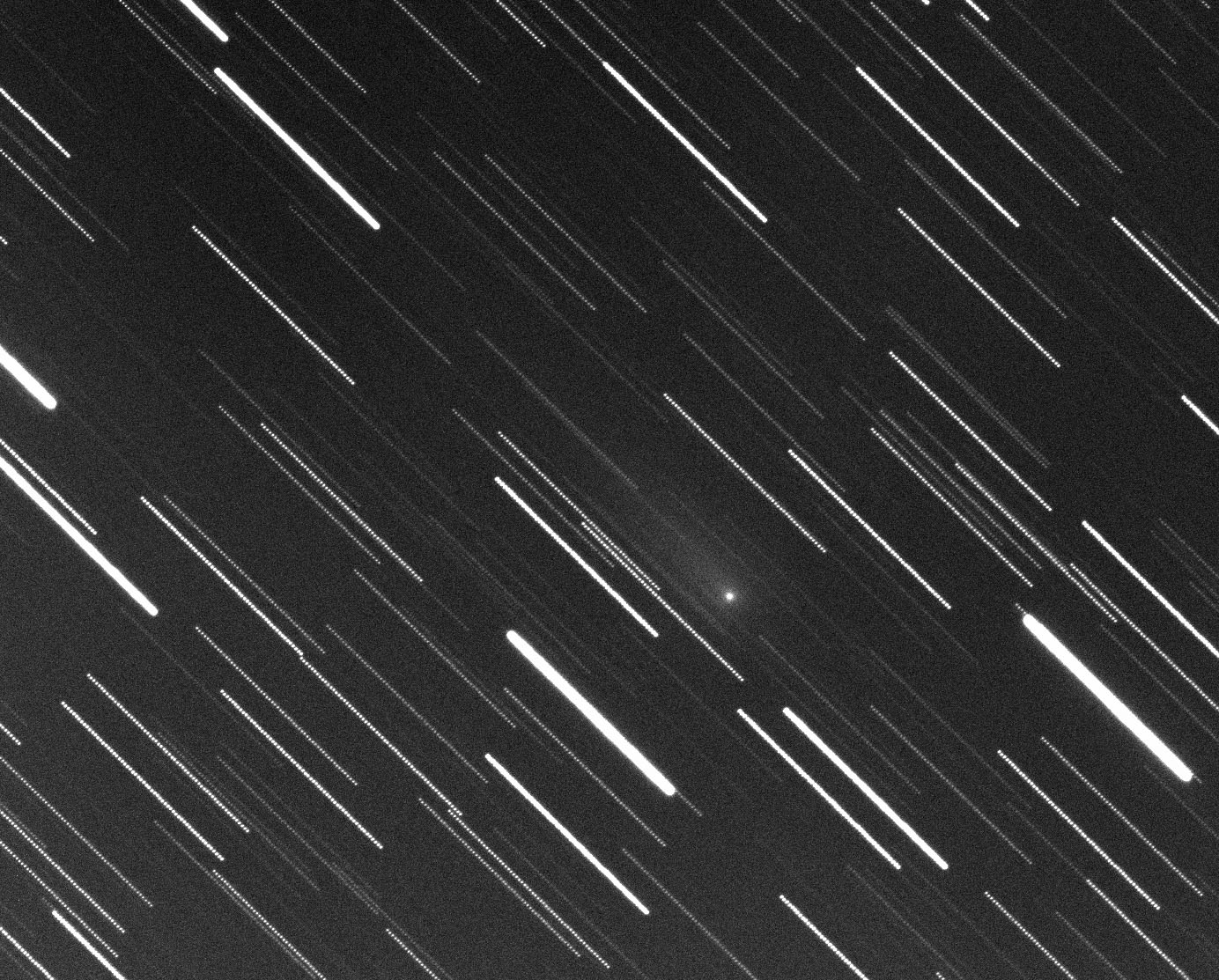
Captured with the new AlbaNova Telescope during a two-hour observation, this image shows the interstellar comet 3I/ATLAS tracked against the star field, leaving the surrounding stars as blurred streaks. Estimated to be 0.3-1 km wide, it is just the third known and confirmed visitor from beyond our Solar System. Photo: AlbaNova Telescope, Alexis Brandeker, and Magnus Näslund.
The Department of Astronomy and the Quantum Information and Quantum Optics research group at Fysikum have bought a new telescope together that replaces the old telescope, which has been out of service for a couple of years. The new telescope, with a diameter of 80 cm, will be used for education (by astronomy students, and for public telescope shows). The telescope will also be used for research in quantum communication, where it will observe and track satellites as part of an experiment (within the framework of the National Quantum Communication Infrastructure in Sweden).
We have now received and installed the camera on the new Albanova Telescope and successfully completed a series of initial tests using a temporary control computer, says Alexis Brandeker, associate professor at the Department of Astronomy.
The next steps are to install the filter wheel and the permanent computer system. The telescope is expected to be fully operational later this spring, with public viewing events planned to begin after the summer.
Observed with the new Albanova Telescope, this two-hour image sequence reveals Io crossing Jupiter’s face and projecting its shadow onto the planet’s swirling clouds. Ganymede appears moving leftward, while Europa travels to the right. In case the image is static, click on it to display the animation in an external photo album.
Last updated: 2026-02-19
Source: Department of Astronomy