


Construction agreement signed for the new instrument BlueMUSE on ESO's VLT
On January 30th European Southern Observatory (ESO) signed an agreement for the construction of the Blue Multi Unit Spectroscopic Explorer (BlueMUSE), an upcoming instrument for ESO’s Very Large Telescope (VLT). The signing marks a major first step in the development of BlueMUSE , which will offer new and unique science opportunities to astronomers. Its evolved technology will enable detailed observations within our galaxy and revolutionise the study of the distant Universe by allowing the detection of the diffuse material in the space between galaxies and helping us understand how matter moves within it. The Department of Astronomy at Stockholm University is a member of the consortium building the new instrument.
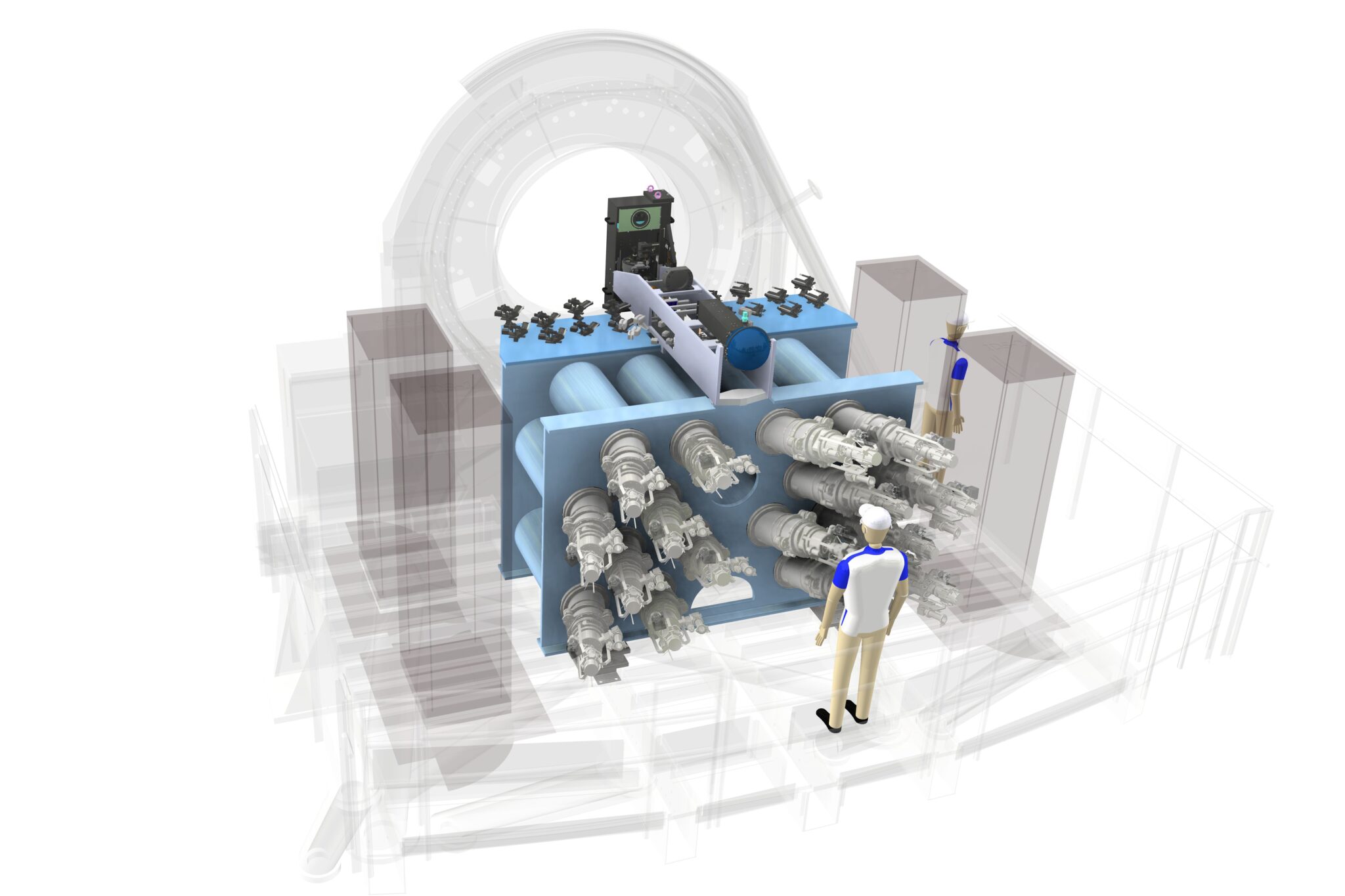
Artist's impression of the BlueMUSE instrument when attached to VLT. Credit: BlueMUSE consortium.
Based on the successful technology of the MUSE instrument installed at the VLT, BlueMUSE is an integral-field spectrograph. It is designed to not only capture a 2D image of a target (or multiple targets) but also to obtain a spectrum which means that it can divide up the light from each object in colour components for each pixel. This results in a full 3D dataset with comprehensive information on the target object. While like MUSE in many respects, BlueMUSE will observe in shorter and therefore bluer wavelengths, with higher spectral resolution (how finely it can distinguish between different wavelengths). This means it will strongly complement large ground- and space-based facilities, such as ESO’s upcoming Extremely Large Telescope and the James Webb Space Telescope, which are optimised to observe in the infrared.
BlueMUSE will be a key instrument in driving astrophysics discoveries in the 2030s and Stockholm University will contribute to the realization of this advanced and complex instrument, says Angela Adamo at the Department of Astronomy and member of the BlueMUSE consortium.
On January 30th 2026, ESO’s Director General Xavier Barcons and Céline Reylé, the Deputy Director for Science for Astronomy and Astrophysics at the French National Centre for Scientific Research (CNRS), signed the BlueMUSE agreement at the ESO Headquarters in Garching, Germany. The CNRS’s Centre de Recherche Astrophysique de Lyon (CRAL) is the institution leading the instrument consortium, which consists of multiple institutes from Europe and Australia, including the Stockholm University. The Principal Investigator of BlueMUSE, Johan Richard, was also in attendance.
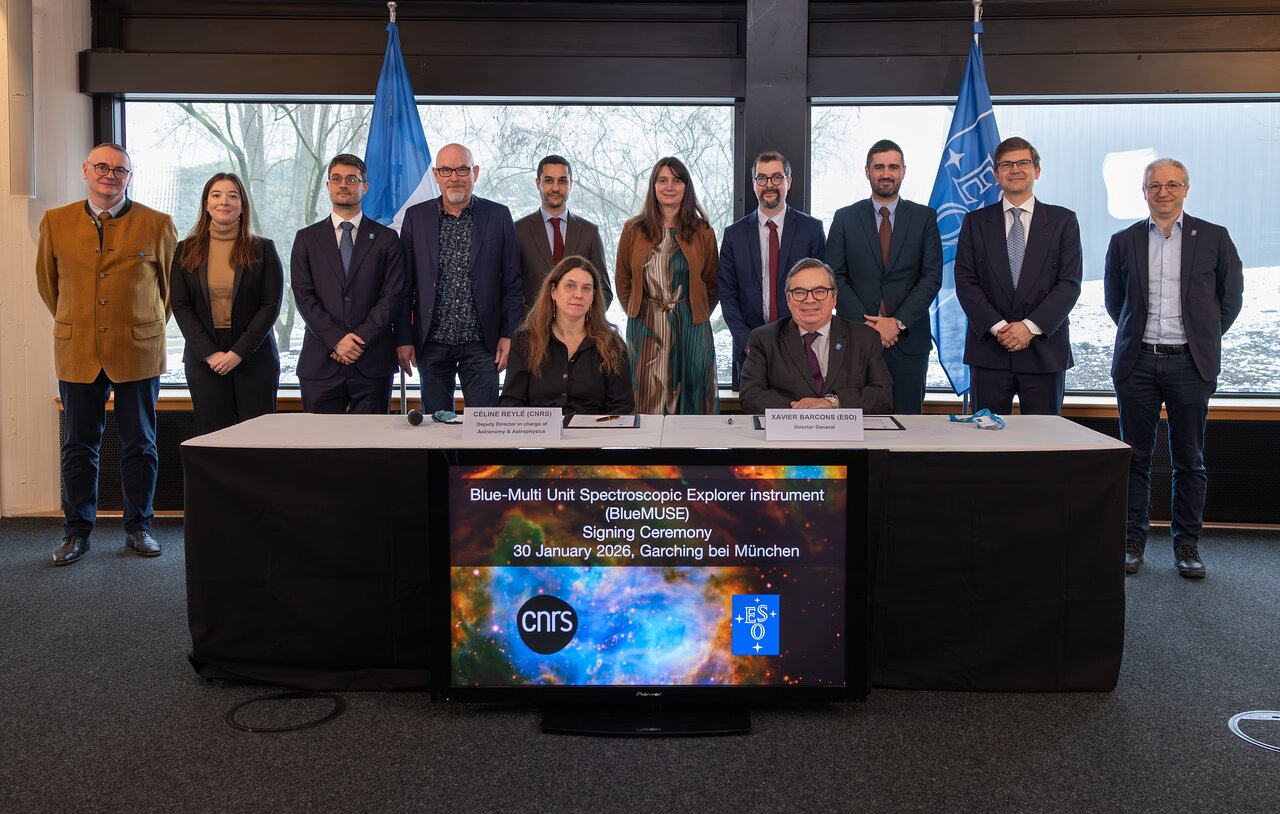
The BlueMUSE project team pose for a photo at the instrument signing ceremony. Céline Reylé, the Deputy Director for Science for Astronomy and Astrophysics at the French National Centre for Scientific Research (CNRS) and Xavier Barcons (Director General, ESO) are in the foreground. Photo: ESO.
Anticipated to see first-light in 2034, BlueMUSE will enable new science opportunities, beyond those possible with MUSE. It will survey larger samples of massive stars in the Milky Way and its galactic neighbourhood, helping answer key questions about stellar evolution. Further afield, it will be able to observe faint galaxies, starburst galaxies, the very diffuse and elusive matter that permeates the space between galaxies, and to probe the emergence of the first galaxy clusters. At the Department of Astronomy at Stockholm University, Angela Adamo and Matthew Hayes (also co-Investigator in the consortium) are involved in the BlueMUSE science and instrument development. Their particular research interests with BlueMUSE are related to star formation in galaxies and how supermassive black holes (quasars) affect their surroundings in the early Universe.
MUSE is one of the most productive and requested instruments at ESO, with BlueMUSE we will get a similar instrument, but enabling new unique science at bluer wavelengths, says Matthew Hayes. For my research the instrument will provide a new perspective on galaxies both near and far.
More Information
The BlueMUSE project will be built by an international consortium composed of 9 research institutes in multiple countries and ESO. The consortium consists of
- Australia: Australian Astronomical Optics
- France: Centre de Recherche Astrophysique de Lyon (CRAL; lead); Astrophysique, Instrumentation & Modélisation (AIM), Saclay; Institut de Recherche sur les lois Fondamentales de l’Univers, Saclay
- Germany: Leibniz Institute for Astrophysics Potsdam (AIP)
- Portugal: Institute of Astrophysics and Space Sciences
- Sweden: Department of Astronomy, Stockholm University
- Switzerland: Observatoire astronomique de l’Université de Genève; Laboratory of Astrophysics, Ecole Polytechnique Fédérale de Lausanne (EPFL)
- United Kingdom: Centre for Advanced Instrumentation, Physics Department, Durham University
ESO also contributes to the project development.
Read more
Contact
Angela Adamo, angela.adamo@astro.su.se, 08-553 785 56
Matthew Hayes, matthew.hayes@astro.su.se, 08-553 785 21
Last updated: 2026-02-02
Source: Department of Astronomy