About the project

CLIMPEAT aims to transform our understanding and ability to quantify the response of northern peatlands to climate change and their feedback on future warming.

We aim to address the critical knowledge gaps that hinder coupled-climate projections of northern peatland dynamics. This project addresses key critical feedbacks missing in current ESM and will inform climate.

The project is organised into four work packages (WPs). WP1 will create uniform and high-quality northern peatland maps, which include layers that quantify the properties that make them vulnerable to change. WP2 will improve empirical process understanding by implementing a first-ever landscape-scale permafrost-peat thaw experiment and quantify disturbance effects on greenhouse gases and lateral fluxes. WP3 will integrate new empirical understanding and data into a hybrid AI-powered process-based model. WP4 will design and implement peat-enabled Earth System Model simulations to assess the risk of amplifying global warming from abrupt changes and increased greenhouse gas emissions.
This WP aims to better understand the distribution of northern peatlands over space and time. Current peatland maps lack agreement, are based on inconsistent data and miss isolated and small peatlands. Inconsistent map data is still the main source of uncertainty for greenhouse gas budgets. There is a need for a new generation of maps that separate individual peatland basins with high spatial accuracy and describe their properties, such as peat depth, peatland morphology, hydrological regimes, permafrost conditions and ice content. Because peatlands have widely different properties, novel combinations of different approaches will significantly improve mapping accuracy.

WP 1 is coordinated by Gustaf Hugelius at the Department of Physical Geography, Stockholm University.

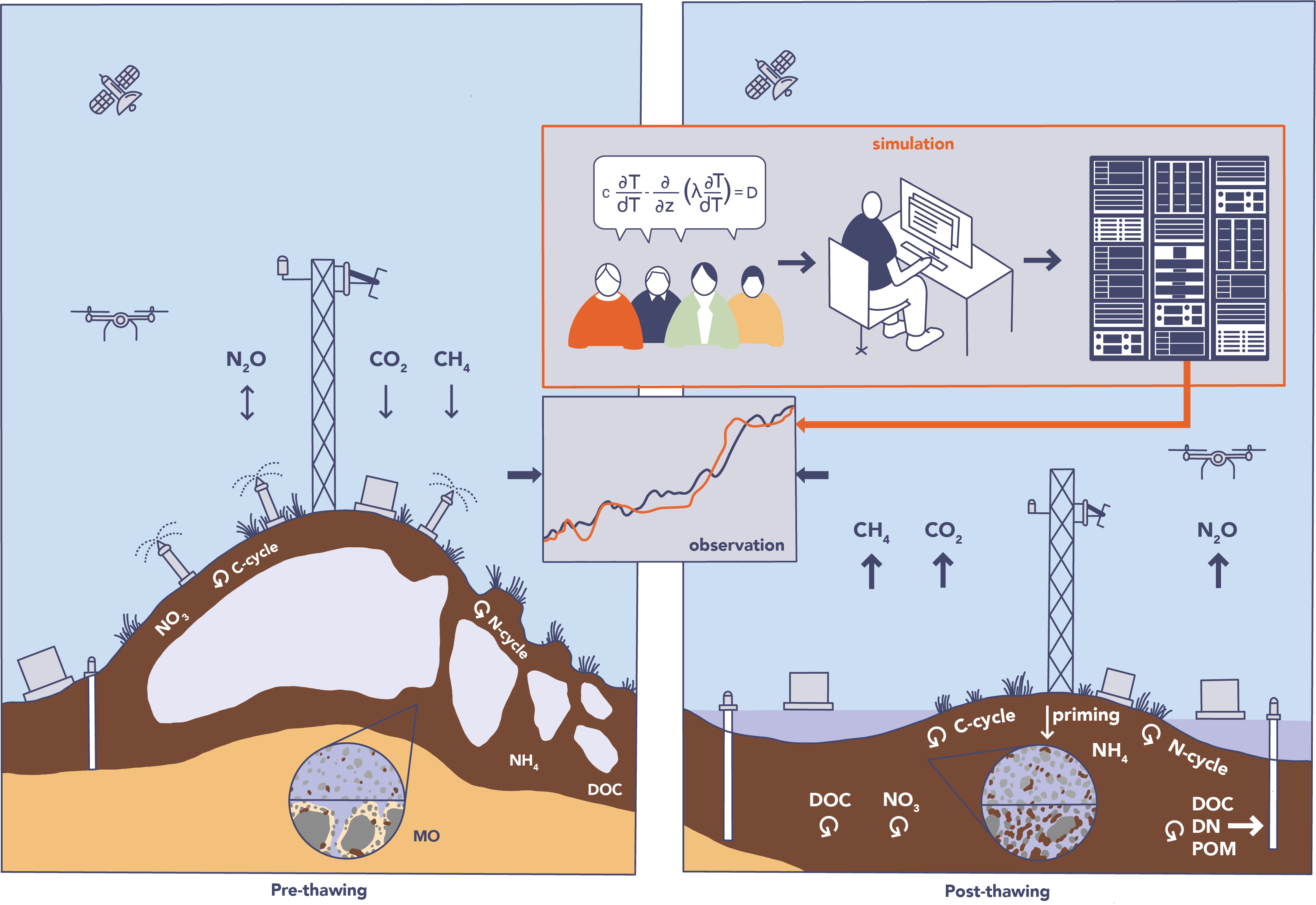
There is only limited experimental data for understanding climate driven peatland changes, especially the effects of permafrost thaw. To fill this gap, WP2 will establish the CLIMPEAT thawing experiment near Kilpisjärvi in Northern Finland. This will be a unique landscape-scale permafrost peatland thaw experiment measuring greenhouse gas fluxes and carbon/nitrogen
dynamics over a period of several years. In addition, new greenhouse gas flux measurements will be made in strategic locations across the Arctic, and we will perform laboratory experiments and soil incubations to assess organic matter decomposition rates and
microbial community shifts with climate change.

WP 2 is coordinated by Christina Biasi, University of Innsbruck.

A giant step is needed for accurately representing peat processes in land surface models. To reach this goal, WP3 will develop an existing model that contains basic peat processes into an advanced AI-empowered model. The new PEAT model will resolve key processes controlling gradual and abrupt changes of carbon and nitrogen stocks and greenhouse gas emissions for different types of peatland abrupt changes. In this WP, the PEAT model will be tested and calibrated from site- to regional scale. In WP4, it will be run from the last glacial maximum to pre-industrial climate, and for future scenarios. Model development will occur in roughly 3 cycles during the project. Model code will be open source and description published in open access journals.

WP 3 is coordinated by Philippe Ciais, LSCE.

This WP focuses on developing an advanced understanding of the long-term and current evolution of northern peatlands and their role in the future climate system. We will synthesise present-day northern peatland greenhouse gas fluxes using three modelling approaches. We will simulate the slow peat accumulation from the Last Glacial Maximum to pre-industrial to understand the evolution of carbon and nitrogen stocks. We will then investigate their future perturbation due to climate change, including abrupt permafrost changes and to direct peatland management effects with a fully fledged peat-enabled Earth System Model, with a focus on different regimes of abrupt change.

WP 4 is coordinated by Pierre Friedlingstein, University of Exeter.

The CLIMPEAT landscape-scale Thaw Experiment where intact permafrost mires will be rapidly thawed by water additions from nearby fens. We will monitor abrupt changes and the observations wills serve as a benchmark for model calibration of abrupt thaw processes. To compensate the thawed area, CLI;PEAT will also use snow manipulation experiments to create new permafrost peatlands.

Last updated: 2026-09-21

Source: Communications Office