


New PhD course in Medieval studies open for applications
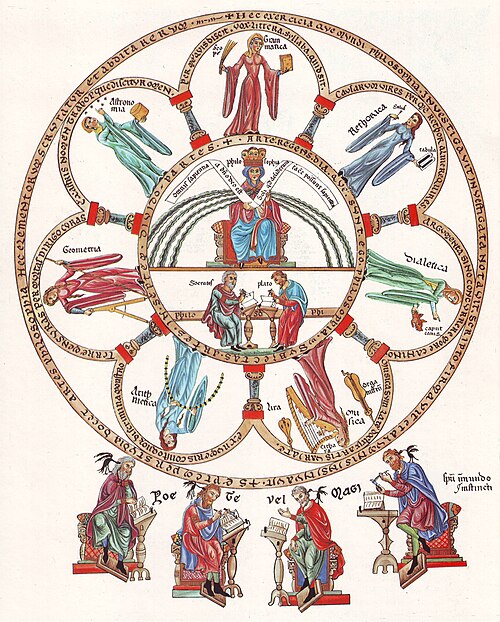
Philosophy and the Seven Liberal Arts, by Herrad of Landsberg, circa 1180.
The Center for Medieval Studies at Stockholm University, in cooperation with the Center for Medieval Studies at University of Bergen, invites applications from PhD students in Scandinavia with any medieval research topic and international PhD students with a research focus on the Scandinavian Middle Ages for the upcoming PhD course, Medieval Interdisciplinarity – past, present, and future. The event will take place between the 26-28 of March in Stockholm, Sweden.
Medieval Interdisciplinarity – past, present, and future
- PhD course – 4 ECTS
- Department of History – Stockholm University, Sweden
- 26–28 March 2026
- Apply before 1 February
Medieval Studies are traditionally both highly interdisciplinary and methodologically aware, for many reasons. Sources are comparatively few compared with later periods and the combination of different disciplines is often necessary to establish a more complete and rigorous understanding of the study area. The nature of the sources also means that a certain amount of philological and palaeographical skill is typically required for anyone interested in studying the Middle Ages, whether their field of interest lies in history, theology, literature, law, etc. The cultural and spiritual world of the Middle Ages is also difficult to fully grasp without some knowledge of art and architecture. Archaeology has a well-established tradition for cooperation e.g. with hard science, but also here the supplementary use of written sources has become rarer.
Interdisciplinarity has been a strength of Medieval Studies since the mid-19th century, and it is now considered an asset in all other humanistic studies and projects. But what is the state of interdisciplinarity in Medieval Studies today, and what are its weaknesses in light of the accelerating technological and societal transformations taking place? Does a dwindling knowledge of what were previously considered to be basic skills, such as proficiency in medieval languages, mean that interdisciplinarity is growing increasingly superficial? Do new tools, such as digital humanities and AI, provide novel opportunities for combining disciplines, or do they jeopardize the earnestness of interdisciplinary approaches?
About the course
The course consists in presentations by teachers, discussions of participants projects, and discussion of three articles on interdisciplinarity that will be distributed before the course.
The course will be examined through two assignments as well as active in-person participation on location in Stockholm. Participants will be required to submit a three-page reflection two weeks prior to the course start on their use of interdisciplinary approaches in their project and the benefits and challenges that they have experienced as a result. The course will run for three days and consist of active discussion of the reflections and an excursion to some medieval sites. One week after the course, participants will submit a two-page reflection on their learnings from the course and the implications of these learnings for the interdisciplinary component of their project.
Dinner will be provided on 26th March and all lunches. The excursion on 28th March will end in the afternoon so it will be possible to travel back on Saturday.
Participants will have to seek their own funding for travel and accommodation during the course.
How to apply
To apply, please submit the following materials no later than 1 February 2026.
- A one-page description of your research project, including its relevance to Medieval Studies.
- A current CV, including your name, contact information, institutional affiliation, and academic background.
- A letter of recommendation from your academic advisor or supervisor, including their contact information.
Applications should be submitted electronically to: sekreterare@medeltid.su.se, kirsi.salonen@uib.no, and kurt.villads.jensen@historia.su.se.
Enrollment will be capped at 20 PhD students. Successful applicants will be notified by 15 February 2026. If necessary, advanced notice for successful applications can be provided upon request.
If you have any questions about the event or the application process, please contact sekreterare@medeltid.su.se.
We look forward to receiving your applications and welcoming you to Stockholm in March!
Organizers
The course is arranged by Karl Farrugia, Post.doc., Oslo University, Nordic Philology, Literary Studies, and History; Fraser Miller, Post.doc., Stockholm University, history and history of law; Anne Katrine Holm Pedersen, PhD student, Stockholm University, history and Climate history; Sune Bechmann Pedersen, lecturer in digital history, Stockholm University; Kirsi Salonen, professor in Medieval history, Bergen, PhD in history and PhD in law, director of the interdisciplinary Centre for Medieval Studies, Bergen University; Christian Lovén, Research fellow emeritus, the National Archives, Stockholm, Docent in art history; Nanouschka Myrberg Burström, docent, Stockholm University, Archeology; Kurt Villads Jensen, professor in Medieval history, director of the interdisciplinary Centre for Medieval Studies, Stockholm University.
Last updated: 2026-01-26
Source: Department of History