


Arctic warming could change the availability of cloud-forming particles
As the Arctic warms, the tiny airborne particles that help clouds form could become more abundant in some regions and less abundant in others. A new study published in Nature Geoscience, involving researchers at the Bolin Centre for Climate Research and the Department of Environmental Science at Stockholm University, reveals contrasting patterns across the Arctic and highlights the importance of regional differences for understanding future climate change.
Small particles, big effects on climate
Clouds play an important role in the Arctic climate system. They can either cool the surface by reflecting sunlight back into space or warm it by trapping heat emitted from the Earth’s surface. Understanding how clouds will respond to a warming climate is therefore important for predicting the Arctic’s future climate.
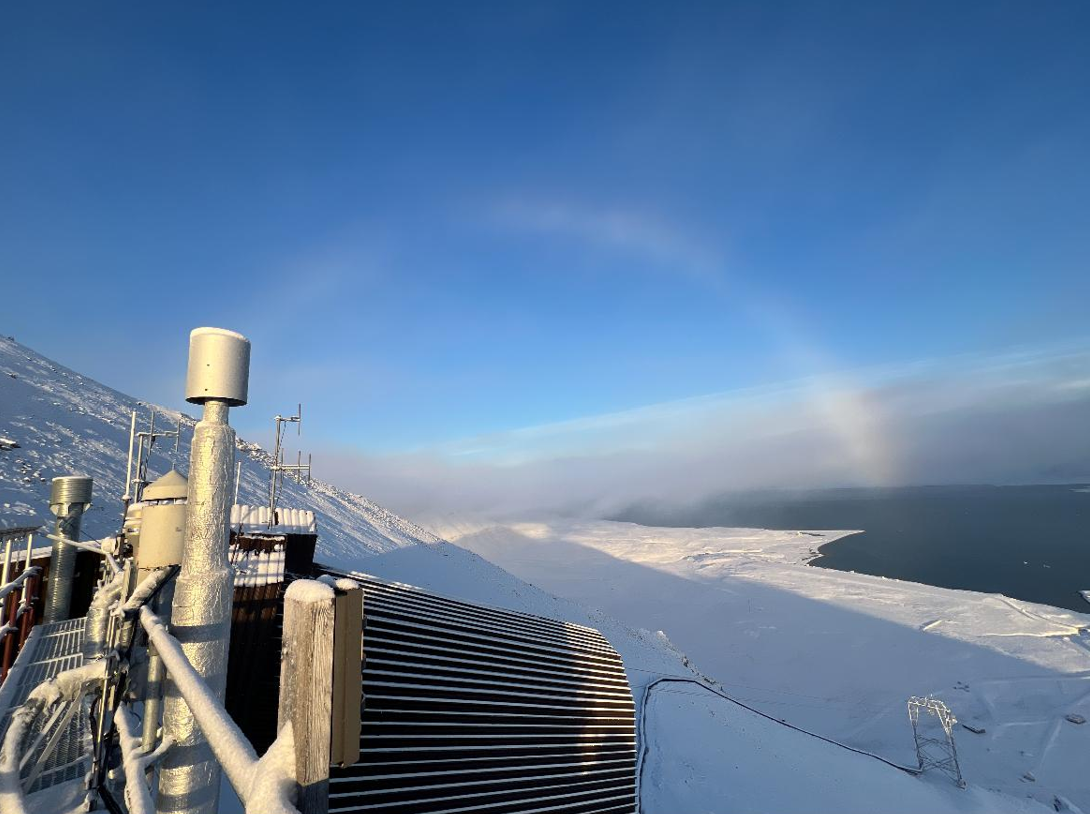
View from the Zeppelin Observatory at the Ny-Ålesund Research Station in Norway, showing a cloudbow above thin, low-level liquid clouds. Photo: Radovan Krejci
One important factor influencing cloud formation and their properties are tiny particles in the air called aerosol. Some particles act as cloud condensation nuclei (CCN), providing surfaces on which water vapor condenses to form cloud droplets or ice crystals. The number of these particles can affect how many and how big droplets form in a cloud and as a result how much sunlight cloud reflects.
New particle formation is a process when gases in the atmosphere react to form new particles. The newly formed nanometer size particles must then grow large enough to become effective CCN.
In the Arctic, where aerosol concentrations can be very low, even relatively small changes in the availability of CCN could have important effects on cloud properties. However, predicting how these particles will respond to warming has been challenging, partly because the Arctic encompasses different environments with different aerosol sources and atmospheric conditions.
To investigate these differences, the researchers brought together aerosol measurements from eight Arctic locations and research expeditions, covering the period from 2003 to 2024. They combined these observations with satellite-derived data to map the potential for new particle formation across the Arctic and examine how it relates to cloud condensation nuclei.
Three Arctic regions, contrasting responses
The analysis revealed three distinct regimes which can be geographically divided into: the High Arctic, the Maritime Arctic and the Continental Arctic.
In the High Arctic (areas around Greenland and the Canadian Arctic Archipelago), local new particle formation plays an important role in the supply of CCN. The study found a positive relationship between the potential for new particle formation and cloud condensation nuclei concentrations, suggesting that changes in local particle formation can directly influence the availability of cloud-forming particles.
The Maritime Arctic (encompassing open waters in areas such as the Barents and Norwegian seas) is similar to the High Arctic with emissions from the ocean and processes associated with sea ice marginal zone can provide gases that contribute to the formation of new particles.
In contrast, the Continental Arctic is more strongly influenced by aerosols transported from lower latitudes, alongside local emissions. In this region, cloud condensation nuclei concentrations showed little relationship with the potential for new particle formation. This suggests that changes in transported aerosols, rather than local particle formation alone, are likely to be particularly important for future cloud-forming particle concentrations.
For the first time, we can present a comprehensive picture by combining in-situ observations with satellite remote sensing. This has allowed us to explore how different parts of the Arctic may respond to continued warming and reveals a complex picture in which different regions are likely to follow different trajectories,” says Radovan Krejci, co-author of the study and researcher at the Bolin Centre for Climate Research as well as the the Department of Environmental Science at Stockholm Unviersity.
Under an intermediate warming scenario, the researchers estimate that cloud condensation nuclei associated with new particle formation could increase by approximately 10 per cent in the High Arctic by the end of the century. In the Maritime Arctic, the corresponding concentrations could decline by around 15 to 30 per cent. These estimates are based on the observed relationships between new particle formation potential and cloud condensation nuclei, combined with projected temperature changes for 2090–2100.
While the overall trends appear robust, the exact magnitude of future changes remains uncertain. Satellite observations cannot directly capture new particle formation events and instead identify regions where conditions are favourable for their occurrence. Future aerosol concentrations will also depend on changes in natural emissions, human activities and atmospheric transport
Last updated: 2026-11-09
Source: Department of Geological Sciences