


New study confirms: Large variability in greenhouse gas fluxes in shallow coastal bays
Shallow Baltic Sea bays are significant but highly variable sources of greenhouse gases. This is shown in a new study conducted by a large group of researchers from CoastClim and the Thriving Bays projects.
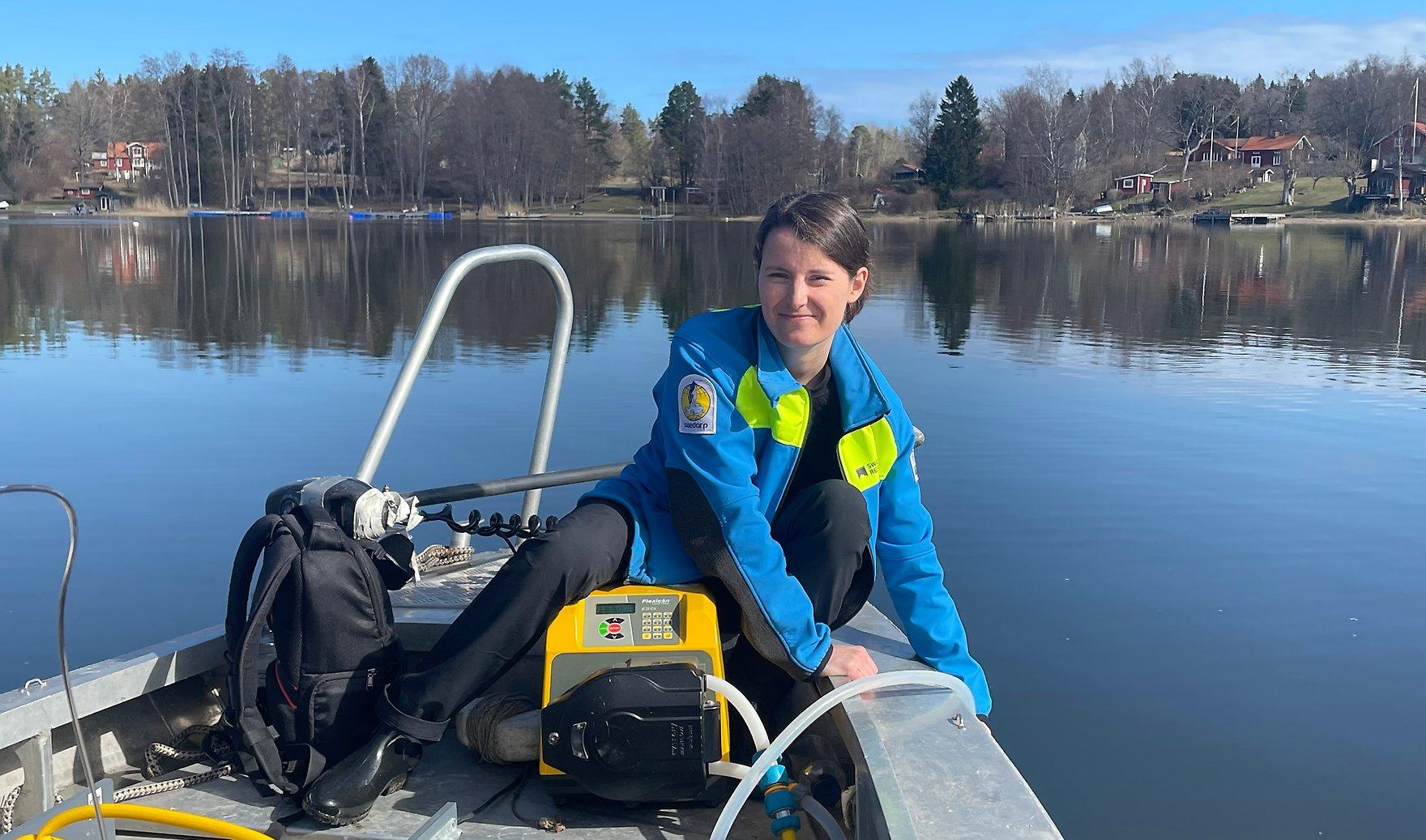
The first greenhouse gas measurements in the project were carried out in Sandviken Bay in April 2024, and followed several additional measurements. Julika Zinke and her colleagues have now analysed the results, which show that Sandviken takes up carbon dioxide but releases a small portion of methane in spring, while both gases are released in autumn. Photo: Lisa Bergqvist
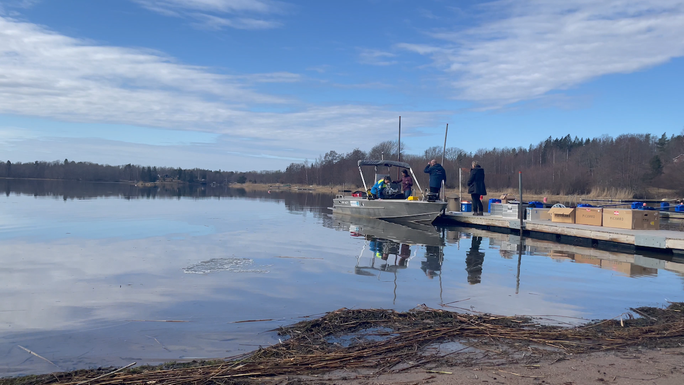
In April 2024 a large group of researchers from different disciplines gathered on the shore of the peaceful Sandviken bay. The researchers in the CoastClim consortium focus on deciphering cycling of carbon and greenhouse gases in the Baltic Sea, and the researchers in the Thriving bays project investigate and evaluate measures to restore sheltered shallow bays. Together they might be able to answer the question: Is there a difference between healthy and degraded coastal bays in terms of greenhouse gas emissions and uptake?
Comprehensive measurements of greenhouse gas concentrations in both water and air were conducted in Sandviken, followed by similar campaigns in the spring and autumn same year in totally six shallow bays. The bays were selected to represent gradients in topographic openness and degradation status, enabled by the fact that they were already thoroughly examined by the Thriving Bays project.
“The results highlight the complex and highly variable nature of greenhouse gas dynamics in these systems. Our findings demonstrate that shallow Baltic Sea bays are significant but highly variable sources of greenhouse gases”, concludes Julika Zinke, who is first author of the new study published in Biogeosciences.
Clear seasonal variations
Most bays sampled in April showed a net uptake of carbon dioxide from the atmosphere during the period of sampling, likely due to the ongoing spring bloom, when growing algae take up carbon dioxide through photosynthesis. The carbon dioxide concentrations in the water also exhibited negative relationship with chlorophyll-a and pH. However, this uptake was partly offset by a smaller release of methane – a stronger greenhouse gas – specially in two of the bays.
In the autumn, when organic material is generally decomposed, almost all bays showed elevated levels of both carbon dioxide and methane in the water, and a net release of both carbon dioxide and methane to the air. The highest release of carbon dioxide, however, was seen from the two bays that weren’t sampled in the spring.
“Estimating fluxes is very difficult, since they depend not only on the concentrations in the water and air, but also of wind speed, which is highly variable”, explains Christoph Humborg, scientific leader at Stockholm University Baltic Sea Centre and another one of the authors.
“The concentrations of methane were oversaturated in all bays, and that methane will be released at some point, even though less significant fluxes occurred during the period of sampling.”
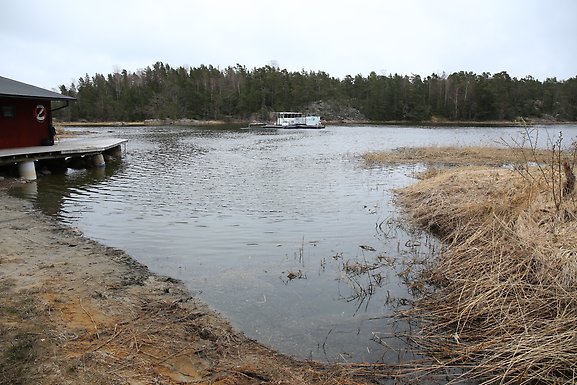
Högklykeviken is by far the most eutrophic of the sampled bays and exhibited the highest methane emissions. The bay is undergoing a repeated aluminium treatment aimed at reducing phosphorus concentrations and mitigating eutrophication. Photo: Lisa Bergqvist
Högklykeviken – a methane source
One of the sampled bays, Högklykeviken, stands out as being considerably more eutrophic than the others. Once a clear and lush cove that attracted anglers from near and far, the bay over years turned to a murky place with almost no seabed vegetation, likely as a result of dredging.
Starting off in between the two sampling periods the bay is undergoing a restoration measure, where an aluminium solution is inserted to the sediment to bind phosphorus and reduce eutrophication.
Högklykeviken also stands out in the greenhouse gas measurements, exhibiting the highest methane emissions in both spring and autumn, while also taking up carbon dioxide in the fall. Although more carbon is taken up than released, this makes the bay a net source of greenhouse gases (when using the sustained global warming potential of 45 for methane).
So, can one conclude from the study that more degraded bays release more greenhouse gases?
“No, against our expectations we did not observe a clear correlation with degradation state. While the most degraded bay, Högklykeviken, exhibited the highest methane concentrations, high methane concentrations were also observed in less degraded bays such as Östra Myttingeviken”, says Julika Zinke.
Accumulation of organic matter cause methane emissions
The high methane concentrations in Östra Myttingeviken and similar bays appear to be caused by the threshold opening of such bays, which results in a substantial accumulation of organic material in the sediments, the researchers explain.
Methane concentrations were generally found to be higher inside the bays than outside, and higher in the more enclosed bays than in the more open ones.
“Both our study and previous ones show that shallow areas accumulating a lot of organic matter tend to become hotspots for methane emissions”, says Sofia Wikström, one of researcher participating in the Thriving Bays project.
The accumulation of organic matter in sheltered bays is a natural phenomenon, but can be intensified by eutrophication.
“This is particularly obvious in Högklykeviken”, says Sofia Wikström. “But we know that all bays in this part of the Baltic Sea are to some degree affected by large-scale eutrophication, even if they are less degraded than Högklykeviken.”
Nitrous oxide – a puzzling player
Apart from carbon dioxide and methane, the researchers also measured concentrations and fluxes of nitrous oxide, N2O. Nitrous oxide is a very powerful greenhouse gas (around 270 times carbon dioxide), but not very widely discussed.
The total fluxes of nitrous oxide in the sampled bays were small, occurring as a release in spring and as an uptake in autumn. However, the pattern of nitrous oxide concentrations in relation to methane was surprising to the researchers: while the overall correlation between methane and nitrous oxide was negative, it shifted to a positive correlation in the two bays with the highest methane concentrations.
“We can explain the negative correlation with the different spatial patterns of the gases – nitrous oxide is higher outside the bays, while methane is higher inside the bays where organic matter accumulates”, Julika Zinke says. “But we can only speculate that the positive correlation is due to different biogeochemical processes dominating at high versus low methane concentrations, indicating the complex carbon-nitrogen cycling dynamics of these systems. Interestingly, this pattern was observed in the highly degraded Högklykeviken, which has also been subject to a phosphorus-binding treatment.”
Climate effects of restoration
In addition to the aluminium treatment in Högklykeviken, the Thriving Bays project is testing different other restoration measures for degraded bays, including the placement of an artificial threshold to one of the bays to reduce erosion driven by water movements. The researchers are also examining the effects of establishing no-take fishing zones and how the impact from recreational boating can be reduced.
Besides improving the environmental conditions in the bays, such restoration could possibly contribute to mitigating climate change.
“The large variability shows that it is difficult to predict the climate effects with certainty”, says Sofia Wikström. “But it is well known that anoxic sediments contribute to higher methane emissions, so if restoration efforts shift anoxic conditions to hypoxic or oxic in shallow sediments it will possibly have substantial influence on the climate effects. Restoration efforts that result in reduced eutrophication and thus reduced production and accumulation of organic matter could also – in the long-run – result in fewer hotspots for methane emissions in shallow bays.”
Text: Lisa Bergkvist
Read the study in Biogeosciences
Related reading
Sheltered bays are significant carbon sinks in the Baltic Sea (2025-03-12)
Muddring orsakade övergödning – nu ska aluminium återställa Högklykeviken (2024-06-11)
Deciphering coastal climate impact: Sandviken Bay exploration (2024-04-30)
New study: Methane emissions offset carbon uptake in Baltic macroalgae habitats (2023-01-04)
Thriving Bays
The project Thriving bays runs 2020-2027 and is conducted by BalticWaters with funding from, and in close cooperation with, Stockholm University and the county administrative board of Stockholm. The Swedish Agency for Marine and Water Management has granted funds to Stockholm University for sampling and evaluation in the project areas.
CoastClim
The Centre for Coastal Ecosystem and Climate Change Research, CoastClim, is an interdisciplinary consortium of researchers and advanced infrastructure. It brings together expertise from the marine and atmospheric units at Stockholm University and University of Helsinki, and explores the links between climate change and biodiversity in the coastal zone.
Last updated: 2026-04-20
Source: Department of Geological Sciences