From text to tech: Digital literacy and the transformation of history, 7.5 ECTS

The aim of this course is to critically examine the technologies supporting historical research and to train participants in the critical handling of humanities data. Participants will develop a foundational understanding of theoretical concepts and gain practical experience in tools and methods for organising and analysing data, based on their own doctoral projects.

Course Content
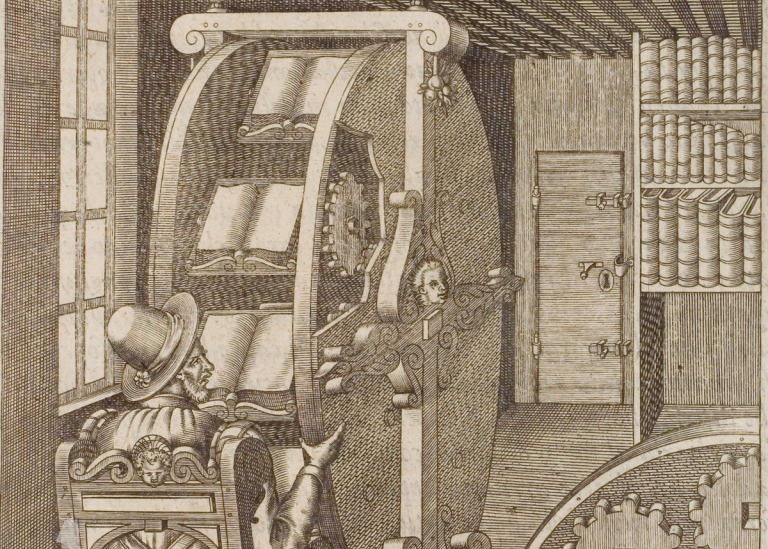
Foto: Bookwheel illustration from “The Various and Ingenious Machines of Captain Agostino Ramelli” (1588). Source: Wikimedia Commons

Historical research is undergoing a profound transformation. Digitalisation is generating new kinds of sources, while older materials are being digitised at scale and archival collections are increasingly accessed through remote servers rather than physical reading rooms. These shifts alter how historians discover, evaluate, and interpret evidence, and they open possibilities for computer‑assisted analysis that challenge established methodological habits. Situated at the intersection of digital humanities and digital history, this course examines the field’s growing dependence on digital technologies and develops participants’ capacity to critically engage with humanities data.

The course combines conceptual reflection with practical training. Teaching consists of seminars, hands‑on workshops, and discussions of current scholarship within the framework of the Digital History Seminar. Participants are introduced to central issues such as structured data, data modelling, database logic, and the methodological consequences of digitisation. They also gain familiarity with open‑source tools for organising and analysing data, explore the implications of AI-assisted techniques for historical inquiry, and experiment with forms of distant reading and other computational approaches. Throughout, the course emphasises how methodological choices shape historical interpretation and encourages participants to integrate digital practices into their own research in a reflective and informed manner.

After completing the course, participants will be able to demonstrate an advanced understanding of how digital infrastructures, methods, and sources reshape the conditions and interpretive frameworks of historical research. They will also be able to demonstrate data literacy by critically assessing how historical data are produced, modelled, structured, and used in digital environments. Furthermore, they will be able to apply and reflect on the use of open‑source software for organising, modelling, and analysing humanities data.

Examination

The course uses a goal‑related two‑grade scale: Pass (G) and Fail (U). A Pass is awarded when the learning outcomes are achieved; otherwise, the grade is Fail.

The course is examined through mandatory preparatory exercises before each workshop, active participation in teaching sessions, and a final take‑home assignment.

Mandatory elements

Physical presence and active participation at all seminars and workshops is a compulsory requirement for completing the course.

Instruction

The course consists of workshops and seminars on campus. They combine lectures, seminar discussions and presentations by participants.

The course is taught on campus in two concentrated blocks to allow for long-distance participants to travel to Stockholm to attend the course.

Please note: The course is offered on campus.

Course dates:

The teaching is delivered on campus in two intensive blocks on 9–10 September and 29–30 September 2026. Preparatory reading is required ahead of the first block.

Language of Instruction:

Swedish or English, depending on the participants.

Litterature list:


Course plan:

HI1DIGI pdf, 191.3 kB.


Application Period

Applications for courses starting in the autumn semester 2026 are received between May 15 and June 30, 2026. Notifications of acceptance are sent out as soon as possible after the final date.

All applications are sent by the supervisor to: doctoralschool@hum.su.se. Official transcript of records, or certificate of registration, verifying the applicant's status as doctoral student should be enclosed with the application.

All courses are free of charge, and they are open to all who are admitted to studies on PhD-level, regardless of faculty or university. Prerequisites and special admittance requirements may apply for some courses.

How to Apply

The application form (document link below) is used to apply for a place in a course. The supervisor (or equivalent) must support the doctoral student’s application with a motivation as to why the doctoral student should participate in the course. The supervisor also submits the proposal to the following address: doctoralschool@hum.su.se.

Application form for place in a joint faculty course docx, 368 kB.

Doctoral candidates enrolled at universities other than Stockholm University must attach proof of registration in Ladok (or equivalent), confirming admission to third-cycle (doctoral) studies.

Who can apply?

The Faculty of Humanities’ doctoral students have priority for places, and external doctoral students (from Stockholm University or another university) can be admitted to a course subject to availability. External doctoral students will be registered in Ladok in order to enable the Board to monitor all participants in a course.

This course is offered by the Department of History, and course coordinator is Sune Bechmann Pedersen.

Research officer: Mikael Kalm, Fil. dr

forskarskolan@hum.su.se

Mikael Kalm

Last updated: 2026-05-06

Source: Områdeskansliet för Humanvetenskap