


Disputation Adrian Rexgren
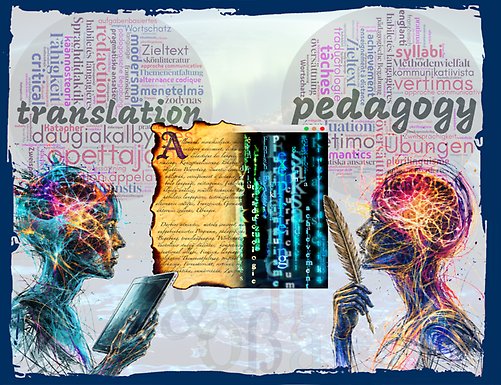
Adrian Rexgren, doktorand vid Institutionen för pedagogik och didaktik, försvarar sin avhandling "Crossroads Between Translation Pedagogy, Translanguaging and 21st-Century Education in Digital Environments". Disputationen hålls på engelska. Välkommen!
Följ disputationen via zoom
Zoom-länk: https://stockholmuniversity.zoom.us/j/65402194813
Länk till avhandlingen i fulltext i DiVA
Avhandlingstitel
Crossroads Between Translation Pedagogy, Translanguaging and 21st-Century Education in Digital Environments.
Opponent
Olcay Sert, professor, Institutionen för samhällsvetenskap och humaniora, Mälardalens universitet.
Betygsnämndsledamöter
Stefan Ekecrantz, docent, Institutionen för pedagogik och didaktik, Stockholms universitet.
Helen Melander Bowden, professor, Institutionen för pedagogik, didaktik och utbildningssociologi, Uppsala universitet.
Heini Lehtonen, docent, Finskugriska och nordiska avdelningen, Helsingfors universitet.
Suppleant
Catrin Norrby, professor, Institutionen för svenska och flerspråkighet, Stockholms universitet.
Ordförande
Enni Paul, docent, Institutionen för pedagogik och didaktik, Stockholms universitet.
Handledare
Meeri Hellstén, professor, Institutionen för pedagogik och didaktik, Stockholms universitet.
Andra handledare
Gustav Lymer, docent, Institutionen för pedagogik och didaktik, Stockholms universitet.
Susanne Kreitz-Sandberg, docent, Institutionen för pedagogik och didaktik, Stockholms universitet.
Avhandlingsbeskrivning
The aim of this study is to explore the activities implemented by teachers in higher education (HE) translation courses, with special emphasis on the moments when explicit instances of translanguaging occur. This research examines a number of observations from three Northern European universities and provides an account of similarities and differences across the data gathered at the three locales, adopting an international and comparative education perspective. The significance of the present study lies in the fact that, although inspiring scholarship has been published dealing with translation pedagogy from theoretical points of view, normative stances, and preconceived ideal scenarios, as well as with surveys that map teaching implementation aspects, not many research accounts pertain actual instruction as achieved during lessons. A comparative approach has been chosen to investigate real-life instances of multilingual interaction during instruction happening in nation-states located in regional vicinity, but whose official languages do not have strong etymological proximity. Hence, the research design allows for a transversal outlook on classroom activities and its deployment in translation courses at different universities.
The conceptual framework draws on transdisciplinarity, articulating notions like translanguaging in educational settings and translator competence development as discussed in theoretical translation studies. In addition, the sociological approach of ethnomethodology is adopted in order to identify and analyse the architecture of social interaction in the classroom during translanguaging moments. Thus, the micro-social realities are explored as constructed by interactants during the digital delivery of a series of lessons in translation courses. The present study describes instructional talk, the nature of teaching activities, and the resulting specific interactional events. The talk-in-interaction, produced in the digital environments, has been studied through the lens of conversation analysis. Results across the three datasets show that crucial interactional formats are present across the chosen educational settings. All these formats are described and analysed using the term ‘instructional arrangements’. The arrangements in common were identified in three collections: i) sight translation, ii) facilitated discovery involving online services like databanks and web services, and iii) parallel-text processing with and without machine translation tools. Further, unique formats were identified (i.e. arrangements with no counterparts in the other two locations). These include consideration or careful inspection of a) translation strategies, b) linguistic register variation, c) audio-visual translation instances, d) teacher’s personal experiences, and e) deliberative dialogue involving learners’ votes.
The moments that feature explicit translanguaging, chosen to be the focal point, provide evidence that these dynamic linguistic practices do not only occur when participants cite passages from source or target texts. They also resort to hybrid lexical items and find support in an additional language that is neither the source language, nor the target language. The specific pedagogical value of these translanguaging events is varied, but sometimes such conversational tokens are used to complement explanations, exemplifications, or “mirror” internal structures of elements in the original in a derivative rendition. In other instructional occasions, these verbal production items are interlingual pivots that expand or clarify the meanings that can be elusive or challenging before choosing the final rendition. Finally, it was observed that professional behaviours connected to the digital literacy skillset of translators tend to be delivered in demonstrations and tutorials in the digital environments of both a translation memory suite, and other open resources in the cloud.
Senast uppdaterad: 2026-06-03
Sidansvarig: Institutionen för pedagogik och didaktik