


Disputation i internationella relationer - Zigne Edström
Den 6 november 2026 försvarade Zigne Edström framgångsrikt sin avhandling "Imagining Sweden in a League of Nations: Narrative, Identity, and the Possibility of Policy in Interwar Sweden".
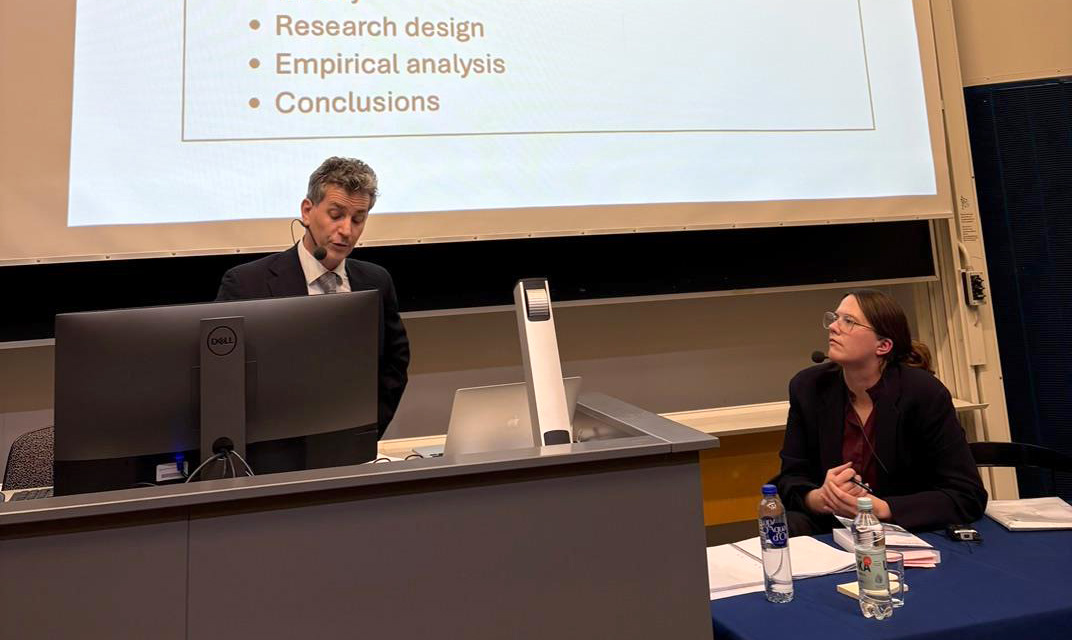
Medverkande
Opponent: Linus Hagström, Statsvetenskapliga institutionen, Försvarshögskolan
Betygsnämndsledamöter:
Ulf Mörkenstam, Institutionen för statsvetenskap, Stockholms universitet
Haakon Andreas Ikonomou, SAXO-Institute - Archeology, Ethnology, Greek and Latin, History, Köpenhamns universitet
Anna Michalski, Institutionen för statsvetenskap, Uppsala universitet
Suppleant: Karina Shyrokykh, Institutionen för ekonomisk historia och internationella relationer, Stockholms universitet
Ordförande: Maria Wendt, Institutionen för ekonomisk historia och internationella relationer, Stockholms universitet
Handledare 1: Emma Rosengren, Institutionen för ekonomisk och industriell utveckling, Linköpings universitet
Handledare 2: Aryo Makko, Institutionen för militärhistora, Försvarshögskolan
Om avhandlingen
Abstract [en]
In 2022, Sweden abandoned its longstanding policy of neutrality and military non-alignment, a central feature of its national identity, to apply for membership in a military alliance. Yet, this was not the first time Sweden had faced such an upheaval of its foreign policy tradition. A century earlier, accession to the League of Nations confronted Sweden with a comparable challenge: reconciling national identity with membership in an international organisation premised on collective security. This thesis explores how foreign policy narratives in the Interwar years (i.e. 1919-39) reproduced and contested Swedish national identity in the context of Sweden’s League membership. Conceptually, it offers International Relations (IR) and constructivist Foreign Policy Analysis a specified apparatus for narrative analysis and identity reconstruction, grounded in a reflexive historical constructivism. It also bridges IR and International History, identifying research about the League of Nations as a fruitful site for dialogue between the disciplines. The thesis carries out close analysis of issue narratives about four Interwar crisis moments – Corfu in 1923–24, Mosul in 1924–26, Manchuria in 1931–33, and Abyssinia in 1935–36 – and reassembles the foreign policy narratives that cut across them. The analysis finds that these crises were narrated in multiple different ways. The narratives presented contrasting spatial and temporal settings, dissimilar portrayals of protagonists and antagonists, and distinctive plots oriented towards diverse futures. These narratives, in turn, reproduced and contested specific imaginaries of Sweden, and the analysis conceptualises these using a layered model of national identity. In the most sedimented layer, the narratives all presented a broadly shared understanding of positions, but nonetheless provided them with different hierarchical meanings. In the less sedimented layer, which involved more detailed self- and other-portrayals, similar traits were often reproduced, but the narration of Sweden’s roles and (non-)responsibilities showed greater contestation. The least sedimented layer of programmes further illustrates how different actions followed from diverse reasons and objectives. Across these programmes, Sweden was pushed towards active participation, restrained involvement, radical reform, revolutionary detachment, and regional withdrawal.
Senast uppdaterad: 2026-11-06
Sidansvarig: Institutionen för ekonomisk historia och internationella relationer