


Linguistics is key to understanding how language can effect change
Lena Stüdeli spends her days communicating to decision-makers, influencing them to act on climate change. For her, linguistics is key to understanding how to use the English language most effectively. She studied a master’s programme with the Department of English, which was critical for clarifying her career path.
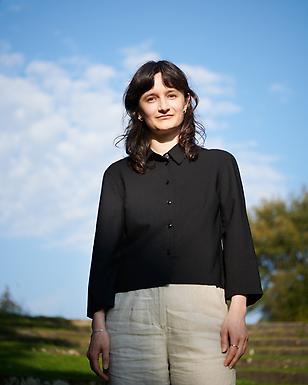
- Linguistics is the key to use the English language most effectively, says Lena Stüdeli, Head of Communications at NewClimate Institute.
Lena Stüdeli is Head of Communications at NewClimate Institute, which is a climate think tank based in Berlin, Germany. Through research, policy advice and knowledge sharing, the think tank advocates for a higher global ambition for climate action and transition that is fair for all. NewClimate Institute achieves this by influencing policymakers and decision-makers in the public and private sector to implement more ambitious and fair climate policies, as well as to make sure the enablers for this transition are in place. While the think tank is based in Germany, we focus mainly on international climate policy – and as such conduct most of our work in English.
- I’ve been with the institute for about one and a half years. My job involves strategic communications and science communication, as well as team management. How we present ourselves and how we can make sure that we reach our target audiences are key to my work, Lena says. English is a lingua franca in her working environment. Being part of an international team, she uses it in her daily work.
- This is where my studies really come in handy. Now, I can put into practice what I learned during my master’s, she says.
Her thesis explored how scientists versus journalists communicate about climate change, what rhetorical and discursive strategies they use to engage the readers and whether one group was generally more effective in their communication. She developed a hybrid analytical framework for her analysis of popular science blogs – blending linguistics and communication science. Lena’s analysis shows that both writer types use many of the same strategies. However, in the texts analysed by Lena, the journalists seemed to be a little more effective, being able to emphasize newsworthiness and catch the readers’ attention more effectively.
- That is maybe not too surprising, since journalists get a very different education. After all, journalism is all about catching attention, emphasising emotion and shock, Lena says.
She found that the scientists, on the other hand, wrote their blogs in a more personal way – using more personal pronouns, voicing opinion and adding references to themselves – for example with phrases such as ”I found that...” or ”according to my opinion...”. This could be explained by scientist writers’ personal proximity to the research they’re writing about. However, that can lead to disconnecting the readers from those texts, as they so not share this proximity.
- In 2026, I conducted a follow-up study where I applied the same framework from my thesis to my own writing. During my time working as a climate communication expert, I’ve written several blogs on various climate issues. In the 2026 study, I found that I was influenced by my thesis’ findings – I largely avoided pronouns, made prominent use of newsworthiness and more.
- However, there is no one-size-fits-all method in climate communication, Lena explains. You always have to look at who you want to reach and think about how you can reach them – influencing the general public versus policymakers requires very different strategies and channels.
Before studying at Stockholm University, Lena studied a bachelor’s programme in multilingual communication in Zurich, Switzerland. There, the focus was mostly on translation and interpretation. I knew that I wanted to continue studying language(s) but wanted to move away from a primarily technical understanding of language. I chose Stockholm because the master’s programme in Applied English Linguistics spoke to me. It was a chance for me to investigate language(s) as something dynamic and inherently linked to society, history and culture.
During her master’s, having Maria Kuteeva as her supervisor, the course World Englishes showed Lena that there are no right or wrongs with English; there are a myriad of Englishes in the world, each as much a ‘real’ English as British English. Another course that unexpectedly stuck out to Lena was Middle English. The course made her realise for the first time just how hybrid and flexible the English language is, drawing on influences from Old Norse through Viking settlement, French through the Norman nobility, and many others, all blending together to create the many forms of English spoken around the world today.
Having studied applied linguistics, Lena now has a much deeper understanding of how language is used and how it changes with time, people and culture. Language in ingrained in identity, and therefore it comes with many nuances. It is key to try to understand and consider these nuances when communicating effectively, especially on climate change – an issue that can evoke strong emotions, from existential fear, anger or helplessness.
Senast uppdaterad: 2026-10-06
Sidansvarig: Engelska institutionen,Matematiska institutionen