


Research project In pursuit of global knowledge: Scandinavian ocean travelers 1650-1810
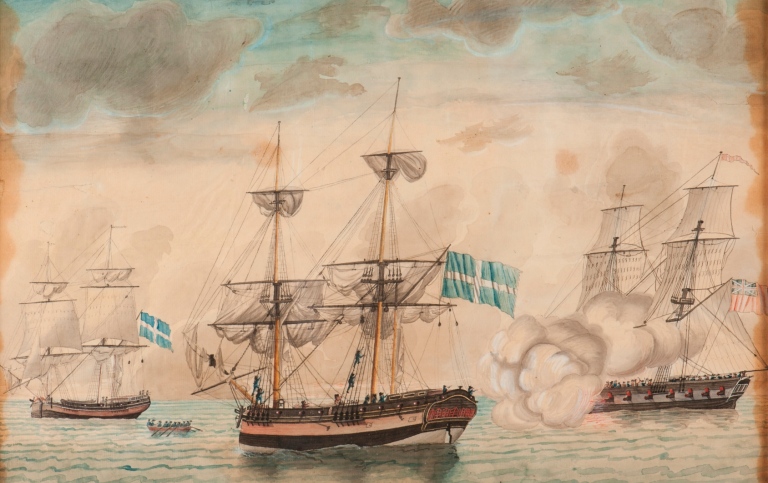
Briggen Snauen Resolution, according to the painting description attacked by an English Cutter Brigg on December 5 1793. Artist: F.A. Collections of the Maritime museum.
This project studies global knowledge as it was produced, adapted, and communicated by non-elite Scandinavian ocean travelers during the early modern period. Margaret Hunt, project leader, will study Scandinavian sailors’ projects of self-education, including their interest in non-European cultures and informants, the networks they formed, and the challenges they faced. Leos Müller, co-researcher, will study how skippers and low and mid-level merchants learned to negotiate the complexities and risks of neutral shipping and how they circulated that knowledge.
The project covers four years. The main source is the so far little-studied records of 3.500 seized Scandinavian ships from the 1600s and 1700s, today housed in the British National Archives - the Scandinavian Prize Papers.
Informed by a view of knowledge as socially situated and emerging through social negotiation, our method involves actor-centered, microhistorical close reading with a focus on networks. The project will produce articles, a handbook on using Prize Papers for Scandinavian research, two conferences and an edited volume. Non-elite knowledge production has been little studied for the early modern period in Scandinavia due to a paucity of sources. This project will supplement prior work on elite and learned knowledge production in Scandinavia with a “view from below,” one that emphasizes non-elite subjectivity and explores the larger impact of non-elite knowledge production and exchange in the Nordic countries and beyond.