


Research project The Earth Climate Observatory (ECO): Observing the Earth’s Energy Imbalance from Space
The ECO mission objective is to observe the Earth’s energy imbalance directly from space with unprecedented accuracy and stability. This is achieved by measurements from a multitude of satellites and dedicated instruments.
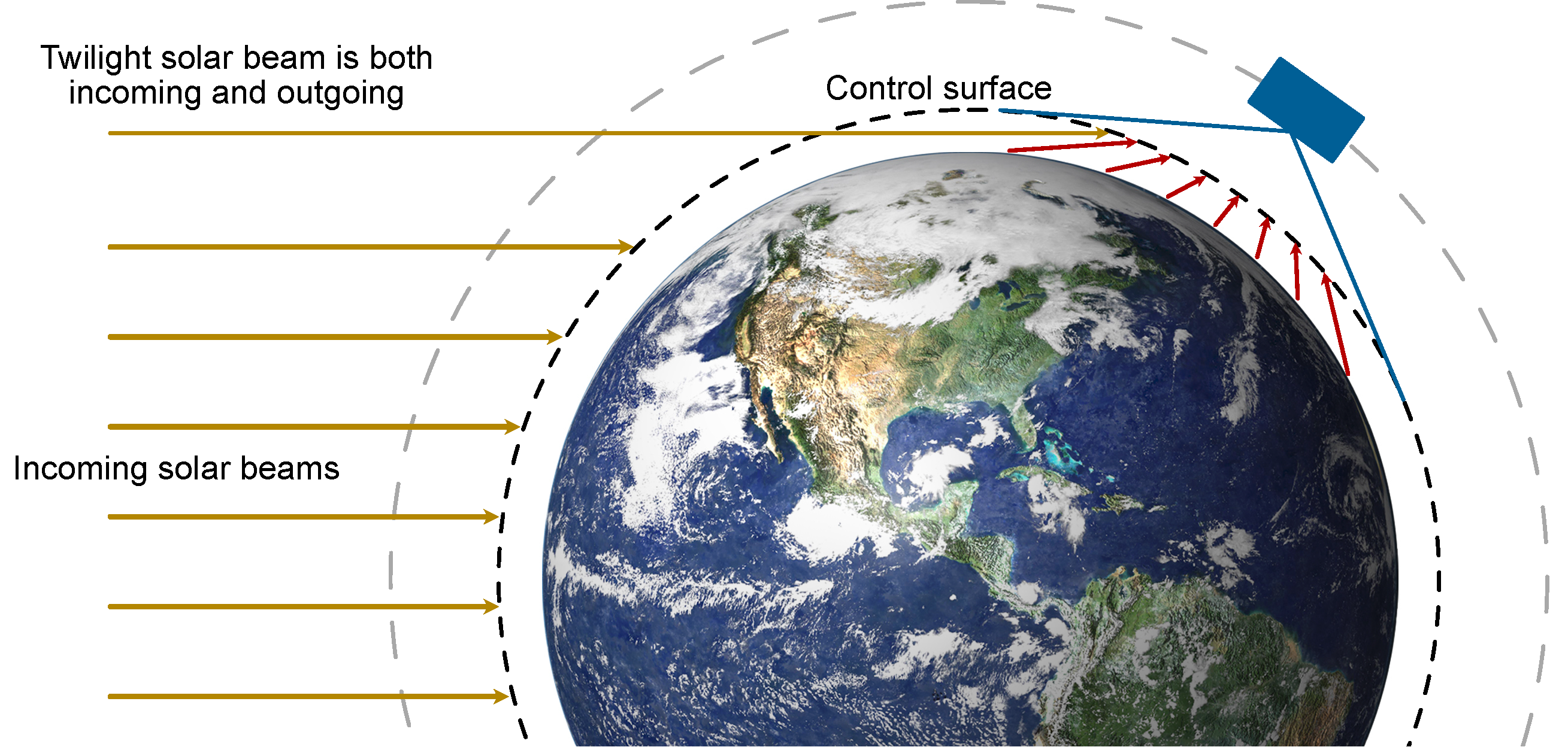
The Earth is warming because greenhouse gases have upset the balance between incoming sunlight and the emitted and reflected radiation. This imbalance leads to accumulating heat in the atmosphere and the oceans as well as diminishing ice cover. The consequences are rising temperatures and sea levels, and extreme weather such as heavy precipitation, heat waves and dry spells.
Past space missions have not been able to measure this difference with sufficient accuracy, and instead has monitored it through the slow increase of energy stored within the climate system. The Earth Climate Observatory (ECO) mission will measure the Earth’s energy imbalance directly from space with unprecedented accuracy and stability. This will be achieved through a constellation of satellites and instrumentation, at the levels required to inform international climate policy. A complete end-to-end mission simulator is developed to assess the ECO mission performance.
The accumulation of energy within the Earth's climate system is at the heart of the climate problem. Increasing levels of greenhouse gases from anthropogenic sources have upset the delicate balance between incoming sunlight and reflected and emitted terrestrial radiation. The resulting Earth Energy Imbalance (EEI) has been recognised by scientists as one of the most fundamental properties of the climate system for more than 200 years [e.g. Fourier, 1822, Arrhenius, 1896, Hansen et al., 2005, von Schuckmann et al., 2016, Stephens et al., 2023]. The EEI, today believed to be about 1 Wm−2, is the reason temperatures are rising, causing glaciers and ice sheets to melt, sea level rise, and more extreme weather with severe impacts around the globe [IPCC, 2021]. Despite the above, the current knowledge of EEI is poor. In fact, current space missions have accuracy levels well above 1 Wm−2, meaning that even its sign cannot be determined by direct observations, and EEI is currently instead estimated from ocean heat uptake.
As global temperatures rise, there is a time delayed response to the accumulated past EEI, and as a result a system monitoring EEI will reveal the direction of future climate change one to two decades earlier than if monitoring the global temperature alone [Meyssignac et al., 2023]. Moreover, the EEI, in concert with measurements of the shortwave and longwave components of the radiation budget, offers a means to identify and quantify the effects of any unexpected behaviour. It is therefore crucial that humanity closely monitors EEI as efforts are made to limit global warming. It is also of paramount scientific interest to monitor the EEI, as well as the associated components of the radiation balance.
The Earth Climate Observatory (ECO) mission’s primary objective is to support the societal need to constrain future global warming by observing the EEI directly from space. In practice this requires a system monitoring global mean EEI at the annual time scale at community assessed levels. This is unique: past and current space missions suffer from larger biases and ocean heat uptake-based EEI estimates require longer time scales.
The ECO mission proposal is to use wide field of view (WFOV) cavity radiometers, which measure directly the flux at the satellite level, as opposed to scanning radiometers that measure directional radiance from a narrow footprint that needs to be converted to a flux. The key innovations of the ECO mission which ensure the fulfillment of the primary objective to be outlined in this proposal are:
- The use of a constellation of satellites to sample globally the diurnal and annual cycles such that no uncertain diurnal cycle model is necessary
- Differential observation of the flux from both the Earth and the Sun using inter-calibrated radiometers
- Active thermally controlled payload environment to avoid large thermal offsets
- Use of dual radiometers to monitor and correct for instrument ageing, resulting in very low systematic drift.
Auxiliary multi spectral cameras offering spectral imaging within the visible, near-infrared and thermal wavelength ranges, are applied to achieve high resolution data products for climate model evaluation, cloud and aerosol process studies, and allow for synergies with other missions. These cameras are calibrated to match the on board WFOV radiometers. Thereby the cameras allow mapping and cross-calibration with a number of other existing and planned NASA missions, such as CERES and the follow-on Libera missions, and will greatly enhance synergies with planned ESA missions, such as FORUM, TRUTHS and IASI-NG, as well as enhancing the operational international meteorological imagers that provide the high space/time resolution ISCCP-NG imagery and derived data products. Thus, the ECO mission can serve multiple future scientific needs.
The development of the ECO mission will establish European leadership in the tackling of the urgent societal challenge of limiting global warming, supporting the United Nations Sustainable Development Goal 13 on Climate Action, by providing an essential tool for safeguarding our planet for future generations.
References
Arrhenius, S. On the influence of carbonic acid in the air upon the temperature of the ground. J. Sci. 41, 237–275 (1896).
Fourier, J.B.J. Theorie analytique de la chaleur. Didot, Paris, 639 pp, 1822.
Hansen, James, Larissa Nazarenko, Reto Ruedy, Makiko Sato, Josh Willis, Anthony Del Genio, Dorothy Koch et al. ”Earth’s energy imbalance: Confirmation and implications.” Science 308, no. 5727 (2005): 1431-1435.
IPCC, 2021: Summary for Policymakers. In: Climate Change 2021: The Physical Science Basis. Contribution of Working Group I to the Sixth Assessment Report of the Intergovernmental Panel on Climate Change [Masson-Delmotte, V., P. Zhai, A. Pirani, S.L. Connors, C. Péan, S. Berger, N. Caud, Y. Chen, L. Goldfarb, M.I. Gomis, M. Huang, K. Leitzell, E. Lonnoy, J.B.R. Matthews, T.K. Maycock, T. Waterfield, O. Yelek¸ci, R. Yu, and B. Zhou (eds.)]. Cambridge University Press, Cambridge, United Kingdom and New York, NY, USA, pp. 3-32, doi:10.1017/9781009157896.001.
Meyssignac B., Ablain M., Guérou A., Prandi P., Barnoud A., Blazquez A., Fourest S., Rousseau V., Bonnefond P., Cazenave A., Chenal J., Dibarboure G., Donlon C., Benveniste J., Sylvestre-Baron A., Vinogradova N. How accurate is accurate enough for measuring sea level rise and variability. Nat. Clim. Change, https://doi.org/10.1038/s41558-023-01735-z, 2023
von Schuckmann, K., Palmer, M., Trenberth, K. et al. An imperative to monitor Earth’s energy imbalance. Nature Climate Change 6, 138–144, 2016.
Stephens, G., Polcher, J., Zeng, X., van Oevelen, P., Poveda, G., Bosilovich, M., Ahn, M., Balsamo, G., Duan, Q., Hegerl, G., Jakob, C., Lamptey, B., Leung, R., Piles, M., Su, Z., Dirmeyer, P., Findell, K. L., Verhoef, A., Ek, M., L’Ecuyer, T., Roca, R., Nazemi, A., Dominguez, F., Klocke, D., Bony, S. The First 30 Years of GEWEX. Bull. Amer. Meteor. Soc., 104, E126–E157, doi:10.1175/BAMS-D-22-0061.1, 2023.