


Research project Investigating the molecular mediators necessary for establishing N2-fixing diatom cyanobacteria/bacterial symbioses
How do vital partnerships between organisms form in the ocean? This project investigates how microalgae and nitrogen-fixing bacteria establish symbiotic relationships that supply marine ecosystems with new nitrogen and help sustain ocean productivity.
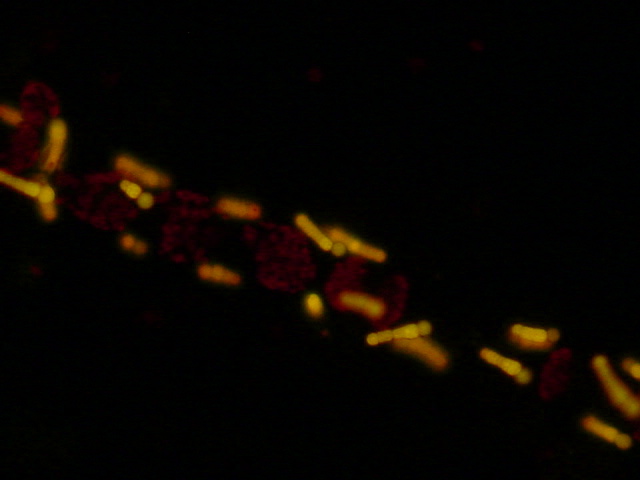
A close-up of one of the ocean's tiny but important partnerships. The microalga Chaetoceros (red) lives together with the bacterium Richelia (yellow), which provides the algae with nitrogen, a key nutrient for growth. Image: Rachel Foster
In nutrient-poor regions of the ocean, symbioses between microalgae and nitrogen-fixing bacteria are crucial for providing biologically available nitrogen to marine ecosystems. Despite their importance, scientists still know little about how these partnerships form and function. By studying recently isolated microalgae-bacteria symbioses, the project will explore the chemical signals and communication processes that enable these organisms to establish and maintain cooperative relationships. The results will advance understanding of marine nutrient cycling, the evolution of symbiosis, and the ecology of ocean ecosystems.
When two or more organisms live together in close association, the relationship is known as a symbiosis. Such partnerships are widespread in nature, particularly in environments where nutrients are scarce. Some of the most intriguing and least understood symbioses occur in the nutrient-poor surface ocean, where single-celled microalgae, known as phytoplankton, interact with a variety of bacterial partners.
Among the most important of these relationships are symbioses between microalgae and nitrogen-fixing bacteria. Through the process of nitrogen fixation, bacteria convert atmospheric nitrogen gas into ammonia, a form of nitrogen that can be used for growth. These symbionts therefore act as natural fertilisers for their hosts while also supplying new nitrogen to surrounding marine ecosystems.
Symbioses have also played a fundamental role in the evolution of life. Key cellular structures, including plastids responsible for photosynthesis and mitochondria responsible for respiration, originated through ancient symbiotic events. More recently, the discovery of the nitrogen-fixing organelle known as the nitroplast has provided another example of how symbiosis can drive biological innovation.
Despite their ecological, evolutionary and biogeochemical importance, nitrogen-fixing planktonic symbioses remain poorly understood. Most of these associations have proven difficult to maintain in long-term laboratory cultures, limiting researchers’ ability to investigate how hosts and symbionts interact, which chemical compounds mediate communication, and how resources are shared or competed for within these partnerships.
This project aims to uncover how symbiotic relationships between microalgae and bacteria are established. Using two recently isolated nitrogen-fixing microalgae-bacteria symbioses and a specialised analytical platform, the research will investigate the chemical signalling and host-symbiont communication that promote the formation and maintenance of these partnerships. The results will provide new insights into marine nutrient cycling, the ecology of plankton communities, and the evolutionary processes that shape complex symbiotic relationships.