


Research project Adaptations to climate change in the northern Baltic region ca 1500–1900
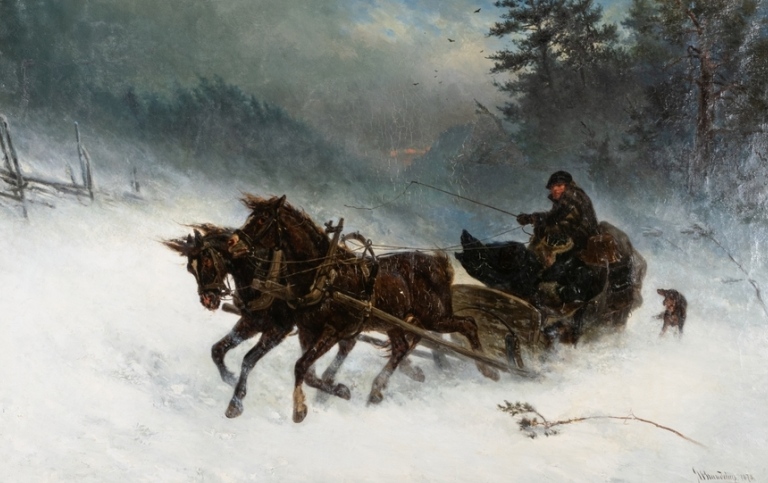
Sleigh in a snow storm, Gustaf Brandelius 1878. County Museum of Gävleborg through Digitalt museum.
This project is expected to contribute to the state of scientific knowledge on climate change by:
- Estimating, for the northern Baltic Sea region, how effects of climate change have varied over time and space as well as how successful different adaptation measures have been.
- Increasing understanding of how different historical actors have been affected by climate variability in the northern Baltic Sea region as well as what technologies and cultural aspects were utilized in the adaptation process.
- Developing new tools for studying historical climate adaptation that allow for results from historical studies of climate adaptation to be used in contemporary and future climate adaptation strategies.
The project “Adapting to Climate Change in the Northern Baltic Sea Region, AD 1500–1900” consists of two subprojects which together address the effect of, and adaptation to, climate change in agriculture and winter transport.
The project uses a combination of quantitative and qualitative methods to study the association between harvests, temperature and precipitation, demographic fluctuations, as well as the impact of winter climate variability on land and sea transport.
The research is expected to result in eight scientific articles written in collaboration with two postdoctoral researchers and a number of other collaborators. The research is breaking new ground by applying research questions similar to those in research on contemporary climate change adaptation on the past.
Skoglund, Martin K. & Svensson, Patrick, "Extreme weather, harvest failures, and epidemics: southern Sweden during the 1783–1785 crisis", Geografiska Annaler A: Physical Geography (2026): https://doi.org/10.1080/04353676.2026.2688690
Skoglund, Martin K. & Ljungqvist, Fredrik Charpentier, ”Climatic effects on grain harvest variations across Sweden c. 1665–1810”, Geografiska Annaler A: Physical Geography (2026): https://doi.org/10.1080/04353676.2026.2666716
Skoglund, Martin K., ”Klimat, väder och spannmålsodling i Jämtland under historisk tid”, Jämten 118 (2025): 42–49.