


Research project New pathways for studying exoplanet formation
Planets around other stars than the Sun are collectively called “Exoplanets”. The first exoplanets were discovered in the late 1990s, and since then, the field has rapidly developed, with thousands of exoplanets known to date. One long-standing puzzle in exoplanet research is how exoplanets form and grow into their final sizes. Recent detections of very young exoplanets that are still in the process have forming have opened up the opportunity to study the formation process as it actually happens.
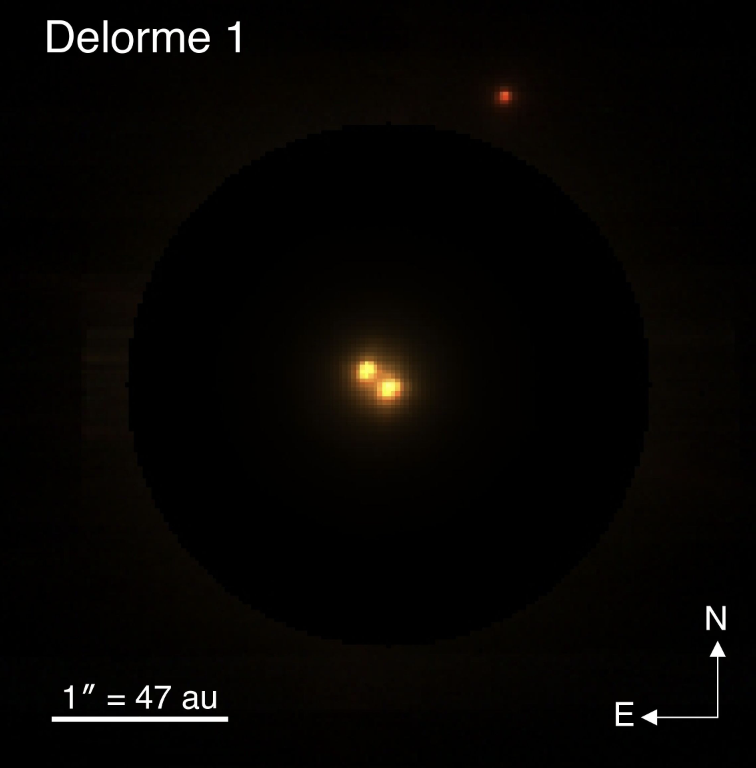
Direct image of the planet close to the binary star system Delorme 1.
When the first exoplanets were discovered in the mid-1990s, they fundamentally changed our understanding go how planets form, which previously had been based purely on our own Solar system as the only known example. Exoplanets turned out to exist in entirely unexpected configurations, which implied that important components were missing in the models for formation and early evolution of planetary systems. New theories were developed that could better explain the observed exoplanet populations. However, many ingredients for a complete understanding of planet formation are still missing. This is largely due to the fact that for a long time, it was only possible to study exoplanets in relatively old planetary systems, where the original conditions are difficult to trace, If it were possible to study planets that are still in the process of forming, many of the important gaps of our understanding could be filled.
Based on newly developed techniques that allow for the separation of weak planetary light from the bright light of the star it orbits, detailed research about this area is now becoming possible. In this project, we are developing new techniques for high-resolution spectroscopy in the context of high brightness contrast between a star and its planet. Using these tools, we are studying the process of gas giants (similar to Jupiter) accumulating their massive gaseous atmospheres from their surrounding medium. The high resolution spectroscopy enables studies of how the gas is flowing, what it consists of, and which physical conditions are prevalent in the area where the surrounding gas crashes into the planet's growing atmosphere. Thereby, a new window is opened for studying planet formation, where the process does not need to be estimated backwards from the conditions at a much later stage, but can instead be examined will it is actively ongoing.