


Research project From Heretic to Sufi Saint: The Reception and Reinterpretation of Nasimi in Mamluk and Ottoman Historiography
This project investigates the historical reception of Imadaddin Nasimi, a 14th-century Hurufi mystic and poet executed for heresy. It explores how his historical image transformed from a condemned heretic in Mamluk records to a venerated Sufi saint in Ottoman historiography.
The study employs comparative historiographical textual analysis to evaluate eleven primary texts from the Mamluk and Ottoman periods. It utilizes memory theory to explain how historical actors reconstruct the past to serve contemporary social and political needs.
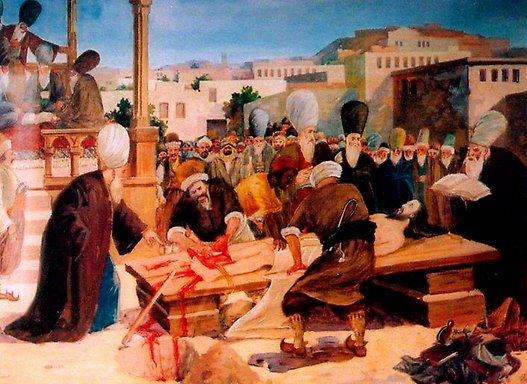
Azimzade, Azim. Execution of Nasimi. 1942. (Painting). National Art Museum of Azerbaijan, Baku. Source: Wikimedia Commons. Public domain.
The research examines how Islamic orthodoxy and heresy are negotiated by analyzing historical chronicles, biographical dictionaries, and legal texts from the 15th to the 17th centuries. Nasimi was executed in Aleppo due to his ecstatic poetry and his association with the Hurufi movement, which Mamluk authorities viewed as a direct threat to political stability. While Mamluk jurists documented his death as a necessary purge to maintain social order, Ottoman biographers later reinterpreted his execution as the tragic martyrdom of a spiritually overwhelmed saint. By comparing these shifting accounts, the project demonstrates that collective memory and historical narratives are shaped by institutional needs and political contexts.