


Research project Body posture as a window into biological foundations of speech
This project examines how the speech production system adapts when we change our body posture. We will investigate these adaptations by recording synchronized physiological, acoustic, and visual data — which together capture the complex patterns of the speech apparatus.
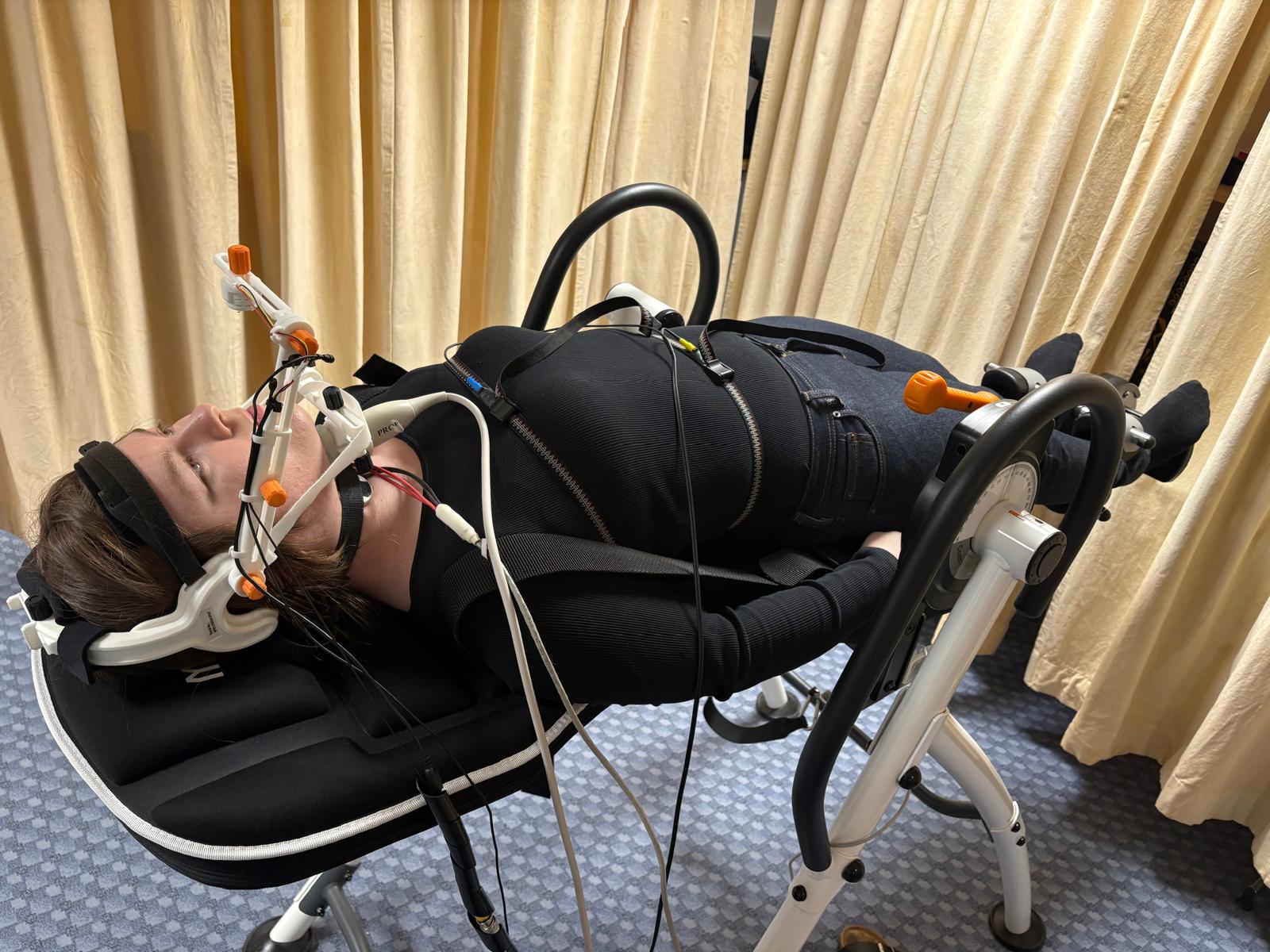
Demonstration of equipment used in the research project. Photo: Christine Ericsdotter Nordgren
The human speech production system has evolved to adapt to different body positions, enabling people to produce speech in almost any posture. When lying on the back, for example, adjustments are required to counteract the abdominal contents pressing against the lungs, which affects both breathing and phonation. Similarly, adaptations are needed to counteract the effects of gravity on the tongue and lips. However, existing models of speech production cannot account for these mechanisms.
The research project ”Body posture as a window into biological foundations of speech” examines how the speech production system adapts when body posture changes from (1) an upright position to (2) a supine position to (3) a partially inverted position (the body tilted with the head downward).
Body posture is varied using an inversion table, which can be tilted at an adjustable angle. The resulting speech production adaptations are investigated through synchronized recordings of various physiological, acoustic, and visual data, which together capture the complex patterns of the speech apparatus. A smaller group of classically trained singers will be included for comparison.
By studying adaptations within as well as coordination between the systems of the speech apparatus, the research will reveal fundamental yet previously unexplored principles underlying speech production.
The results will contribute both to improved biomechanical models of speech production and to broader theories of how gross and fine motor control interact.
In addition to its theoretical contributions to basic research, the project has important practical applications, for example in the treatment of voice disorders, in health applications that use speech, and in voice and singing pedagogy.